The Adult Life: From Settled Two-Year-Old to Senior
When a Golden Retriever settles out of adolescence, many families feel they have arrived at the life they were hoping for all along. The dog is easier to read, easier to live with, and easier to carry through ordinary days. That does not mean the work is over. It means the work has changed. The first two years built the dog. The adult years are the years the family gets to live with what was built.
This page opens the final Living With Your Dog dispatch by naming the full arc honestly. Golden Retrievers usually spend roughly two to seven years in what most families experience as settled adulthood. Somewhere around seven to nine, many begin the transition into early senior life. By nine to eleven, aging is often more visible. Beyond that, individual variance becomes large enough that no calendar can substitute for the dog in front of the family.
The population context belongs beside the warmth. Modern Golden Retriever lifespan data generally clusters in the low teens, often around ten to twelve years depending on the dataset and how deaths were recorded. Observed-JB Cancer is the leading age-limiting burden in the breed, and that fact should be faced honestly rather than softened by folklore. But the purpose of this category is not to turn the dog's life into a countdown. It is to say that the settled adult years are the years the philosophy was for.
What It Means
The Middle Years Are the Point
Families sometimes speak as though puppyhood is the main event because that is the stage that demands the most attention. JB sees it differently. Puppyhood and adolescence matter because they create adulthood. The adult dog is the life. It is the long period when the family no longer feels like it is constantly laying track. The track is there. The dog begins to run on it with much less help.
That is when the earlier JB language becomes background.
The calm floor does not disappear. It becomes ordinary.
The household rhythm does not disappear. It becomes invisible because it works.
Mentorship does not disappear. It becomes less like active scaffolding and more like a settled relationship.
Structured Leadership does not disappear. It becomes the atmosphere of the house.
Indirect Correction does not disappear. It becomes infrequent precisely because the dog understands the social world it lives in. Observed-JB
The Lifespan Arc
It helps families to have a broad map.
In many Goldens, roughly two to seven years is the most settled adult stretch. The dog is physically mature, socially easier, and fully integrated into ordinary life. Between about seven and nine, many dogs begin to show the first meaningful signs that the body and nervous system are changing. These can be subtle at first: slower recovery, more stiffness in the morning, longer sleep, less enthusiasm for intensity, or changes in how long a dog wants to stay out. Observed-JB From about nine onward, those signals usually become easier to see.
(Note: The lifespan framework presented here represents observed patterns in JB's population cohort and should be understood as a guide rather than a universal timeline.)
This is not a rigid sequence. Some dogs hold youth longer. Some feel old earlier. Males and females can age differently. Disease can reshape the arc. Good luck and hard luck both exist. But families benefit from a map because it keeps them from being surprised by a transition that was always part of the life.
Why the Adult Life Still Needs Attention
The adult years are the easiest time to drift because the dog is so much easier than it was before. Families become less deliberate, which is natural. Sometimes that is harmless. Sometimes it slowly erodes the very structure that made adult life so good. Rhythm loosens, exercise becomes less thoughtful, weight drifts upward, veterinary care becomes more reactive than preventive, travel becomes more chaotic than the dog can comfortably hold, and the breeder relationship gets quiet until something goes wrong.
None of these changes usually feels dramatic on its own. Over years, they matter.
That is why JB treats adulthood as a practice rather than as a reward state. The dog is easier now, but the quality of the middle years still depends on the family continuing to live the philosophy in ordinary ways.
The first two years build the dog. The adult years reveal whether the method truly diverged from the usual pet-dog path. A settled adult life is the most persuasive evidence of the philosophy because it is the life families were trying to create all along.
The Honest Epidemiology
Golden Retriever families deserve the truth about the breed. The truth is not despair. It is proportion.
Goldens are a cancer-burden breed.
The leading cancers matter.
The Morris Animal Foundation lifetime cohort matters because it is the best prospective platform the breed has for understanding what happens over time.
Lean body condition matters because the healthiest years are shaped not only by genetics but by how the dog is carried through life.
Older Golden folklore should not be allowed to become false reassurance. At the same time, population-level risk should not be allowed to rob families of the years they actually have. The right stance is the same one JB uses everywhere else: truthful, calm, and not theatrical.
What This Dispatch Is Really About
This dispatch closes the Living category by walking through the architecture of those later years: the adult rhythm, travel and environmental change, multi-dog decisions, annual care and breeder continuity, the aging process, the senior transition, cognitive change, quality-of-life questions, and end-of-life and grief. Observed-JB
That list sounds clinical when written out. Lived well, it is not clinical at all. It is family life with a dog who is moving through time.
Why It Matters for Your Dog
This page matters because it reframes the adult years away from maintenance and toward stewardship. The family is no longer raising a puppy. It is stewarding a relationship, a body, and a daily life that now has history behind it and aging ahead of it.
The settled years are where the dog becomes the quiet gravity of the home. The senior years are where the family learns how to keep that gravity gentle as the dog changes. Nothing in that arc undoes the earlier work. The soft landing was never only about the first week. It was a lifelong orientation toward how a dog is held in human life.
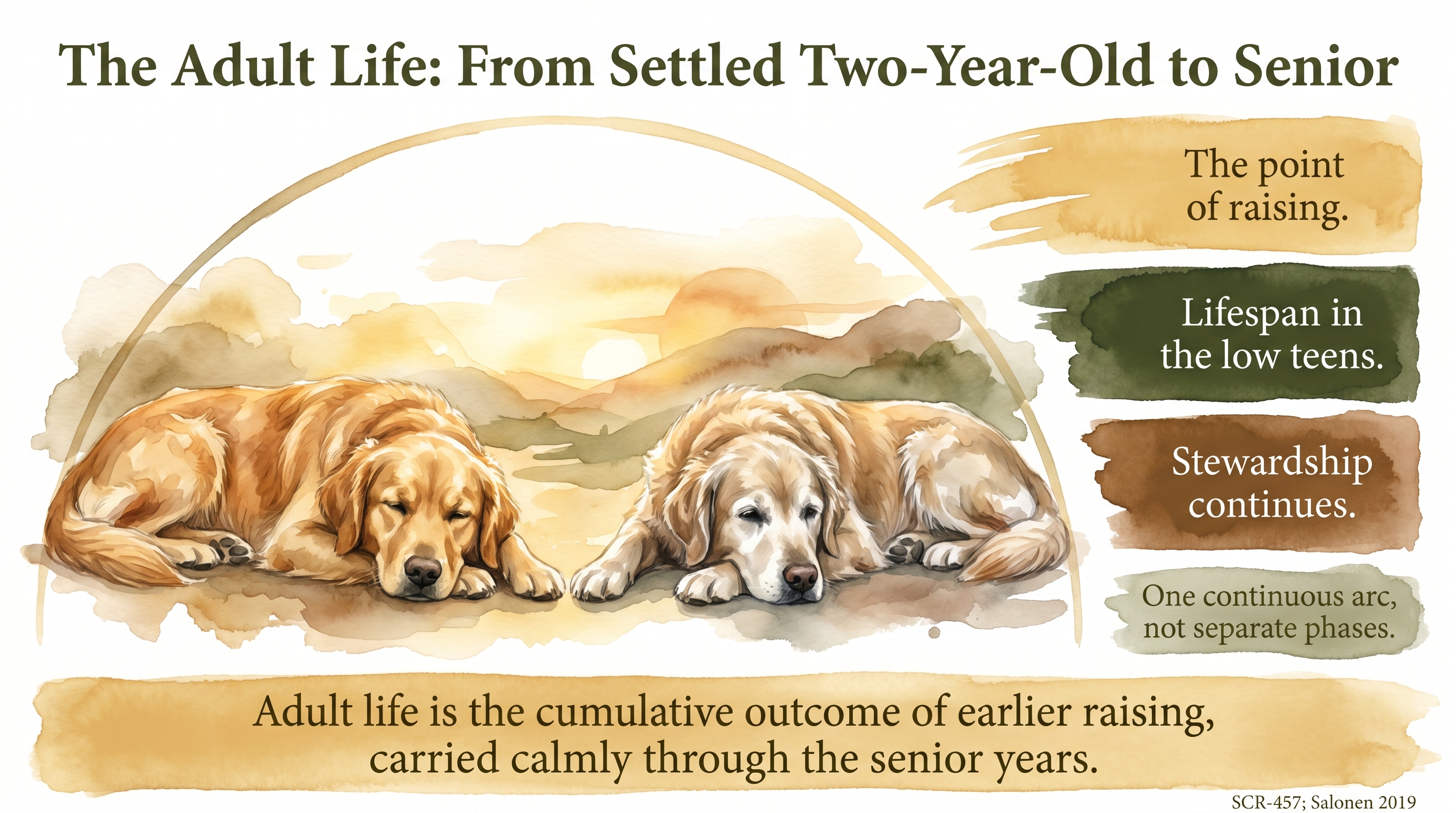
Adult life is the cumulative outcome of earlier raising, carried calmly through the senior years.
Key Takeaways
- The adult years are the point of the earlier raising work, not a period when the philosophy becomes irrelevant.
- Most Golden Retriever lifespan data supports a low-teens expectation, with cancer as the breed's leading mortality burden.
- Settled adulthood, the senior transition, and later-life care are all part of one continuous relational arc.
- The adult dog's quality of life still depends on family stewardship, not only on what was built in puppyhood.
The Evidence
- modern Golden lifespan datasetsGolden Retrievers
Current Golden Retriever lifespan estimates cluster in the low teens, most often around ten to twelve years depending on the study population and method. - Golden cancer epidemiologyGolden Retrievers
Cancer is the central mortality burden in the breed and remains the leading cause of death in major Golden datasets. - Morris Animal Foundation lifetime cohortGolden Retrievers
The Golden Retriever Lifetime Study provides the strongest prospective platform for understanding how health and aging unfold across the breed.
- JB breeder observationGolden Retrievers
Families often experience the years from settled adulthood into the early senior transition as the heart of the relationship, when the dog is most deeply integrated into ordinary life. - JB household practicefamily-raised Goldens
The quality of those years depends on continuing rhythm, weight discipline, veterinary stewardship, and calm inclusion rather than assuming the dog now runs itself.
No published study directly tests the practical implications of the adult life: from settled two-year-old to senior for domestic dog raising programs. The application to household dog raising remains an interpretive synthesis rather than a directly tested intervention finding.
SCR References
Sources
- Guy, M. K., Page, R. L., Jensen, W. A., et al. (2015). The Golden Retriever Lifetime Study: Establishing an observational cohort study with translational relevance for human health. Philosophical Transactions of the Royal Society B, 370(1673), 20140230. https://doi.org/10.1098/rstb.2014.0230
- Simpson, M., Searfoss, E., Albright, S., Brown, D. E., Wolfe, B., Clark, N. K., McCann, S. E., Haworth, D., Guy, M., & Page, R. (2017). Population characteristics of Golden Retriever Lifetime Study enrollees. Canine Genetics and Epidemiology, 4, 14. https://doi.org/10.1186/s40575-017-0053-5
- Labadie, J. D., Elser, B. A., Brown, D. C., Searfoss, E. E., & Page, R. L. (2022). Cohort profile: The Golden Retriever Lifetime Study (GRLS). PLoS ONE, 17(6), e0269425. https://doi.org/10.1371/journal.pone.0269425
- Fleming, J. M., Creevy, K. E., & Promislow, D. E. L. (2011). Mortality in North American dogs from 1984 to 2004: An investigation into age-, size-, and breed-related causes of death. Journal of Veterinary Internal Medicine, 25(2), 187-198. https://doi.org/10.1111/j.1939-1676.2011.0695.x
- Morris Animal Foundation. (n.d.). Golden Retriever Lifetime Study. https://www.morrisanimalfoundation.org/golden-retriever-lifetime-study
- Just Behaving program observation disclosure. (2026). Boundary: this internal observation is limited to JB-raised Golden Retrievers whose families continued the JB framework after placement; cohort size, time window, and counting rule are deferred in this revision. Treat as program observation supporting the adult-life overview pattern, not as published external evidence.