Parent vs. Playmate
JB's "parent, not playmate" phrase is not anti-fun. It is anti-role-confusion. Puppies need adults who pull them upward toward maturity, not peers who keep reinforcing puppy energy as the center of the relationship. Heuristic
What It Means
The modern pet industry often invites owners into a best-friend model. Bonding is framed as shared excitement, roughhousing, constant praise, and treating the dog like a social equal. The adult's job becomes entertainment. The relationship stays warm, but its asymmetry dissolves.
JB argues that this misses the developmental reality. Young mammals are not raised by peers. They are raised by adults whose role is different from theirs. Adults define safety, hold the structure, pace stimulation, and guide the young toward more competence than the young already possess. That is what parent means here.
The playmate model creates problems because peers mirror each other. Parents do not. A playmate tends to match the puppy's energy, meet arousal with more arousal, and treat every interaction as a game. Heuristic A parent notices the puppy's state without becoming governed by it.
That distinction matters because dogs are powerful social learners. If the puppy repeatedly sees the human become more animated, louder, and more stimulating in response to puppy intensity, the human is teaching the puppy what connection looks like. If the human instead stays calm, responsive, and structured, the human teaches a different kind of connection.
This is not about withholding affection. In fact, the parent role is often warmer in the deeper sense. Mammalian caregiving systems are built around attachment, safety, and regulation. Documented A calm adult can be profoundly loving while still remaining the adult in the room.
The oxytocin-gaze literature adds a useful qualifier here. Bonding is not the same thing as stimulation. Calm affiliative interaction has documented physiological significance. Documented So JB's critique is not that owners are "too loving." It is that many owners have equated love with excitement and playmate energy, when a calmer and more parent-like bond may be developmentally stronger.
This is also why JB says many modern dogs are social puppies in adult bodies. The claim is heuristic, but the pattern is recognizable. The dog gets older physically while the relationship keeps rewarding juvenile social habits: constant solicitation, constant excitement, low frustration tolerance, and a human who prefers being adored to being developmentally useful.
A parent role changes the trajectory. Heuristic The adult still plays, but play happens inside structure. The adult still comforts, but comfort does not dissolve standards. The adult still enjoys the puppy, but enjoyment does not require becoming another puppy.
This distinction shows up most clearly in moments that seem small. A playmate turns reunion into a spike of stimulation. A parent makes reunion warm but regulated. A playmate lets the puppy decide when interactions start and stop. A parent notices bids for connection, but still sets pace and tone. A playmate often tries to fix distress by becoming louder, busier, or more entertaining. A parent fixes distress first by becoming steadier.
That is why JB treats rough role language so carefully. "Best friend" sounds kind, but it can flatten the asymmetry that development needs. The dog does not primarily need another adolescent in the room. The dog needs an adult reference point.
Families often discover this the hard way when affection is high but steadiness is low. The dog feels bonded, but not guided. The relationship is emotionally rich and developmentally thin. JB is trying to preserve both: a strong bond and a clear adult role inside that bond.
Why It Matters for Your Dog
Role determines tone. If the owner acts like a playmate, the puppy keeps looking sideways for stimulation. Heuristic If the owner acts like a parent, the puppy has a chance to start looking upward for guidance.
The question is not whether you love your puppy. The question is what role your love is teaching the puppy to expect from you.
What parent looks like:
- calm greetings
- clear limits
- warm but steady handling
- guidance during confusion
- the adult setting the pace of interaction
What playmate looks like:
- matching puppy arousal with more arousal
- turning every interaction into stimulation
- letting the puppy set the social agenda
- confusing excitement with closeness
Why the difference matters:
- parents help young animals mature
- playmates keep the relationship centered on immediacy
- parents create security
- playmates often create dependency on stimulation
How play still fits at JB:
- play can happen, but the adult opens and closes it
- fun is fine, but the nervous system should still be able to come back down
- affection is abundant, but it is not used to avoid boundaries
- the relationship keeps its warmth without losing its hierarchy
That is the balance JB is after. The home should feel loving, but the love should still have adult shape. The puppy should experience the human as enjoyable and safe without mistaking the human for another puppy.
JB is not banning fun. It is trying to preserve hierarchy in the developmental sense: the adult should still be the adult.
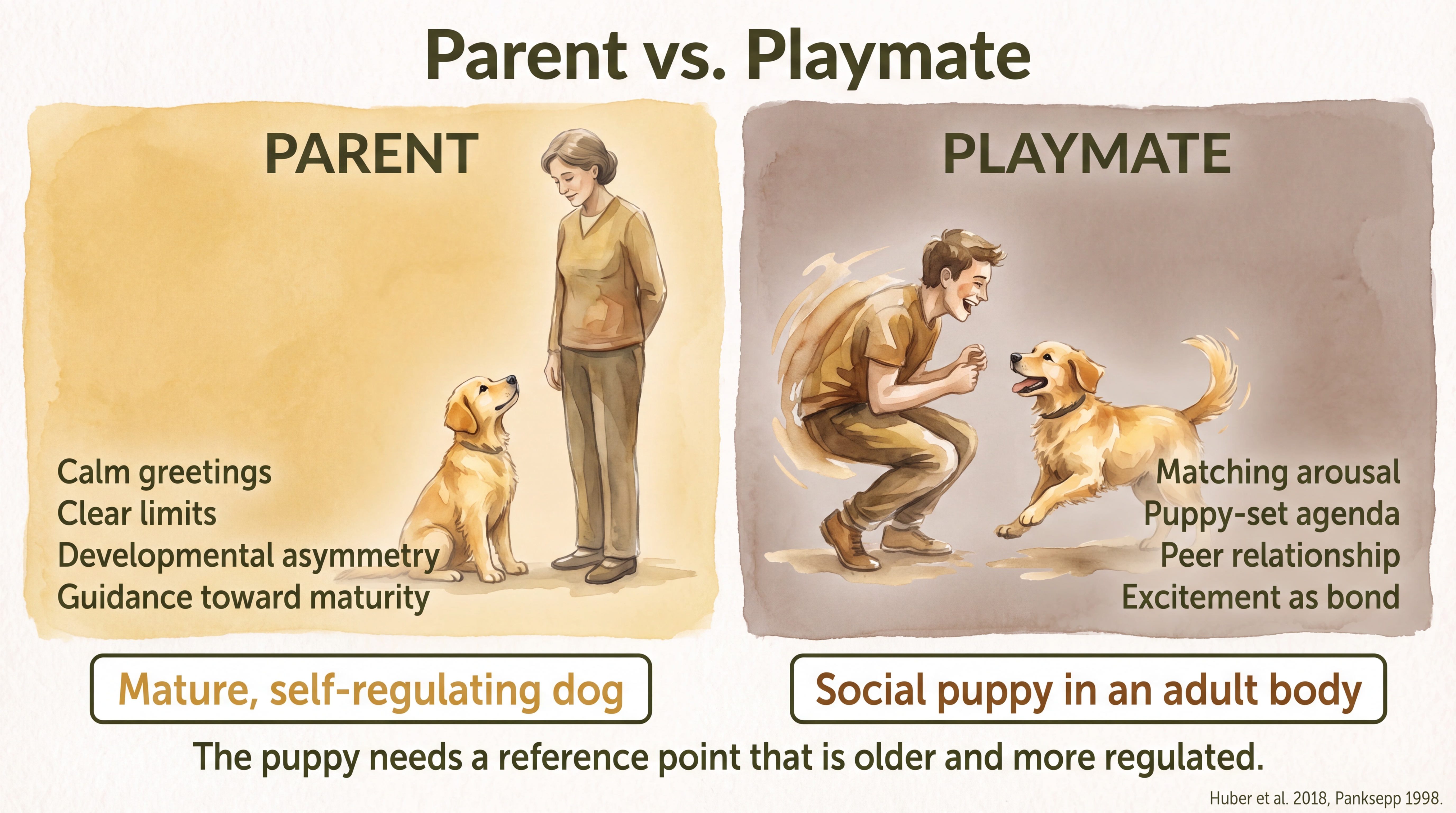
The puppy needs a reference point that is older and more regulated - parent, not playmate.
Key Takeaways
- Love expressed as calmness is different from love expressed as excitement - your role is to be the steady adult, not another puppy.
- Playmates match arousal; parents notice it without becoming governed by it, so how you respond to your puppy becomes part of what they learn about connection.
- Dogs mature best when they have a reference point that is older and more regulated than they are, not a peer who mirrors their juvenile energy.
- The goal is not to stop having fun, but to hold the fun inside a framework where the adult stays the adult and the puppy is pulled toward maturity.
The Evidence
- Huber et al. (2018, 2020, 2022)domestic dogs
Dogs copy demonstrated actions and are influenced by caregiver modeling, showing how owner interaction style becomes developmental input. - Nagasawa et al. (2015)domestic dogs and humans
Calm affiliative interaction can participate in a documented oxytocin-mediated loop in dog-owner dyads.
- Panksepp (1998)multiple mammals
CARE and attachment-related systems help explain why regulated adult caregiving differs developmentally from peer-level social stimulation.
- JB synthesisdomestic dogs
The distinction between parent-role and playmate-role is a practical developmental framework, not a formally tested categorical model in dog research. - JB synthesisdomestic dogs and humans
JB's claim is that calm parental asymmetry pulls puppies toward maturity, while peer-style interaction tends to keep the relationship organized around juvenile arousal. - JB synthesisdomestic dogs
The warning that many pet homes accidentally reward prolonged social juvenility is an observational program inference rather than a controlled comparative finding.
No published study directly tests the specific claims or protocols described in this entry within a controlled canine trial.
SCR References
Sources
- Huber, L., Popovova, N., Riener, S., Salobir, K., & Cimarelli, G. (2018). Would dogs copy irrelevant actions from their human caregiver? Learning and Behavior, 46(4), 387-397.
- Huber overimitation package: source group supports caregiver-modeling relevance, not the whole parent-vs-playmate framework. Use three-paper expansion only if later ratified.
- Nagasawa, M., Mitsui, S., En, S., Ohtani, N., Ohta, M., Sakuma, Y., Onaka, T., Mogi, K., and Kikusui, T. (2015). Oxytocin-gaze positive loop and the coevolution of human-dog bonds. Science, 348(6232), 333-336. DOI: 10.1126/science.1261022.
- Panksepp, J. (1998). Affective Neuroscience: The Foundations of Human and Animal Emotions. Oxford University Press.