Social Puppies in Adult Bodies: The JB Consequence Thesis
This is one of the most recognizable Just Behaving ideas and one of the easiest to overstate if it is not handled carefully: most pet dogs are social puppies in adult bodies. Heuristic The phrase does not mean that adult dogs are biologically still puppies. It means something narrower and more pointed. The body matures on schedule. Sexual organs mature. long bones close. muscle mass changes. coat and proportions settle. But social maturity, emotional regulation, and day-to-day behavioral composure do not necessarily rise in parallel. JB argues that many modern pet dogs remain socially juvenile long after their bodies look grown.
That full claim is philosophical and interpretive. It is not a peer-reviewed canine label. It belongs at [Heuristic], and it should stay there. But it is not a random slogan either. It is JB's synthesis of several documented realities: developmental timing is not identical across domains, social mammals rely on adult guidance to pull the young upward, and everyday pet culture often organizes canine life around excitement, peer play, food-mediated response loops, and prolonged puppy framing rather than around calm adult mentorship.
In other words, the phrase is not a diagnosis. It is a critique.
What It Means
What the Thesis Is Trying to Name
The most charitable reading of the modern pet-dog problem is that people adore their dogs but often relate to them at the wrong developmental altitude. They keep the young dog in a peer-to-peer mode, reinforce arousal because it looks joyful, substitute repeated cues for household culture, rely on play, novelty, treats, classes, and stimulation to organize the relationship, and talk constantly to the dog while giving very little structured social gravity.
The result can be a physically mature dog whose social orientation still feels adolescent: easily tipped into excitement, dependent on external stimulation, poor at ordinary stillness, uncertain about boundaries unless a formal exercise is running, and more practiced at performing for humans than at living calmly with them.
JB names that gap directly. The consequence is not just a dog that needs more training. It is a dog that remained young in its social posture because the adults around it kept relating to it as a perpetual baby, teammate, or entertainment project.
Biological Maturity Is Not Social Maturity
This distinction is the center of the page.
A Golden Retriever can become large, reproductively mature, and physically impressive long before it looks emotionally settled. That is ordinary development, not a JB invention. Dogs mature in layers. Some layers close earlier than others. The brain continues changing after puppyhood. sleep changes. inhibition changes. attachment expression changes. social confidence changes. group role changes.
Human beings understand this easily in children and teenagers. We do not assume a taller body equals a settled adult mind. JB asks families to grant dogs the same developmental complexity. Heuristic
Where the philosophy becomes more distinctive is in its explanation for why some dogs seem to stay socially young for longer and with more intensity than others. JB does not blame the dog. It looks at the social environment.
If adults do not pull the young upward, the young do not stay neutral. They stabilize wherever the environment keeps rewarding them. JB argues that much of pet culture rewards the juvenile register.
The Mammalian Comparison
Across group-living mammals with extended parental investment, the young are not mainly matured by being entertained by equals. They are matured by living around adults who already embody the relevant social rules. The young watch, shadow, imitate, receive calm interruption, learn timing, and absorb hierarchy without having to formalize it into lessons. That general pattern is strongly documented across species even though the details vary.
JB applies that template to dogs. Heuristic Puppies and adolescents are expected to grow toward adult composure by living inside an adult social world. If that world is missing, the dog still develops, but it develops around a thinner model. Peer play takes more space. high-arousal games take more space. food-conditioned response loops take more space. novelty becomes the organizing engine of engagement.
Again, the exact causal chain is not fully documented in dogs as JB states it. That is why the thesis remains heuristic. But the interpretive structure is coherent: if development is relational, then the relationships available during development matter.
What JB Thinks the Industry Normalized
JB is not claiming that every treat, toy, or training class creates a socially juvenile dog. That would be sloppy and unfair. The sharper claim is that the dominant culture of pet-dog life tends to drift toward extended puppyhood as its emotional default.
The signs are familiar: the dog is constantly hyped up to show love, calm proximity is undervalued because it looks like doing nothing, adult boundaries are delayed because the dog is still just a puppy, dog-dog interaction is treated as the primary teacher, and the human becomes a playmate first and a mentor later, if ever. Heuristic
If this pattern continues through the first year and into adolescence, JB argues that the result is visible. The dog may be loved, cared for, and extensively trained, but still feel socially unfinished. It struggles with stillness. It seeks charge. It appears more physically mature than emotionally settled. It acts like a big puppy because, in a meaningful sense, that is the social role it has been allowed to keep rehearsing.
The JB Alternative
The alternative is not coldness. It is upward pull.
Mentorship replaces entertainment as the center of the relationship.
Calmness becomes the baseline instead of the occasional break between stimulating events.
Structured Leadership appears early instead of being delayed until a problem forces it.
Prevention keeps juvenile habits from becoming the dogs permanent social language.
Indirect Correction provides adult feedback without turning the relationship adversarial.
The most important line in that list is the first one. Dogs do not mature because someone lectures them into adulthood. They mature because adulthood is the atmosphere they are living in.
That is why adolescence is such an important test case for the thesis. When the dog hits its first major developmental turbulence, the family can often feel whether it has been pulling the dog upward all along. A mentored adolescent usually becomes difficult in a way that is still readable. A socially juvenile adolescent often becomes difficult in a way that feels scattered, peer-oriented, stimulation-dependent, and chronically dysregulated.
What This Is Not
The social puppies in adult bodies thesis is not a scientific synonym for delayed maturation, a claim that every non-JB dog is permanently damaged, a statement that physical maturity does not matter, a blanket dismissal of humane training methods, or proof that any single practice causes lifelong social immaturity. Heuristic
It is a framework for interpreting a pattern JB sees repeatedly.
That distinction matters because this page is strongest when it is honest. The underlying developmental and caregiving literature is real. The full explanatory synthesis belongs to JB.
Why It Matters for Your Dog
Families often think the main question of adolescence is, How do we get through this stage? JB thinks the deeper question is, What kind of adult are we pulling this dog toward?
If the answer is a larger puppy who still needs constant stimulation, then the households daily life becomes more effortful as the dog grows.
If the answer is a socially settled adult companion, then the family organizes life differently from the start.
The thesis matters because it changes what people aim for. Heuristic It tells them that maturity is not mostly a trick of age. It is a product of age plus social environment. That does not mean every outcome is controllable. genetics matter. temperament matters. adversity matters. But it does mean adulthood should be actively cultivated rather than passively awaited.
For JB, that is the whole point of adolescence. It is the period where the difference between body growth and social growth becomes impossible to ignore.
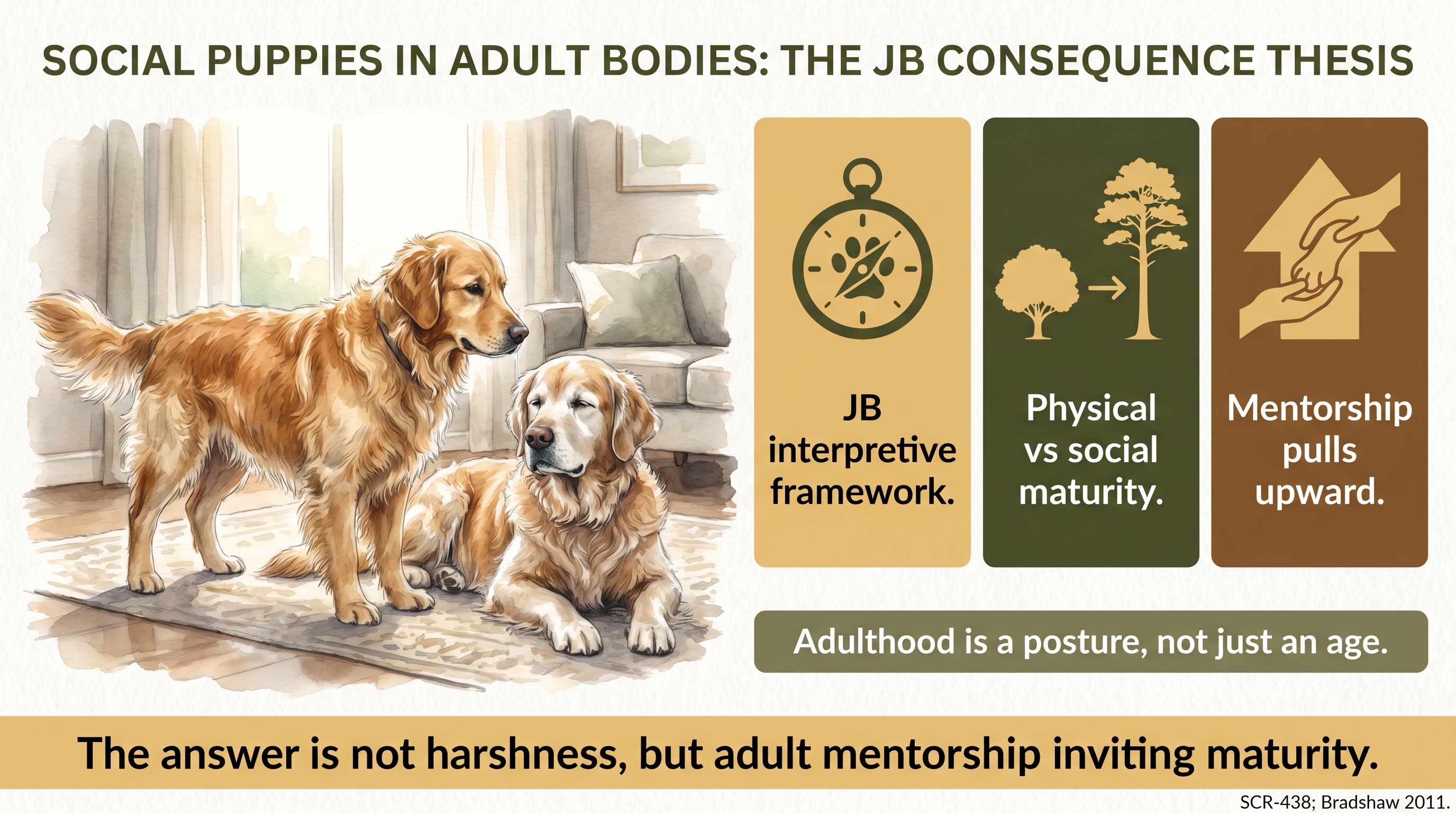
The answer is not harshness but adult mentorship that invites the dog into mature life.
Key Takeaways
- The phrase social puppies in adult bodies is a JB interpretive framework, not a peer-reviewed canine diagnosis.
- Physical maturity and social maturity do not always arrive together in dogs.
- JB argues that prolonged puppy framing, stimulation, and peer-style handling can keep a dog socially juvenile even as the body matures.
- The practical answer is not harshness but adult mentorship that pulls the dog upward toward settled household life.
The Evidence
- cross-species parental investment literaturegroup-living mammals
Young mammals with extended parental investment are shaped by adult models, predictable boundaries, and repeated co-regulation rather than by peer activity alone. - developmental caregiving literaturemammals
Maturation depends on the quality of social scaffolding available during development, not only on the passage of time.
- canine brain development and sleep physiology literaturedomestic dogs
Different domains of canine maturation unfold on different timelines, with physical growth, sleep architecture, and neural maturation not closing all at once. - attachment and adolescence findings summarized in JB source documentsdomestic dogs
Attachment quality and adolescent behavior remain linked well after early puppyhood, indicating that later developmental organization still depends on relationship context.
- JB synthesisfamily-raised dogs
Many modern pet dogs appear physically mature while remaining socially juvenile because modern pet culture often reinforces the puppy register longer than it pulls the dog upward toward adult composure. - JB breeder observationGolden Retrievers
The difference often becomes clearest during adolescence, when dogs raised inside calm adult structure look more readable and less chronically juvenile than dogs raised in stimulation-heavy peer culture.
No published study directly tests the practical implications of social puppies in adult bodies: the jb consequence thesis for domestic dog raising programs. The application to household dog raising remains an interpretive synthesis rather than a directly tested intervention finding.
SCR References
Sources
- Asher, L., England, G. C. W., Sommerville, R., & Harvey, N. D. (2020). Teenage dogs? Evidence for adolescent-phase conflict behaviour and an association between attachment to humans and pubertal timing in the domestic dog. Biology Letters, 16(5), 20200097. https://doi.org/10.1098/rsbl.2020.0097
- Reicher, V., Kis, A., Simor, P., Bodizs, R., Gacsi, M., & Topal, J. (2021). Developmental features of sleep electrophysiology in family dogs. Scientific Reports, 11, 22760. https://doi.org/10.1038/s41598-021-02117-1
- Topal, J., Miklosi, A., Csanyi, V., & Doka, A. (1998). Attachment behavior in dogs (Canis familiaris): A new application of Ainsworth's Strange Situation Test. Journal of Comparative Psychology, 112(3), 219-229. https://doi.org/10.1037/0735-7036.112.3.219
- Payne, E., Bennett, P. C., & McGreevy, P. D. (2015). Current perspectives on attachment and bonding in the dog-human dyad. Psychology Research and Behavior Management, 8, 71-79. https://doi.org/10.2147/PRBM.S74972
- Trivers, R. L. (1972). Parental investment and sexual selection. In B. Campbell (Ed.), Sexual selection and the descent of man, 1871-1971 (pp. 136-179). Aldine.
- Pal, S. K. (2005). Parental care in free-ranging dogs, Canis familiaris. Applied Animal Behaviour Science, 90(1), 31-47. https://doi.org/10.1016/j.applanim.2004.08.002
- Just Behaving framework-boundary disclosure. (2026). Boundary: the social-puppy-in-adult-body phrase is retained as a descriptive developmental metaphor and heuristic framing for under-mentored social immaturity, not as a measured JB program outcome claim; cohort size, time window, and counting rule are not asserted in this revision. See also What JB Means by Social Puppy in an Adult Body.