The Operant Question
The operant question is not whether consequences shape behavior. Of course they do. The harder and more important question is whether trainer-style operant systems fully describe how puppies naturally develop inside relationships. The strongest JB answer is no, but that answer has to be written with discipline because the most ambitious part of it remains heuristic rather than settled. Heuristic
What It Means
The whole argument turns on definition. "Operant conditioning" can mean two different things, and confusion between them creates most of the heat in this debate.
In the broad behavioral-science sense, operant conditioning means behavior changes because consequences follow it. Heuristic When a puppy sits and receives attention, sitting is reinforced. When a puppy jumps and access disappears, jumping meets extinction pressure. In that broad sense, operant processes are everywhere. Natural life is full of consequences, and JB does not deny that at all.
In the narrow trainer-technology sense, operant conditioning means something more specific: engineered markers, deliberate reward schedules, systematic shaping through successive approximation, prompt fading, and intentional assembly of target behaviors by a human acting as consequence manager. This is the technology most people mean when they talk about modern dog training.
The notebook is right that the distinction matters enormously. If "operant" means all consequence-shaped behavior, then saying there is no operant analog in natural development would be too strong. Puppies clearly live amid reinforcing and discouraging outcomes in ordinary life. If "operant" means the engineered trainer system, the argument changes. That narrower system does not have an obvious documented analog in natural canine rearing.
That is where the ethological observation becomes important. The social-learning notebook notes that no study of natural canid puppy development has documented adults running anything like a clicker protocol, conditioned marker system, or schedule-managed reinforcement plan to teach arbitrary skills. Documented Adult dogs provision, correct, block, groom, play, and regulate access. They do not appear to behave like formal behavior technicians.
At the same time, honesty requires the second half of the same sentence. Natural consequences still exist all through puppyhood. Milk access, play access, proximity to adults, invitation into or exclusion from social space, and relief from discomfort can all function as consequences. Adult responses to puppy behavior may shape future puppy behavior whether or not anyone intends them as training. Broad operant processes are real.
So the serious question is not "operant or not?" The serious question is comparative weight. What contributes more to baseline development: ambient socially embedded modeling and regulation, or naturally occurring operant contingencies? That is the question JB actually cares about because it is the question that determines what families should foreground during the first months.
The best evidence in favor of the socially embedded side is indirect but meaningful. Puppies learn from demonstrators at eight weeks. Dogs retain observed action through deferred imitation and incidental encoding. Dogs sometimes copy inefficient caregiver actions through overimitation. Puppies use adult emotional appraisal through social referencing. None of those phenomena are well captured by a narrow reward-schedule picture. They all point toward a learning channel operating through relationship, observation, and state.
This is why the operant question belongs inside the bond category rather than only in a training-methods category. The issue is not whether trainers can build behaviors. They can. The issue is whether a relationship-centered developmental account explains some parts of puppyhood better than a technique-centered account does. For emotional regulation, social calibration, and the building of ordinary household style, the social-learning literature looks unusually relevant.
The safest JB position is layered rather than combative. First layer: broad operant processes are always present. Second layer: trainer-style engineered reinforcement systems are a specific human technology, not a documented natural canine parenting strategy. Third layer: the claim that socially embedded learning is the dominant developmental channel in ordinary puppy life is coherent and evidence-aligned, but it remains formally untested.
That last sentence is the one that must remain hedged. The notebook is explicit that no published study has directly compared the relative contribution of socially guided learning versus naturally occurring operant contingencies in canine development. Documented No one has coded natural adult-pup interactions into ambient affiliative modeling versus contingency-delivery events and then measured which better predicts long-run developmental outcomes.
The absence of that study is not a small footnote. Documented It is the core evidence gap under the strongest version of the mentorship claim. If JB were to write as if the comparison had already been experimentally resolved, that would be slippage. The honest version is less flashy but stronger: the social-learning evidence makes the JB account plausible and in some domains quite compelling, while the decisive relative-contribution test still does not exist.
This is also why the operant vocabulary itself should not be treated as the enemy. Many JB household moments can be described in operant terms at the level of mechanics. Calm attention can reinforce a settled posture. Withdrawal can reduce a pushy one. The question is not whether the vocabulary can describe the mechanics. The question is whether the vocabulary alone captures the relationship, the emotional climate, and the developmental meaning of those mechanics.
The DAID comparison offers a useful clue here. When dogs learn by observation, the resulting behavior can differ in flexibility and transfer from stepwise shaped behavior. The deferred-imitation work strengthens that clue by showing that observed events can be retained and later used outside the immediate contingency. These findings do not disprove operant learning. They suggest that another channel is doing real work alongside it.
An everyday analogy is the difference between school curriculum and family culture. Curriculum matters. It teaches explicit skills. Family culture matters too, often earlier and more continuously. It teaches pace, expectations, stress tone, and how problems are approached before anyone hands the child a worksheet. The JB claim is that puppy development contains a similar distinction. The science supports the plausibility of that claim, but it has not yet fully weighed the two channels head to head.
See also JB and Standard Learning Theory for the construct-by-construct mapping of JB language to standard learning-theory categories, including where the framework is equivalent, narrower, merely relabeled, or genuinely interpretive.
For the companion boundary question, see Aggression and Hard Cases, which defines where JB's raising framework ends and clinical referral begins.
Why It Matters for Your Dog
For families, this entry matters because it releases them from two bad extremes. One extreme says only formal training matters. The other says training science is irrelevant. The evidence supports neither. Puppies clearly learn from consequences, and they also clearly learn through relationship, modeling, and social regulation. The practical question is what to emphasize when building the foundation.
The operant question matters because JB is not claiming that consequences stop working. JB is claiming that relationship-centered social learning may be doing more of the foundational developmental work than the training industry usually admits.
This is also where calm, structured family life gains scientific dignity. A quiet, readable home is not merely the backdrop against which "real training" happens later. It may be part of the primary channel by which the puppy becomes the kind of dog who can later learn everything else more cleanly. That is a powerful claim, but it stays strongest when it remains honestly bounded.
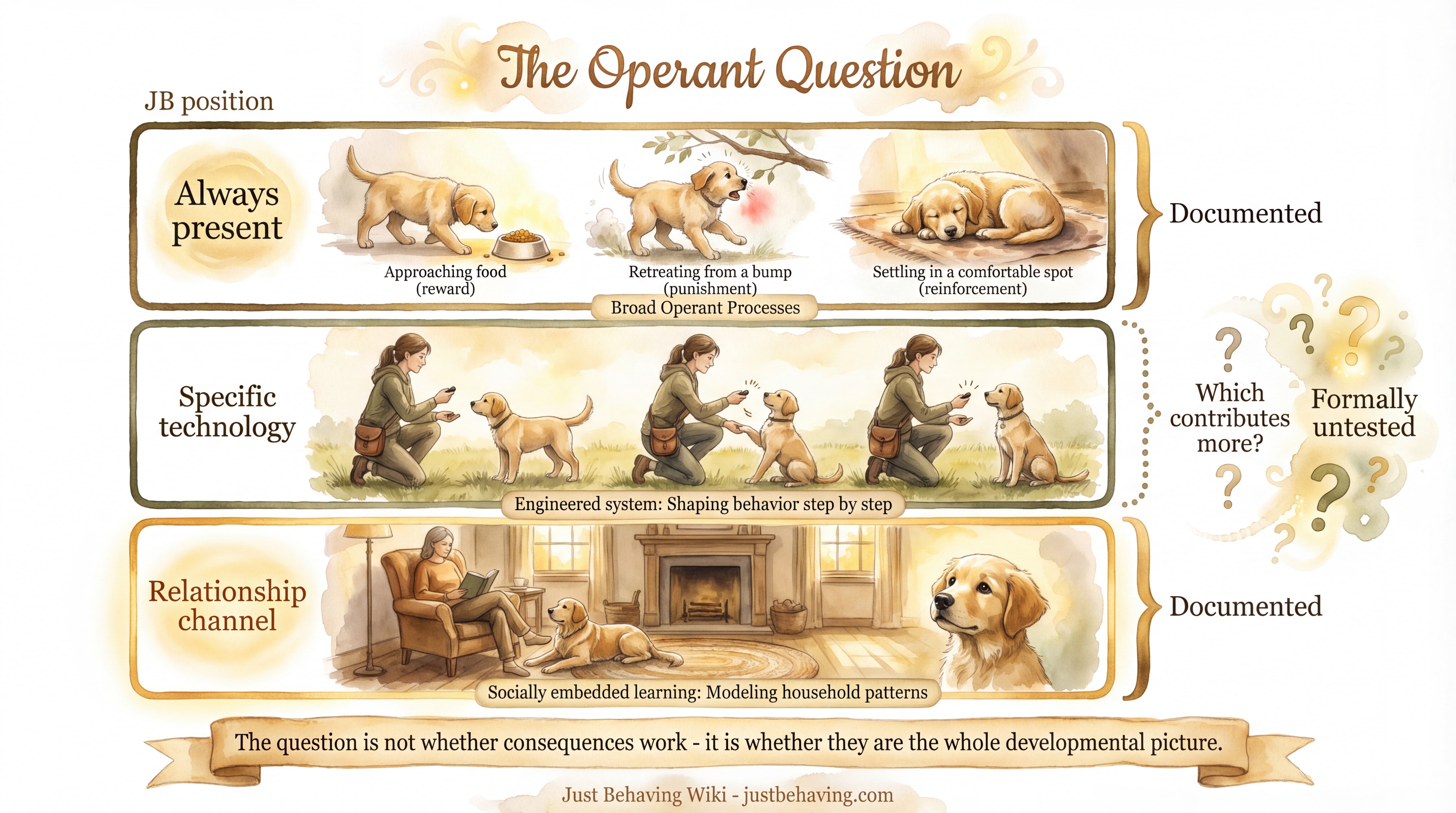
Operant conditioning accurately describes behavioral mechanics, but the relational context in which those mechanics operate changes what the dog actually learns and retains.
Key Takeaways
- The operant question turns on definition: broad consequence-shaped behavior is everywhere, but engineered trainer-style reinforcement is a narrower human technology.
- The strongest social-learning findings in dogs are hard to reduce to a simple reward-schedule story, which is why JB treats mentorship as a real developmental channel.
- The claim that social learning is the dominant natural developmental pathway remains coherent and evidence-aligned, but it is still formally untested.
- For families, the practical lesson is to stop treating calm relationship life and formal training as if only one of them is real learning.
The Evidence
- Fugazza, C. et al. (2018)domestic dogs
Showed that puppies from eight weeks can acquire useful information from social demonstrators, establishing a real early non-instructional learning channel. - Fugazza, C., and Miklosi, A. (2015)domestic dogs
Found a direct advantage for a social-learning method over shaping in a tested object-related task, suggesting that different learning routes can produce meaningfully different outcomes. - Huber, L. et al. (2018)domestic dogs
Documented overimitation from caregivers, showing copying that is not easily captured by pure efficiency logic.
- SCR-004 synthesisdomestic dogs
The claim that engineered operant reinforcement protocols have no documented analog in natural canine development is a reasoned ethological argument rather than a fully settled empirical finding. - SCR-004 boundarydomestic dogs
The stronger claim that socially embedded learning is the dominant developmental channel in natural puppy life remains plausible and coherent, but it has not been directly compared against naturally occurring operant contingencies in a published study.
No published ethological study has yet separated natural adult-puppy interactions into contingency-driven events versus ambient social-modeling events and then measured which better predicts long-term developmental outcomes.
SCR References
Sources
- Bouton, M. E. (2002). Context, ambiguity, and unlearning: Sources of relapse after behavioral extinction. Biological Psychiatry, 52(10), 976-986. https://doi.org/10.1016/S0006-3223(02)01546-9
- Fugazza, C., & Miklosi, A. (2015). Social learning in dog training: The effectiveness of the Do As I Do method compared to shaping or clicker training. Applied Animal Behaviour Science, 171, 146-151. https://doi.org/10.1016/j.applanim.2015.09.011
- Fugazza, C., Pogany, A., & Miklosi, A. (2016). Recall of others actions after incidental encoding reveals episodic-like memory in dogs. Current Biology, 26(23), 3209-3213. https://doi.org/10.1016/j.cub.2016.09.057
- Fugazza, C., Moesta, A., Pogany, A., & Miklosi, A. (2018). Social learning from conspecifics and humans in dog puppies. Scientific Reports, 8, 9257. https://doi.org/10.1038/s41598-018-27654-0
- Huber, L., Popovova, N., Riener, S., Salobir, K., & Cimarelli, G. (2018). Would dogs copy irrelevant actions from their human caregiver? Learning & Behavior, 46(4), 387-397. https://doi.org/10.3758/s13420-018-0336-z