Correction vs. Punishment
Compound evidence detail1 SCR / 2 parts
- Documentedcanine welfare evidence on aversive training methods (Vieira de Castro 2020, Ziv 2017, Hiby 2004) and attachment-mediated stress modulation evidence (Schoberl 2015, Asher 2020, Brubaker and Udell 2023)
- HeuristicJB claim that secure attachment context measurably alters how dogs experience mechanically operant-identical correction procedures, RF-flagged in the SCR and formally untested in controlled canine studies
Correction vs. Punishment is one of the most important distinctions in the JB framework. Correction is communication inside an ongoing relationship. Punishment is imposed suffering intended to suppress behavior through fear, pain, startle, or intimidation. The welfare case against aversive punishment is much stronger than JB's fuller relational interpretation of why correction can be categorically different. Mixed Evidence
What It Means
The training world often treats these categories as functionally the same. If a behavior decreases after an unpleasant event, the story is considered complete. Documented JB thinks that description is too coarse.
For JB, correction has defining features:
- brief
- calm
- proportionate
- relationally grounded
- immediately over
Punishment, by contrast, is designed to suppress through aversive consequence. The tools may vary, but the logic is the same: fear, pain, startle, or intimidation do the heavy lifting.
The page has to be honest about the overlap. Some JB corrections may still be classifiable as positive punishment in operant terms. Mixed Evidence JB does not claim exemption from the laws of learning. It claims that behavioral classification alone does not capture the moral, physiological, or developmental meaning of what happened.
That is why the aversive literature matters so much. It clearly documents higher stress, poorer welfare, and more downstream behavioral concern when harsh methods are used. Documented What it does not directly settle is the stronger JB claim that relational context changes what a mechanically similar interruption does to the organism. That second step is more speculative and has to stay tagged as such. Heuristic
Why It Matters for Your Dog
If the distinction is real, then families are not trapped between permissiveness and fear. They can set boundaries without turning the relationship adversarial.
If the distinction is fake, then JB is simply relabeling punishment and the whole pillar collapses ethically. Mixed Evidence
JB's claim is not that all interruption is harmless. It is that not all interruption is equivalent, and the delivery context matters morally and developmentally.
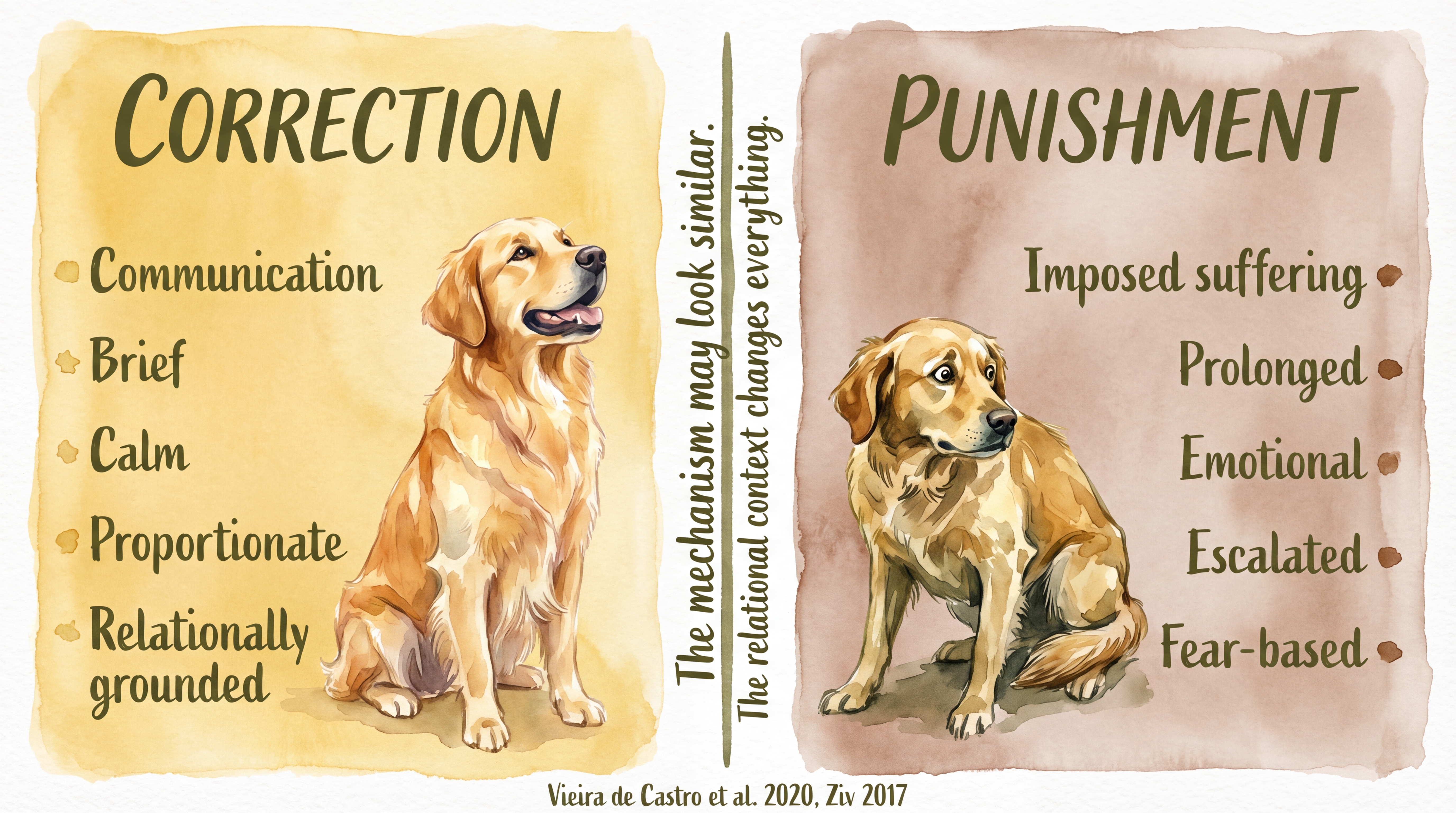
Correction is communication within a relationship. Punishment is imposed suffering. The mechanism may look similar - the context changes everything.
Key Takeaways
- The aversive welfare literature is clear: harsh methods predict higher stress and more behavioral problems.
- JB does not claim exemption from operant classification - it claims that classification alone is incomplete.
- Correction in JB terms is brief, calm, proportionate, and immediately over. Punishment is designed to suppress through fear or pain.
- If the distinction is real, families can set boundaries without turning the relationship adversarial. If it is fake, the whole pillar collapses.
The Evidence
This entry uses mixed-evidence claim-level tags beyond the dedicated EvidenceBlocks below. These tags mark claims that combine documented findings with observed practice, heuristic application, or unresolved gaps.
- Vieira de Castro, A. C. et al. (2020)domestic dogs
Dogs exposed to aversive training methods showed higher cortisol, more stress-related behavior, and more pessimistic judgment-bias outcomes than reward-trained dogs. - Ziv (2017)domestic dogs, review literature
Review evidence supports welfare risks from aversive methods without a demonstrated superior-efficacy case that would justify those risks. - Hiby, E. F. et al. (2004)domestic dogs
Punishment use correlated with a greater number of behavior problems, while the authors explicitly noted that correlational directionality remained open.
- SCR-004 and SCR-005 synthesisdomestic dogs and JB philosophy
JB argues that operant classification alone does not capture the difference between calm relational correction and punitive aversive control. That is a reasoned position with indirect support, not a directly settled empirical result.
No published study directly tests the specific claims or protocols described in this entry within a controlled canine trial.
SCR References
Sources
- Hiby, E. F., Rooney, N. J., & Bradshaw, J. W. S. (2004). Dog training methods: Their use, effectiveness and interaction with behaviour and welfare. Animal Welfare, 13(1), 63-69.
- Vieira de Castro, A. C., Fuchs, D., Morello, G. M., et al. (2020). Does training method matter? PLOS ONE, 15(12), e0225023.
- Ziv, G. (2017). The effects of using aversive training methods in dogs: A review. Journal of Veterinary Behavior, 19, 50-60.
- SCR-004 and SCR-005 synthesis. Aversive-method welfare evidence is documented. The correction-versus-punishment relational-modulation distinction remains [Heuristic] (anchors: SCR-004, SCR-005 RF-flagged).