The Relational Modulation Claim
Compound evidence detail2 SCRs / 4 parts
- Documentedcanine welfare evidence on aversive training methods (Vieira de Castro 2020, Ziv 2017, Hiby 2004) and attachment-mediated stress modulation evidence (Schoberl 2015, Asher 2020, Brubaker and Udell 2023)
- HeuristicJB claim that secure attachment context measurably alters how dogs experience mechanically operant-identical correction procedures, RF-flagged in the SCR and formally untested in controlled canine studies
- Documentedthe human attachment evidence base together with the canine-direct secure-base findings (Topal 1998, Horn 2013) and Schoberl-documented physiological effects of secure caregiving in dogs
- Heuristicthe full attachment-theory apparatus transfer to canine relationships, including internal working models and attachment-classification systems
The Relational Modulation Claim is one of the most philosophically important and most evidence-sensitive claims in the JB system. It says that the same physical interruption can land differently depending on relational context. The stronger version of that claim remains heuristic and must stay there. Heuristic
What It Means
If a calm, established caregiver steps into a puppy's path, the puppy may process that act as social guidance inside a secure relationship. If an angry, inconsistent, or unfamiliar person performs the same movement, the puppy may process it as threat. Mechanically similar act. Different organismal meaning.
JB argues that the relationship is not background. It is part of the intervention.
That argument is not pulled from nowhere. Attachment science does show that secure relationships change how social information and stress are processed. Documented Dogs also form attachment bonds with humans and show secure-base effects. Documented Owner attachment quality and owner variables are associated with behavioral outcomes in clinical behavior contexts. Documented
But that does not directly prove the full JB thesis. None of those findings is a study where two mechanically identical corrections are delivered under manipulated relational conditions and then compared. Documented That missing step matters.
So the page has to say something narrower and more honest:
- the claim is biologically plausible
- the claim is indirectly supported
- the claim is not directly demonstrated as a settled canine correction finding
Why It Matters for Your Dog
This claim matters because it sits under the ethical architecture of Indirect Correction.
If relational context does modulate outcome, then calm parental correction inside a secure bond may be categorically different from punitive handling. If relational context does not matter in that way, the distinction between correction and punishment becomes much harder to defend. Heuristic
This is the weakest link in the JB evidence chain and one of the most important. It should be foregrounded as a hypothesis with indirect support, not hidden under confident language.
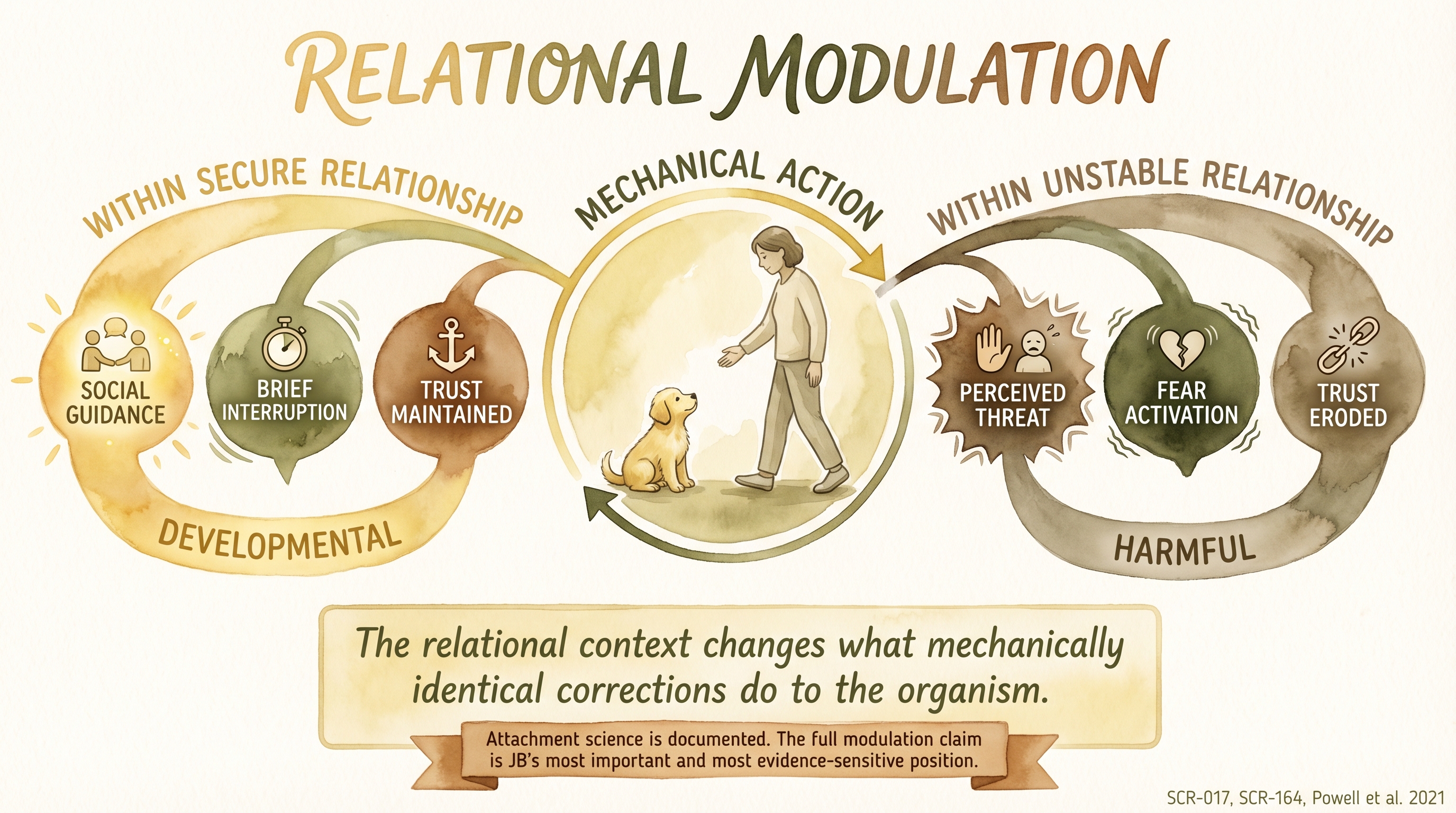
The relational context changes what mechanically identical corrections do to the organism.
Key Takeaways
- This is JB's most philosophically important and most evidence-sensitive claim.
- Attachment science supports the idea that secure relationships change how social signals are processed, but no study has directly compared identical corrections under manipulated relational conditions in dogs.
- The claim is biologically plausible and indirectly supported - not settled.
- If the claim holds, calm parental correction inside a secure bond may be categorically different from punitive handling. That is the ethical foundation of Pillar V.
The Evidence
- Attachment literature summarized in SCR-017humans, with partial canine transfer
Secure attachment forms from consistent, predictable, sensitively responsive caregiving and changes how social signals and stress are processed. - Topal et al. and related dog attachment work summarized in SCR-018domestic dogs
Dogs form attachment bonds functionally analogous to infant-caregiver bonds and show secure-base effects. - Powell et al. (2021) summarized in SCR-164domestic dogs
Owner personality and owner-dog attachment were associated with treatment outcomes after behavioral consultation.
- domestic dogs and JB synthesis
The specific claim that relational context changes what mechanically similar corrections do to the organism is biologically plausible and partly supported indirectly, but it has not been directly tested as a settled intervention finding.
No published study directly tests the specific claims or protocols described in this entry within a controlled canine trial.
SCR References
Sources
- Asher, L., England, G. C. W., Sommerville, R., & Harvey, N. D. (2020). Teenage dogs? Biology Letters, 16(5), 20200097.
- Brubaker, L., & Udell, M. A. R. (2023). Does pet parenting style predict the social and problem-solving behavior of pet dogs? Animal Cognition, 26(1), 345-356.
- Powell, L., et al. (2021). Owner personality and treatment outcome in canine behavioral medicine cases. Journal of Veterinary Behavior, 45, 34-42.
- Schoberl, I., et al. (2015).