Bright Line Rules
Compound evidence detail1 SCR / 2 parts
- Documentedcanine welfare evidence on aversive training methods (Vieira de Castro 2020, Ziv 2017, Hiby 2004) and attachment-mediated stress modulation evidence (Schoberl 2015, Asher 2020, Brubaker and Udell 2023)
- HeuristicJB claim that secure attachment context measurably alters how dogs experience mechanically operant-identical correction procedures, RF-flagged in the SCR and formally untested in controlled canine studies
Bright Line Rules are the non-negotiable boundaries that define what Indirect Correction is not. They exist because without hard limits, "gentle correction" can become a euphemism for punishment. The rules themselves are philosophical guardrails shaped by the documented welfare literature on aversive methods. Heuristic
What It Means
JB's bright lines are explicit:
- No yelling or raised voice.
- No physical force.
- No intimidation.
- No punishment-based isolation.
- No correction that drags on beyond a few seconds.
- Stop immediately if fear appears.
Those rules are not cosmetic. They are the category boundary.
If the human is shouting, the interaction has already left Indirect Correction. Heuristic If the human is scruffing, jerking, pinning, or forcing, the interaction has already left Indirect Correction. If the dog is cornered, trapped, or staring at the human in fear, the interaction has already left Indirect Correction.
JB also includes two process guardrails that matter just as much:
- if the human is angry, do not correct
- if three calm corrections do not work, change the environment instead of escalating
Why It Matters for Your Dog
The bright lines matter because intent is not enough. Heuristic People can sincerely believe they are being calm and still cross into coercion. A philosophy that relies on subtle communication needs visible stop rules.
Bright lines exist so that Indirect Correction cannot become punishment with better branding.
The documented aversive literature gives these rules their seriousness. Documented If harsh or fear-based methods predict worse welfare and more behavioral fallout, then the system needs clear prohibitions, not vague encouragement to "be gentle."
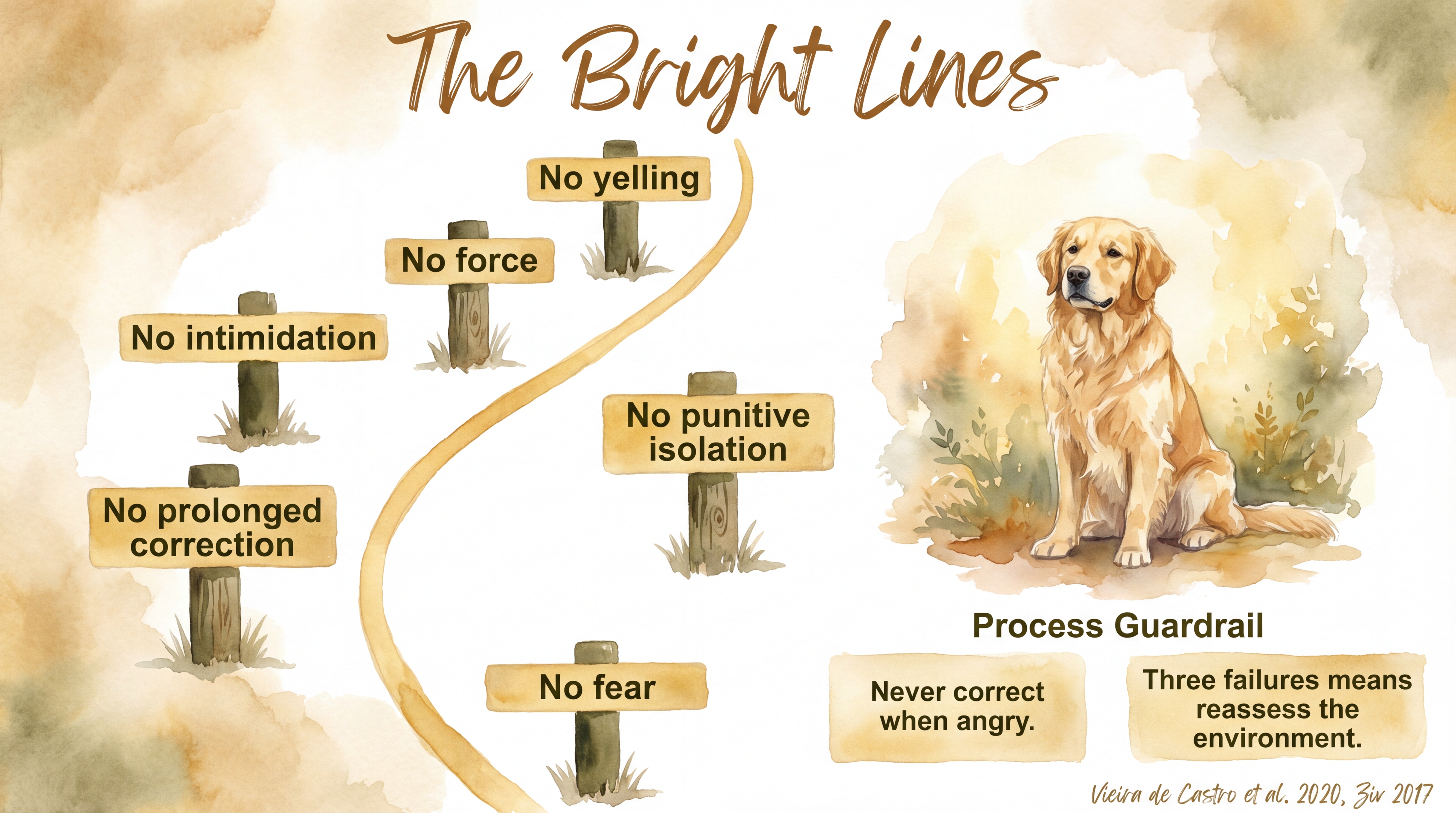
Six hard stops that prevent gentle correction from becoming euphemism for punishment.
Key Takeaways
- Bright lines exist so that Indirect Correction cannot become punishment with better branding.
- Six hard stops: no yelling, no physical force, no intimidation, no punitive isolation, no correction beyond a few seconds, and stop immediately if fear appears.
- Two process guardrails matter just as much: do not correct when angry, and reassess the environment after three unsuccessful attempts.
- The aversive welfare literature gives these rules their seriousness - vague encouragement to 'be gentle' is not enough.
The Evidence
- Vieira de Castro, A. C. et al. (2020)domestic dogs
Aversive-trained dogs showed higher cortisol, more stress behavior, and more pessimistic cognitive bias than reward-trained dogs. - Ziv (2017)domestic dogs, review literature
Review evidence supports welfare risks from aversive methods without a demonstrated superior-efficacy case that would justify those risks. - Hiby, E. F. et al. (2004)domestic dogs
Punishment use correlated with a greater number of behavior problems, reinforcing the need for strict boundaries around correction practices.
- domestic dogs and JB synthesis
The exact six bright-line rules are JB guardrails built from the philosophy and the aversive welfare literature rather than a published six-point validated instrument.
No published study directly tests the specific claims or protocols described in this entry within a controlled canine trial.
SCR References
Sources
- Hiby, E. F., Rooney, N. J., & Bradshaw, J. W. S. (2004). Dog training methods: Their use, effectiveness and interaction with behaviour and welfare. Animal Welfare, 13(1), 63-69.
- Vieira de Castro, A. C., Fuchs, D., Morello, G. M., et al. (2020). Does training method matter? PLOS ONE, 15(12), e0225023.
- Ziv, G. (2017). The effects of using aversive training methods in dogs: A review. Journal of Veterinary Behavior, 19, 50-60.