Senior Wellness Screening
Compound evidence detail1 SCR / 2 parts
- Documentedthe twice-yearly veterinary examination cadence in senior dogs combined with periodic blood work, urinalysis, and blood-pressure assessment; the standard senior panel components (complete blood count, serum chemistry, urinalysis, total T4, with SDMA as an additional early renal screen); and the underlying principle that early detection of age-related disease measurably improves quality-of-life management
- Heuristicthe specific seven-year senior threshold for large breeds and the specific imaging cadence for cancer surveillance - program-level cadence judgments rather than outcome-validated thresholds, with downstream presentation requiring breed-and-individual caveats
Senior wellness screening matters because older dogs often do not announce disease early with dramatic symptoms. They become a little slower, drink a little more, lose a little weight, carry a little more stiffness, or develop a lab abnormality before anyone feels alarmed. The point of senior screening is to catch those quieter shifts before they become harder, more expensive, and more painful to manage. In Golden Retrievers, that matters especially because kidney disease, endocrine drift, body-condition change, and cancer surveillance all become more relevant as the breed ages. Documented
What It Means
When a Golden Becomes a Senior
There is no magical birthday when a dog becomes old, but for many Golden Retrievers the senior-care conversation starts around seven to eight years. That does not mean the dog is already frail. It means the preventive strategy should change before obvious decline forces it to.
This is one reason age categories matter. A dog can still feel like the same happy Golden while moving into a life stage where annual screening is no longer enough.
Why Semiannual Care Becomes More Reasonable
Senior screening often shifts from annual visits toward every six months because older dogs change faster. Observed-JB
At that stage, six months can be the difference between a mild lab drift and a late-stage problem; a small mass and a much larger one; and a subtle weight change and clear clinical decline. Documented
The goal is not overmedicalization. It is shorter intervals between chances to notice meaningful change.
What Senior Screening Usually Includes
A senior wellness workup often includes a detailed physical exam, blood chemistry and complete blood count, urinalysis, body-condition assessment, thyroid discussion where clinically appropriate, blood-pressure measurement, and kidney screening including SDMA. Observed-JB
The exact package varies by clinician and dog, but the broader principle is stable: older dogs benefit from more proactive lab and exam surveillance than younger adults do. Documented
Why Kidney Screening Matters
This is one of the clearest places where earlier detection changes outcomes. The SCR already supports that SDMA can detect declining filtration earlier than creatinine alone and now sits inside the IRIS renal framework.
That means senior screening can sometimes surface kidney disease before appetite has fallen significantly; vomiting starts; and the dog looks obviously ill.
That earlier notice does not cure the disease. It does create more room for management.
Why It Matters for Your Dog
Cancer Surveillance in Goldens
Goldens deserve especially serious senior screening because cancer is one of the main later-life burdens in the breed. That does not mean screening can prevent every cancer. It means families and veterinarians should become more deliberate about lump checks; weight trends; stamina changes; bloodwork interpretation in context; and deciding when imaging or further workup is justified.
The best senior families are not the most frightened. They are the ones who stop calling every change "just old age" without checking.
Body Condition Still Matters
Senior dogs need body-condition discipline every bit as much as younger dogs do, sometimes more.
That is because extra weight worsens arthritis burden; muscle loss can hide behind stable scale weight; and kidney and endocrine interpretation can be affected by body composition.
A senior Golden who stays lean and well-monitored often lives more comfortably than one whose extra weight has been normalized for years.
The Cost Reality
Senior wellness usually costs more than younger adult wellness because it includes more frequent exams, more bloodwork, more follow-up testing, and more discussions about chronic disease management. Observed-JB
Families should know that going in. More screening often reveals more actionable information, and that is exactly the point. Surprise is what makes the cost conversation feel adversarial.
End-of-Life Planning Belongs Here Too
Senior wellness screening is not only about extending life. It is also about protecting quality of life and preventing crisis decision-making later.
That means the senior period is also when families should begin learning about quality-of-life assessment; hospice and palliative options; and what euthanasia planning actually looks like.
Thinking about those topics early is not giving up. It is part of loving an older dog responsibly.
When to See a Veterinarian
Do not wait for the next scheduled senior appointment if your dog develops new lumps; unexplained weight loss; more drinking or urinating; repeated vomiting; collapse or sudden weakness; marked stiffness or reluctance to rise; and persistent appetite change.
Senior screening is preventive, but it does not replace reacting promptly to real change.
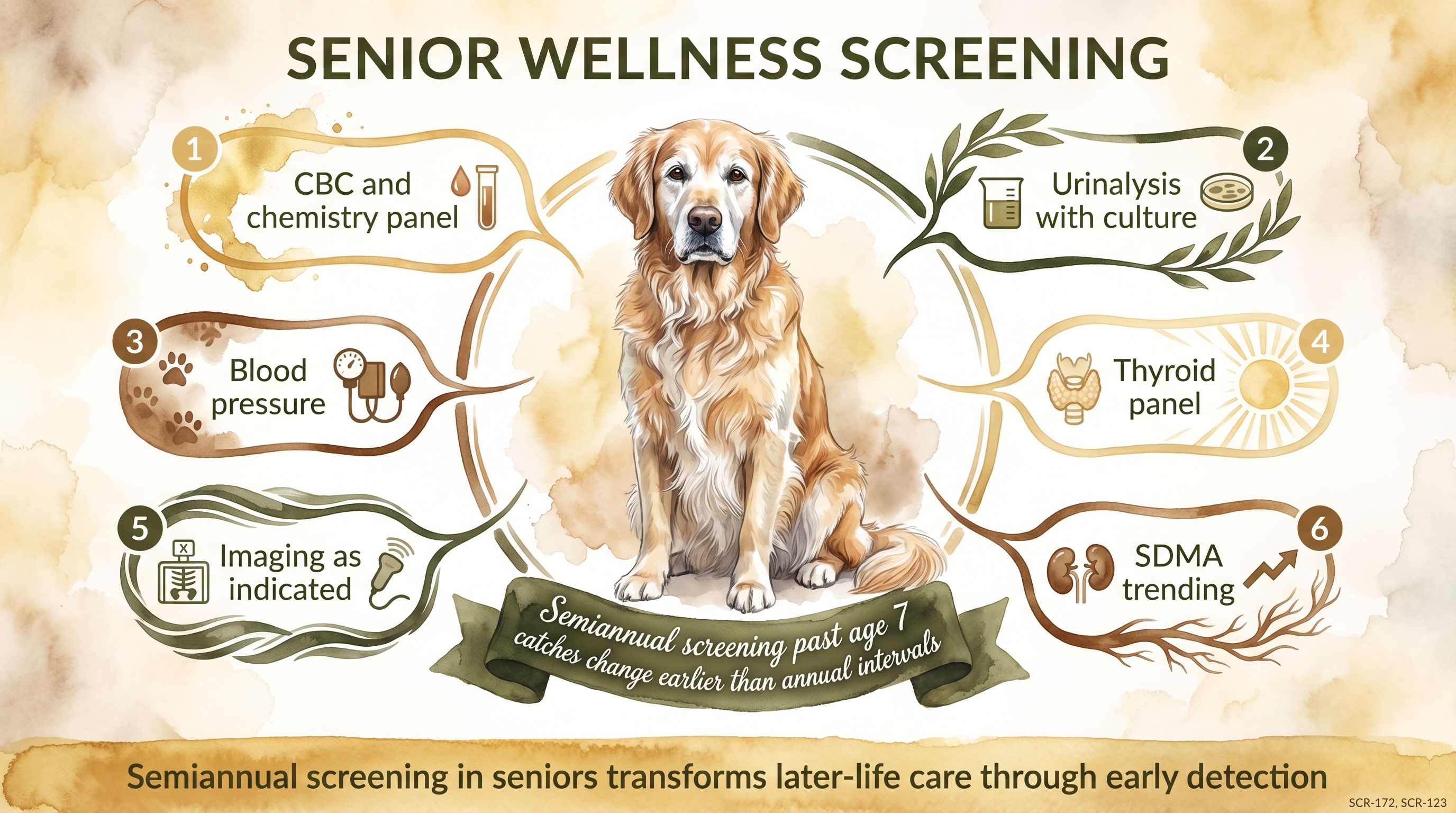
Semiannual screening in seniors transforms later-life care through early detection.
Key Takeaways
- Senior wellness screening is about detecting quieter later-life disease before it becomes harder to manage.
- For many Golden Retrievers, the senior-care conversation should begin around seven to eight years rather than waiting for obvious decline.
- Kidney screening, body condition, blood pressure, and cancer vigilance all become more important as Goldens age.
- The senior period is also the right time for calm quality-of-life and end-of-life planning, not only for diagnostics.
The Evidence
This entry uses observed claim-level tags beyond the dedicated EvidenceBlocks below. These tags mark JB program observation or practice-derived claims that need dedicated EvidenceBlock coverage in a later content pass.
- SCR-122 supportdogs
SDMA improves earlier recognition of declining kidney function compared with creatinine alone, which is why it belongs in serious senior screening. - SCR-123 supportdogs
Modern IRIS renal staging integrates SDMA into the broader CKD framework, making earlier detection more clinically useful. - SCR-114 supportGolden Retrievers
Golden later-life health discussion is dominated by real disease burden rather than folklore, which makes proactive senior surveillance especially important.
- Senior-care guideline logicdogs
Older dogs often benefit from semiannual rather than annual wellness evaluation because clinically meaningful changes can appear faster in later life. - Golden-health synthesisGolden Retrievers
Cancer burden and chronic-disease risk make senior screening especially valuable in Goldens even though no one screening protocol catches every later-life problem.
- domestic dogs
No published study directly defines the single best testing interval, threshold, or decision rule for senior wellness screening across all Golden Retriever households and breeding programs.
SCR References
Sources
- American Animal Hospital Association. (2023). 2023 AAHA senior care guidelines for dogs and cats. Journal of the American Animal Hospital Association, 59(1), 1-21. https://doi.org/10.5326/JAAHA-MS-7343
- Creevy, K. E., Grady, J., Little, S. E., Moore, G. E., Strickler, B. G., Thompson, S., & Webb, J. A. (2019). 2019 AAHA canine life stage guidelines. Journal of the American Animal Hospital Association, 55(6), 267-290. https://doi.org/10.5326/JAAHA-MS-6999
- Nabity, M. B., Lees, G. E., Boggess, M. M., Yerramilli, M., Obare, E., Yerramilli, M., Rakitin, A., Aguiar, J., & Relford, R. (2015). Symmetric dimethylarginine assay validation, stability, and evaluation as a marker for the early detection of chronic kidney disease in dogs. Journal of Veterinary Internal Medicine, 29(4), 1036-1044. https://doi.org/10.1111/jvim.12835
- International Renal Interest Society. (2023). IRIS staging of CKD. https://www.iris-kidney.com/iris-staging-system
- Epstein, M., Kuehn, N. F., Landsberg, G., Lascelles, B. D. X., Marks, S. L., Schaedler, J. M., & Tuzio, H. (2023). 2023 AAHA senior care guidelines for dogs and cats. Journal of the American Animal Hospital Association, 59(1), 1-21. https://doi.org/10.5326/JAAHA-MS-7343
- Nabity, M. B., Lees, G. E., Boggess, M. M., Yerramilli, M., Obare, E., Yerramilli, M., Rakitin, A., Aguiar, J., & Relford, R. (2015). Symmetric dimethylarginine assay validation, stability, and evaluation as a marker for the early detection of chronic kidney disease in dogs. Journal of Veterinary Internal Medicine, 29(4), 1036-1044. https://doi.org/10.1111/jvim.12835