Body Condition Scoring
Compound evidence detail1 SCR / 2 parts
- Documentedthe WSAVA nine-point body-condition-scoring framework as the canonical clinical assessment instrument, the systematic discrepancy by which dog owners assess their dogs as leaner than veterinary scoring records (concentrated at the overweight end of the scale), and the at-home three-point physical check (rib palpation under light pressure, waist visible from above, abdominal tuck visible from the side)
- Observed-JBthe Golden-Retriever-specific contribution of dense coat volume to visual underestimation of body condition, recurring across veterinary clinical descriptions but not yet quantified in a published controlled comparison
Body condition scoring is the simplest serious health-screening skill most dog families never get taught properly. That is a problem because weight-related disease does not usually begin with a dramatic event. It begins with slow visual normalization. The dog gets a little broader, the waist softens, the ribs disappear under thicker cover, and everyone around the dog keeps saying it looks great. By the time the change feels obvious, the health cost has usually been accumulating for a while. Documented
What It Means
What Body Condition Scoring Is
Body condition scoring, often shortened to BCS, is a standardized way of estimating body fat based on visible shape and palpation. Observed-JB The most common veterinary system is the 9-point scale.
The scale is not about body weight alone. It is about how the dog is carrying that weight.
That distinction matters because a large dog is not automatically an overweight dog; a muscular dog and an overfat dog can weigh the same; and breed size does not tell you whether the current condition is healthy.
The 9-Point Scale in Practice
The family-friendly version of the scale looks like this: 1 to 3 means underconditioned, 4 to 5 means ideal, 6 to 7 means overweight, and 8 to 9 means obese.
Most healthy adult dogs should live around 4 or 5. Estimated
At that level, you should generally find ribs that are easy to feel with light fat covering; a visible waist from above; and an abdominal tuck from the side. Documented
Those features are the core visual and tactile anchors. If they disappear, the score has probably drifted upward.
Why Palpation Matters More Than the Eye Alone
Fluffy coats, breed stereotypes, and family familiarity can all mislead the eye. Goldens are especially vulnerable to this problem because their coat can hide shape changes and because many people culturally associate a plush Golden with a healthy Golden.
This is why a real BCS check includes your hands.
Ask can I feel the ribs easily without pressing hard; is there a waist when I look from above; and is there an abdominal tuck from the side.
If the answer is no to all three, the dog is probably not in ideal condition even if the overall impression feels normal.
Why This Matters So Much Medically
The strongest evidence in the whole discussion is already in the SCR: keeping dogs lean extends lifespan and delays chronic disease.
That means body condition scoring is not cosmetic. It is one of the most practical ways to keep one of the highest-yield health interventions visible in daily life.
Excess body fat affects orthopedic stress; mobility; metabolic health; heat tolerance; cardiopulmonary load; and overall lifespan and healthspan. Documented
Once families understand that, BCS stops feeling like a judgment tool and starts feeling like a health-maintenance tool.
The Ideal Is Usually Leaner Than Families Expect
One reason BCS is so important is that family perception drifts. When a whole social environment treats slightly heavy dogs as normal, the benchmark moves.
Veterinary teams see this every day. Families are usually not trying to overcondition their dogs. They are using a distorted reference picture.
This is why calm, concrete language works best here is what the ribs should feel like; here is where the waist should still be visible; and here is why this matters for lifespan, not only appearance.
That kind of recalibration is far more helpful than vague instructions to "feed less."
Why It Matters for Your Dog
How to Score at Home
A practical home check can be done in less than a minute.
- Stand above the dog and look for a waist behind the ribs.
- Move to the side and look for an abdominal tuck.
- Run your hands lightly over the ribcage and feel how much cover sits over the ribs.
If you have to dig for ribs, the score is too high. If the ribs, spine, and pelvis are sharply visible with minimal cover, the score may be too low. If the ribs are easy to find and the waist is still obvious, you are usually close to the right range.
Puppies Need Their Own Discipline Too
Body condition scoring matters in puppies as well as adults. Large-breed puppies should not be raised round and overfed for aesthetic reasons. Growth-phase overconditioning adds load to developing joints and pushes the puppy toward a worse orthopedic and metabolic trajectory.
That does not mean puppies should look gaunt. It means puppy softness should not become a justification for excess condition.
Where BCS Fits After Spay or Neuter
Many dogs require calorie adjustment after gonadectomy because maintenance needs can change and appetite behavior can shift. Documented This is one reason BCS is more useful than a fixed feeding chart.
The chart may say one thing. The dog in front of you may be telling you another story.
That is also why weight-control conversations after spay or neuter should be proactive rather than reactive.
What Families Should Remember
BCS works best when it becomes routine.
That means checking condition regularly rather than only at annual exams; adjusting food with the dogs actual body in mind; tracking treats honestly; and understanding that love and overfeeding are not the same thing.
The family that learns this skill early will prevent more downstream health burden than the family that waits for the scale or the joints to force the issue.
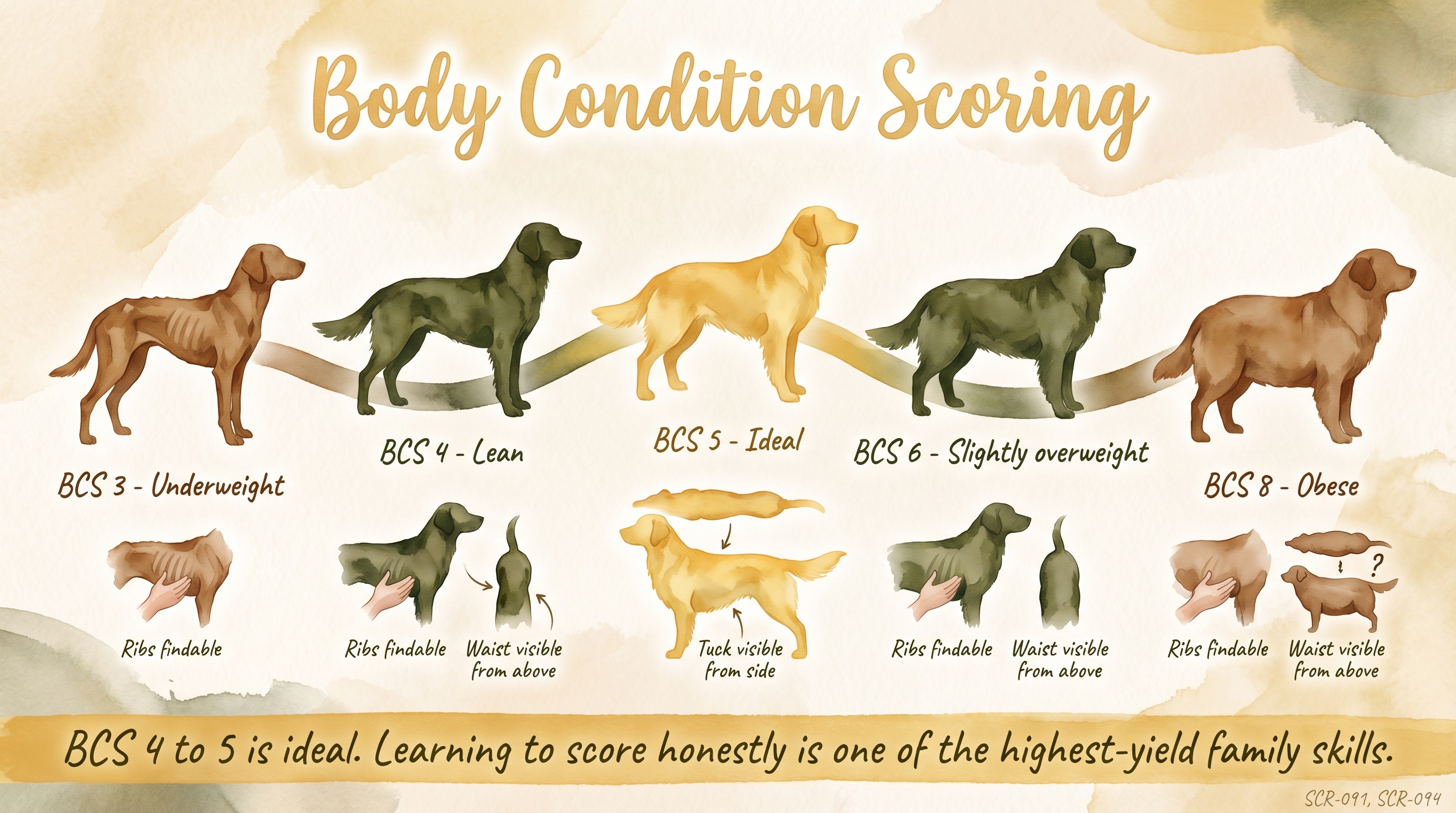
BCS 4 to 5 is ideal - learning to score honestly is one of the highest-yield family skills.
Key Takeaways
- Body condition scoring estimates body fat, not just body weight, and the ideal range for most adult dogs is 4 to 5 on the 9-point scale.
- You should be able to feel ribs easily, see a waist from above, and see an abdominal tuck from the side in a well-conditioned dog.
- Keeping dogs lean is one of the clearest documented ways to extend lifespan and delay chronic disease.
- BCS works best as a routine home skill because visual normalization of mild overweight happens long before owners feel alarmed by it.
The Evidence
This entry uses observed claim-level tags beyond the dedicated EvidenceBlocks below. These tags mark JB program observation or practice-derived claims that need dedicated EvidenceBlock coverage in a later content pass.
This entry uses estimated claim-level tags beyond the dedicated EvidenceBlocks below. These tags mark approximate ranges or timing claims that should remain bounded by the cited sources.
- SCR-075 supportdogs
Maintaining dogs in lean body condition extends lifespan and delays chronic disease, making honest condition scoring one of the highest-yield practical health tools available. - WSAVA guidancedogs
The 9-point body condition framework uses rib palpation, waist visibility, and abdominal tuck to estimate fatness more accurately than body weight alone. - Veterinary nutrition literaturedogs
Routine condition scoring improves earlier recognition of weight drift because visible obesity is usually a late recognition problem rather than an early one.
- Nutrition source synthesisdogs
Owners often normalize mild overconditioning, which is why tactile scoring and veterinary recalibration matter more than eye test alone. - Golden-specific contextGolden Retrievers
Goldens are especially easy to overcondition because coat, food motivation, and family indulgence can all hide or normalize the drift.
- domestic dogs
No published study directly defines the single best testing interval, threshold, or decision rule for body condition scoring across all Golden Retriever households and breeding programs.
SCR References
Sources
- World Small Animal Veterinary Association. (n.d.). Global nutrition guidelines. https://wsava.org/global-guidelines/global-nutrition-guidelines/
- World Small Animal Veterinary Association Global Nutrition Committee. (2021). Global nutrition toolkit. https://wsava.org/wp-content/uploads/2021/04/WSAVA-Global-Nutrition-Toolkit-English.pdf
- Kealy, R. D., Lawler, D. F., Ballam, J. M., Mantz, S. L., Biery, D. N., Greeley, E. H., Lust, G., Segre, M., Smith, G. K., & Stowe, H. D. (2002). Effects of diet restriction on life span and age-related changes in dogs. Journal of the American Veterinary Medical Association, 220(9), 1315-1320. https://doi.org/10.2460/javma.2002.220.1315
- Smith, G. K., Paster, E. R., Powers, M. Y., Lawler, D. F., Biery, D. N., Shofer, F. S., McKelvie, P. J., & Kealy, R. D. (2006). Lifelong diet restriction and radiographic evidence of osteoarthritis of the hip joint in dogs. Journal of the American Veterinary Medical Association, 229(5), 690-693. https://doi.org/10.2460/javma.229.5.690
- Eastland-Jones, R. C., German, A. J., Holden, S. L., Biourge, V., & Pickavance, L. C. (2014). Owner misperception of canine body condition persists despite use of a body condition score chart. Journal of Nutritional Science, 3, e45. https://doi.org/10.1017/jns.2014.25
- Gille, S., Fischer, H., Lindase, S., Palmqvist, L., & Ohlund, M. (2023). Dog owners' perceptions of canine body composition and effect of standardized education for dog owners on body condition assessment of their own dogs. Veterinary Sciences, 10(7), 447. https://doi.org/10.3390/vetsci10070447