The Parasympathetic Walk
For many families, the walk is the center of the dog's day. That is exactly why JB treats it carefully. Modern dog culture often frames walking in minutes, miles, calories, intensity, and output. JB frames it differently. A walk can certainly provide movement, sniffing, and exposure, but its deeper value is regulatory and relational. A parasympathetic walk is a walk that keeps returning the dog to calm engagement rather than continuously driving the dog upward into scanning, pulling, reacting, and recovering. No study has tested a formally named JB parasympathetic-walk protocol in dogs, so that exact phrase remains heuristic. Still, the autonomic science underneath it is real. Dogs have measurable sympathetic and parasympathetic states, and the difference between a dog that walks in a regulated body and a dog that walks in chronic activation is not philosophical. It is physiological. Heuristic
What It Means
A parasympathetic walk is not a stroll so short or so restrained that the dog never moves with purpose. It is a walk whose tempo supports regulation.
That usually means a loose line more often than a tight one, a human pace rather than a frantic canine one, room to sniff and orient, no need to greet every person or dog, and calm recovery when arousal rises.
The walk is still active. The dog is still outside in the world. The difference is that the outside world is not being used to whip the nervous system into a higher state for the sake of feeling that the dog has been "worn out."
JB does not deny that dogs need movement. It denies that high arousal should be the default form of that movement.
The Industry Frame
The ordinary family frame sounds like this: my dog needs a long walk to burn energy, if I can get the dog tired enough, the dog will settle later, and the more intense the walk, the better the outcome. Heuristic
Sometimes that appears to work in the short term. A highly activated dog may come home and sleep. But sleeping from exhaustion is not the same thing as living from regulation. If the daily walk repeatedly rehearses pulling, lunging, frantic social scanning, and emotional spikes around triggers, the family may be building a body that needs that level of activation before it can finally crash. Heuristic
That is not the same as teaching the dog to inhabit a calmer baseline.
What the JB Reframe Changes
On a parasympathetic walk, the handler acts less like an exercise director and more like a steady anchor. The human walks at a normal tempo, breathes normally, keeps the leash quiet, and avoids turning the entire outing into a negotiation or a performance.
Sniffing is not treated as failure. It is part of how dogs process the environment.
Pauses are not treated as defiance. They are often information-gathering.
Passing another dog without greeting is not deprivation. It is often maturity.
The walk becomes a moving version of the calm household rather than a break from it.
What Happens When the Dog Escalates
No family will keep every walk perfectly regulated. Real walks contain bicycles, rabbits, loud trucks, children, other dogs, construction noise, wind, and plain old bad timing. The point is not perfection. The point is what the human does next.
When a dog begins to rise into sympathetic dominance, pulling hard, fixating, vocalizing, or losing the ability to stay in a shared rhythm, the JB response is to lower arousal rather than to layer more stimulation on top of it.
That can mean slowing down, pausing briefly, increasing distance from the trigger, making a quiet change of direction, or waiting for the body to soften before moving on. Heuristic
The walk keeps returning to its baseline.
That return is the entire practice.
Golden Retrievers and the Question of Output
This page needs one important nuance. Not every dog, and not every line within a breed, has the same movement needs. Some dogs do need more substantial physical output than others. Some adolescent or field-heavy Goldens need richer exercise outlets than a gentle neighborhood loop. JB does not deny that biological reality.
What JB questions is the assumption that the daily walk itself should become an arousal engine.
A Golden Retriever can swim, hike, retrieve briefly, explore woods, and move with enthusiasm while still living from a parasympathetic floor. In fact, that floor is often what lets the dog enjoy bigger activity without carrying sympathetic spillover into the rest of the day.
What This Is Not
The parasympathetic walk is not a painfully slow ceremonial procession, a refusal to let the dog sniff, an attempt to suppress all natural curiosity, a claim that no dog ever needs vigorous exercise, or a denial that working lines may require more output.
It is also not a moral critique of families who currently walk in a different way. Many people have only been taught one standard: tire the dog out. JB is offering another standard: regulate the dog while moving.
That difference compounds. A dysregulation-and-recovery walk may look successful because the dog is temporarily spent afterward. A parasympathetic walk often looks quieter in the moment but pays out more deeply across months and years because it keeps reinforcing the same low-arousal relational rhythm the family wants in the house.
Why It Matters for Your Dog
The walk is one of the few activities that happens almost every day for many companion dogs. That is why small differences in how it is done matter so much. Repeated daily patterns shape the dog.
If the walk repeatedly teaches that the outside world is overwhelming, every other dog matters, the leash is always under tension, and movement means activation, then those expectations become the dog's walking life.
If the walk repeatedly teaches that the handler is readable, the pace is shared, the environment can be investigated without urgency, and rising arousal is followed by calm recovery, then that becomes walking life instead.
The walk is not separate from the household philosophy. It is the household philosophy in motion. The same calm floor that matters in the kitchen matters at the end of the leash.
For the family, the benefit is not only a nicer outing. It is the accumulated effect of years spent walking with a dog that sees the handler as the center of the experience, not as the tow cable attached to it.
That is a very different relationship.
And because walks recur so reliably, the difference between those two versions keeps adding up.
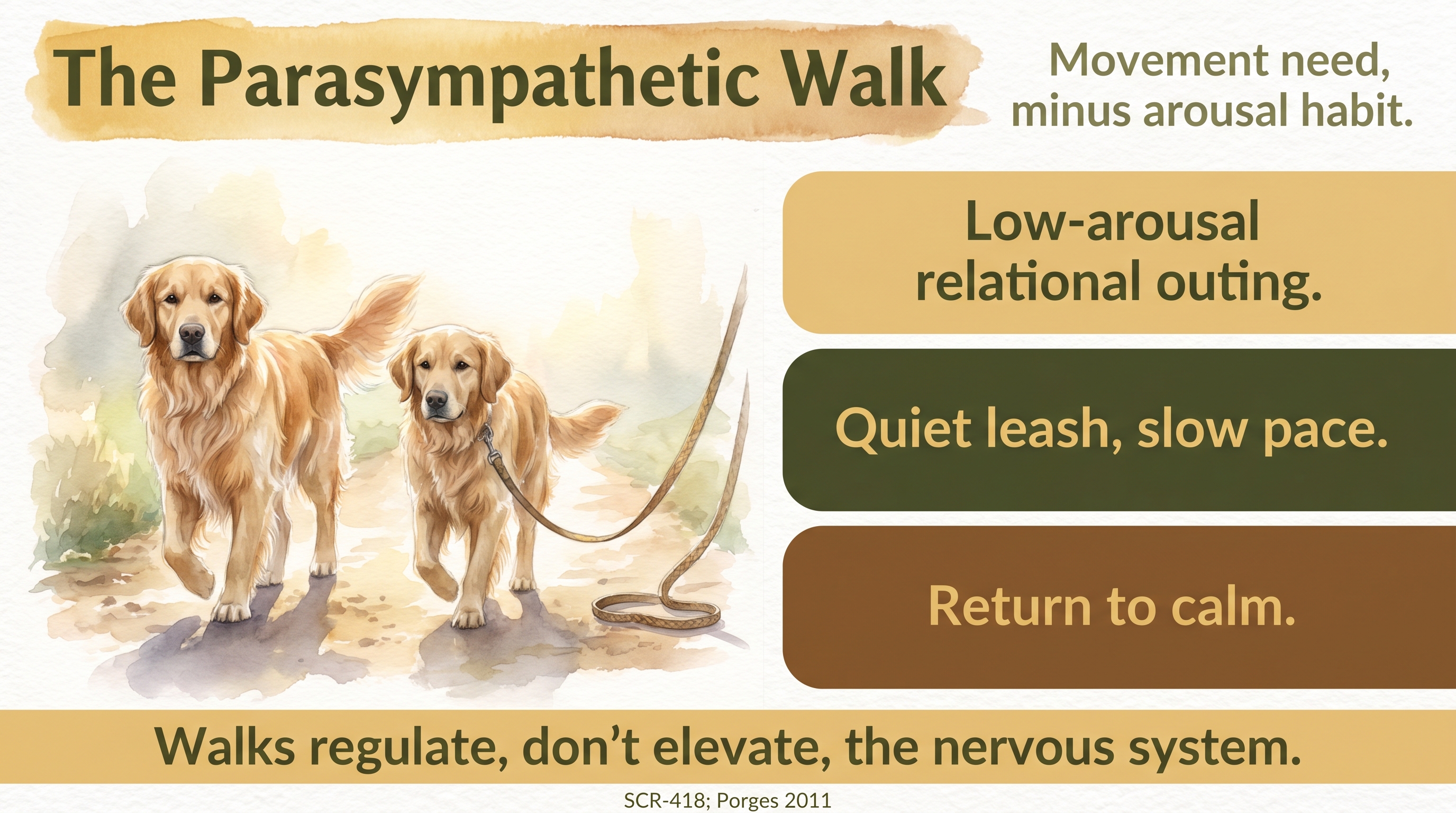
The daily walk can regulate the nervous system instead of reliably elevating it.
Key Takeaways
- A parasympathetic walk is a low-arousal relational outing that keeps returning the dog to calm engagement rather than pushing constant activation.
- JB does not deny movement needs; it questions the assumption that the daily walk should function as an arousal-and-exhaustion routine.
- The handler pace, leash quietness, and response to rising arousal shape the dog's walking nervous system over time.
- The named JB parasympathetic-walk model is heuristic, but the autonomic science beneath the distinction between regulated and dysregulated walking is well grounded.
The Evidence
- Canine HRV and autonomic literaturedogs
Heart rate variability and related measures provide a meaningful window into canine autonomic state, with lower variability often tracking higher sympathetic load and poorer regulation. - Arousal-regulation literaturedogs
Higher chronic arousal is associated with poorer behavioral regulation, lower flexibility, and more difficulty returning to baseline after activation.
- Polyvagal and co-regulation traditionshumans and other mammals
Calm social engagement and predictable pacing support parasympathetic regulation, while chronic activation degrades recovery and cognitive flexibility. - Human-dog owner-state literaturedogs and humans
Dog-owner physiology can co-modulate, supporting the claim that the handlers pace and state are part of the dogs walking experience rather than outside it.
- JB synthesisfamily-dog walking practice
Treating the daily walk primarily as a parasympathetic relational practice rather than an exercise-intensity target is an applied framework supported indirectly by autonomic science and breeder observation, not by a direct protocol trial. - JB observationGolden Retriever family dogs
Goldens raised with calm walking rhythms tend to sustain easier leash behavior and calmer post-walk settling than dogs whose daily walks are built around activation and fatigue.
No published study directly tests the practical implications of the parasympathetic walk for domestic dog raising programs. The application to household dog raising remains an interpretive synthesis rather than a directly tested intervention finding.
SCR References
Sources
- Wormald, D., Lawrence, A. J., Carter, G., & Fisher, A. D. (2017). Reduced heart rate variability in pet dogs affected by anxiety-related behaviour problems. Physiology & Behavior, 168, 122-127. https://doi.org/10.1016/j.physbeh.2016.11.003
- Koskela, A., Tornqvist, H., Somppi, S., Tiira, K., Kykyri, V.-L., Hanninen, L., Kujala, J., Nagasawa, M., Kikusui, T., & Kujala, M. V. (2024). Behavioral and emotional co-modulation during dog-owner interaction measured by heart rate variability and activity. Scientific Reports, 14, 25201. https://doi.org/10.1038/s41598-024-76831-x
- Sundman, A.-S., Van Poucke, E., Svensson Holm, A.-C., Faresjo, A., Theodorsson, E., Jensen, P., & Roth, L. S. V. (2019). Long-term stress levels are synchronized in dogs and their owners. Scientific Reports, 9, 7391. https://doi.org/10.1038/s41598-019-43851-x
- Sharpened by Queue1-DecisionTree: the polyvagal-theory label is dropped from this source request because no canine primary source verifying the named JB parasympathetic-walk model through polyvagal theory was located. Existing canine support remains Wormald et al. (2017), Sundman et al. (2019), and Koskela et al. (2024) for HRV, stress, and dog-owner co-modulation. SCR-418 remains [Heuristic].
- Just Behaving program observation disclosure. (2026). Boundary: this internal observation is limited to JB-raised Golden Retrievers whose families continued the JB framework after placement; cohort size, time window, and counting rule are deferred in this revision. Treat as program observation supporting parasympathetic-walk outcomes, not as published external evidence.