Adult Exercise Across the Lifespan
Adulthood expands a dog's exercise envelope. The body is mature, the growth phase is over, and many Goldens can comfortably do more than they could in adolescence. JB does not dispute that. It simply refuses the common leap from "can do more" to "should do as much intensity as possible." Adult exercise is still governed by the same principle that shaped earlier movement: calm, moderate, sustainable activity usually serves the dog's whole life better than chronic intensity. Observed-JB
That is especially important in Golden Retrievers. The breed is athletic, willing, and easy to overestimate. Goldens will often say yes to more than their joints, soft tissues, and future senior years would have chosen on their own. Observed-JB
What It Means
Adulthood Does Not Cancel the Earlier Lesson
The parasympathetic walk still matters, natural off-leash movement in safe places still matters, and swimming, when the dog enjoys it and the conditions are safe, can be an excellent lower-impact option. Moderate retrieving can be part of life. What changes is not the philosophy of exercise. What changes is the dog's capacity.
The adult dog can usually stay out longer, recover more smoothly, and enjoy a somewhat wider range of activities. Observed-JB But if the family interprets adulthood as permission for repetitive, high-impact, adrenaline-heavy exercise, they often spend down the dog's future comfort without recognizing it.
Why Goldens Need Thoughtful Exercise
Golden Retrievers are not fragile, but they are a breed with real orthopedic considerations. Hip dysplasia and elbow dysplasia are established population concerns, and soft-tissue injuries such as cranial cruciate ligament rupture are meaningful parts of adult canine orthopedic reality. Genetics matter here. Body condition matters too. So does the way the dog is moved over years.
The adult dog who spends life leaping, skidding, twisting, and repeatedly launching into high-impact exercise may still look magnificent in the moment. Observed-JB The cost often appears later, when stiffness, reduced tolerance, or overt injury begins to narrow the dog's world sooner than it needed to.
JB would rather protect the arc.
What Good Adult Exercise Usually Looks Like
In practice, the strongest adult movement pattern is rarely exotic. It often includes long calm walks at a human pace, freedom to sniff and move naturally, safe off-leash exploration where appropriate, moderate retrieves rather than compulsive retrieving marathons, swimming when available and genuinely enjoyed, and sensible rest between demanding activities. This is not a low-activity life. It is an intelligently distributed one.
The adult dog needs movement, cardiovascular challenge in reasonable doses, varied terrain, and a life that uses the body. It does not need daily proof that it is athletic.
The Intensity Trap
Many active families love having a dog that will join anything. The risk is that the Golden becomes a willing athlete inside a human ambition the dog did not choose: repeated ballistic fetch, long runs on hard surfaces without gradual conditioning, weekend-warrior activity patterns with very low weekday movement and very high weekend load, jumping off docks or out of vehicles casually and often, and hours of dog-to-dog chase as the main exercise outlet.
None of these automatically harms every dog. JB simply does not think they are the clearest path to lifespan stewardship in a breed with meaningful joint and soft-tissue burden.
Exercise Has to Match the Dog's Life Stage
The adult from two to six or seven is not the same dog as the one crossing into the senior years. Families who exercise by memory rather than by observation often miss that transition. The dog is still eager, the dog still wants to go, and the dog may still be emotionally game for an old routine. But recovery is a better guide than enthusiasm.
If the dog is stiffer the next morning, slower after long outings, more reluctant at the start of activity, or quietly shortening its own distance, the body is already giving useful information. JB wants families to hear that information early, not after the dog has been pushed to a new limit.
What This Is Not
JB is not anti-exercise, not saying adult dogs should just walk, and not saying active sports families are doing something immoral by being active. It is saying that in a Golden Retriever, lifelong movement should be judged not only by what the dog can perform this month, but by what keeps the dog physically comfortable across years.
There is a difference between conditioning a dog for human goals and carrying a dog wisely through its own life.
Why It Matters for Your Dog
Exercise patterns are one of the quietest ways families shape the senior years long before the senior years arrive. The dog that has spent adulthood at a lean weight, moving consistently, recovering well, and avoiding chronic impact excess usually enters aging with more options still available.
The best exercise plan is not the one that proves the most today. It is the one that still lets the dog move with pleasure years from now. Calm, moderate movement is not lesser exercise. It is exercise that respects the whole lifespan.
That is why JB keeps coming back to the walk. Not because it is the only thing dogs need, but because it captures the central truth. The walk was never just about burning energy. It was about carrying the relationship through the dog's body at a pace the nervous system and joints could both live inside.
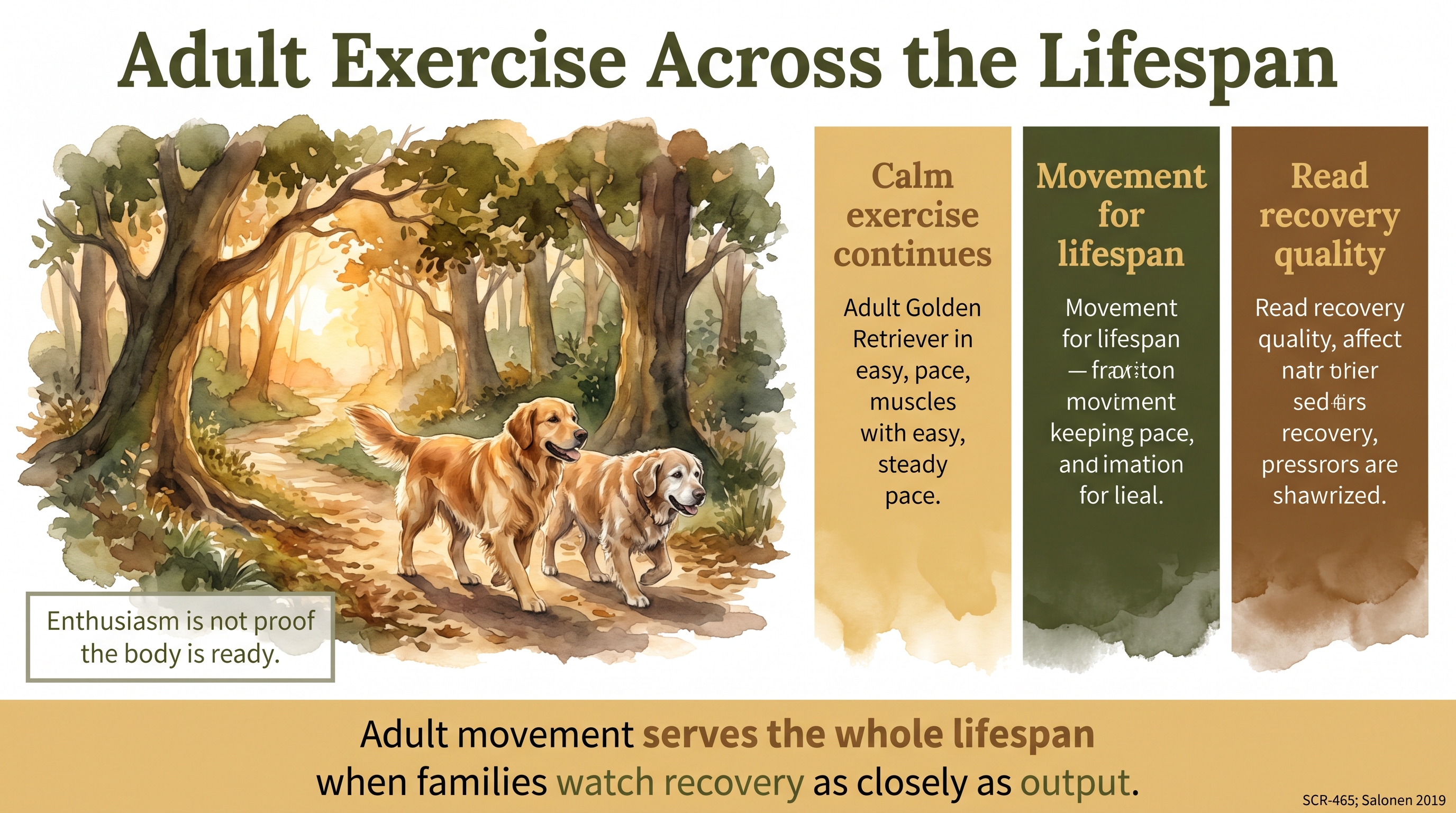
Adult movement serves the whole lifespan when families watch recovery as closely as output.
Key Takeaways
- Adult dogs can do more than adolescents, but adulthood does not erase the need for thoughtful exercise choices.
- Goldens benefit from movement that supports the whole lifespan, not only peak adult performance.
- Recovery quality is often a better guide than enthusiasm when families are deciding how much is still wise.
- The calm-exercise principle continues to serve the dog from adulthood into the senior transition.
The Evidence
- hip and elbow dysplasia literatureGolden Retrievers and dogs
Golden Retrievers carry meaningful orthopedic risk, and body condition plus cumulative movement patterns matter alongside genetics for long-term joint comfort and function. - orthopedic and soft-tissue injury contextdomestic dogs
Repetitive high-impact loading and poor conditioning structure can contribute to injury risk and earlier functional decline.
- JB breeder observationGolden Retrievers
Dogs carried through adulthood on calm moderate exercise often preserve easier movement into the senior transition than dogs whose adult years are dominated by repeated intensity. - JB family practiceadult family dogs
Long walks, moderate natural retrieval, and honest recovery time usually produce more stable whole-life outcomes than exercise patterns built around adrenaline and exhaustion.
No published study directly tests the practical implications of adult exercise across the lifespan for domestic dog raising programs. The application to household dog raising remains an interpretive synthesis rather than a directly tested intervention finding.
SCR References
Sources
- Creevy, K. E., Grady, J., Little, S. E., Moore, G. E., Strickler, B. G., Thompson, S., & Webb, J. A. (2019). 2019 AAHA canine life stage guidelines. Journal of the American Animal Hospital Association, 55(6), 267-290. https://doi.org/10.5326/JAAHA-MS-6999
- American Animal Hospital Association. (2023). 2023 AAHA senior care guidelines for dogs and cats. Journal of the American Animal Hospital Association, 59(1), 1-21. https://doi.org/10.5326/JAAHA-MS-7343
- Kealy, R. D., Lawler, D. F., Ballam, J. M., Mantz, S. L., Biery, D. N., Greeley, E. H., Lust, G., Segre, M., Smith, G. K., & Stowe, H. D. (2002). Effects of diet restriction on life span and age-related changes in dogs. Journal of the American Veterinary Medical Association, 220(9), 1315-1320. https://doi.org/10.2460/javma.2002.220.1315
- Smith, G. K., Paster, E. R., Powers, M. Y., Lawler, D. F., Biery, D. N., Shofer, F. S., McKelvie, P. J., & Kealy, R. D. (2006). Lifelong diet restriction and radiographic evidence of osteoarthritis of the hip joint in dogs. Journal of the American Veterinary Medical Association, 229(5), 690-693. https://doi.org/10.2460/javma.229.5.690
- Creevy, K. E., Grady, J., Little, S. E., Moore, G. E., Strickler, B. G., Thompson, S., & Webb, J. A. (2019). 2019 AAHA canine life stage guidelines. Journal of the American Animal Hospital Association, 55(6), 267-290. https://doi.org/10.5326/JAAHA-MS-6999
- Epstein, M., Kuehn, N. F., Landsberg, G., Lascelles, B. D. X., Marks, S. L., Schaedler, J. M., & Tuzio, H. (2015). 2015 AAHA/AAFP pain management guidelines for dogs and cats. Journal of the American Animal Hospital Association, 51(2), 67-84. https://doi.org/10.5326/JAAHA-MS-7331