Adult Medical Care and the Annual Exam
The annual exam is the center post of adult-dog medical care. It is not just the visit where vaccines are updated or a prescription gets renewed. It is the recurring point where weight, body condition, teeth, skin, ears, heart, mobility, parasite control, behavior changes, and age-related risk all get looked at together by the veterinarian who knows the dog. Documented
JB likes this visit for the same reason good medicine does: problems are easier to understand earlier than later. Documented But JB also adds something relational. The veterinary visit should remain an extension of the calm floor, not a once-a-year emotional derailment.
What It Means
What the Annual Exam Anchors
At minimum, the adult annual visit usually gives the family and veterinarian a chance to review weight and body condition, physical exam findings, dental health, vaccine intervals, parasite prevention and testing, skin/ears/eyes/coat, mobility changes, and basic laboratory screening when age and history warrant it. Observed-JB
That list looks ordinary because it is. Ordinary is exactly what makes it valuable. Many serious problems enter family life as small changes long before they become dramatic disease. Documented
Why This Matters Especially in Goldens
Golden Retrievers deserve particularly thoughtful adult medical stewardship because the breed carries a real burden of later-life disease, especially cancer. That does not mean every annual exam is a hunt for catastrophe. It means routine physical examination, careful palpation of new masses, body-condition tracking, and age-appropriate screening conversations matter.
The family should feel comfortable asking simple direct questions: Has anything changed since last year that you want us watching more closely? Is this the age to add baseline bloodwork if we have not already? Are there mobility or body-condition adjustments we should make now rather than later? Does this dog's age or history change how often you want to see him? Those are not anxious questions. They are grown-up stewardship questions.
Cardiac and Ophthalmic Context
The annual visit is also where broader screening judgment lives. Goldens have breed-relevant cardiac and ophthalmic considerations, and while not every dog needs every test every year, the family benefits from a veterinarian who knows when a murmur, a history, or an age shift should prompt additional evaluation.
That can include discussion of:
- cardiac auscultation findings and whether referral echocardiography is indicated
- ophthalmic concerns or referral when vision or ocular exam findings change
- senior screening plans as the dog crosses out of mid-adulthood
JB does not want families either under-medicalizing or over-medicalizing. The middle path is relationship with a veterinarian who sees the dog regularly enough to notice change in proportion.
Bloodwork, Screening, and the Anxiety Problem
One reason families sometimes drift away from good annual care is that medicine can feel like an invitation to worry. JB understands that pressure, but it does not endorse avoidance. The answer to anxiety is not to stop looking. It is to look calmly and in context.
Baseline bloodwork in adulthood can be useful precisely because it gives later changes something to be compared against. Screening is not a guarantee that disease will be prevented or caught early in every case. It is a way of reducing blind spots.
That distinction matters. JB does not promise that more tests always mean better outcomes. It does say that routine, age-appropriate partnership with a veterinarian is part of carrying the dog honestly through life.
The Visit Itself Should Stay Calm
Families often think the medical content is the main story. The emotional quality of the visit matters too. The dog who arrives in a state of frantic tension is already having a harder experience before the veterinarian even enters the room. Many dogs can be helped enormously by very simple continuity: calm loading and unloading, not turning the waiting room into a social event, giving the dog time to orient in the room, and handling with the same quiet tone the family uses at home.
This does not replace veterinary skill. It makes the dog's body more available to that skill.
The annual exam works best when the family treats the clinic as one more place where the dog can remain itself. Calm handling does not make medicine less serious. It makes the dog easier to assess and easier to care for.
What This Is Not
This page is not saying every adult dog needs an expansive annual testing panel regardless of age, symptoms, or history, and it is not saying normal annual care can abolish Golden Retriever disease burden. It is not making the breeder the veterinarian. The breeder can be a valuable sounding board, especially around breed context and family history. The veterinarian still holds the medical role.
Why It Matters for Your Dog
The annual exam is where prevention, observation, and relationship meet. The dog gets a real medical review. The family gets perspective. The veterinarian gets a longitudinal picture instead of a crisis-only snapshot. Over years, that continuity matters.
The annual visit also quietly trains the family into a better adult posture with the dog. Not panic. Not neglect. Ongoing stewardship. That is exactly the right medical tone for the middle years.
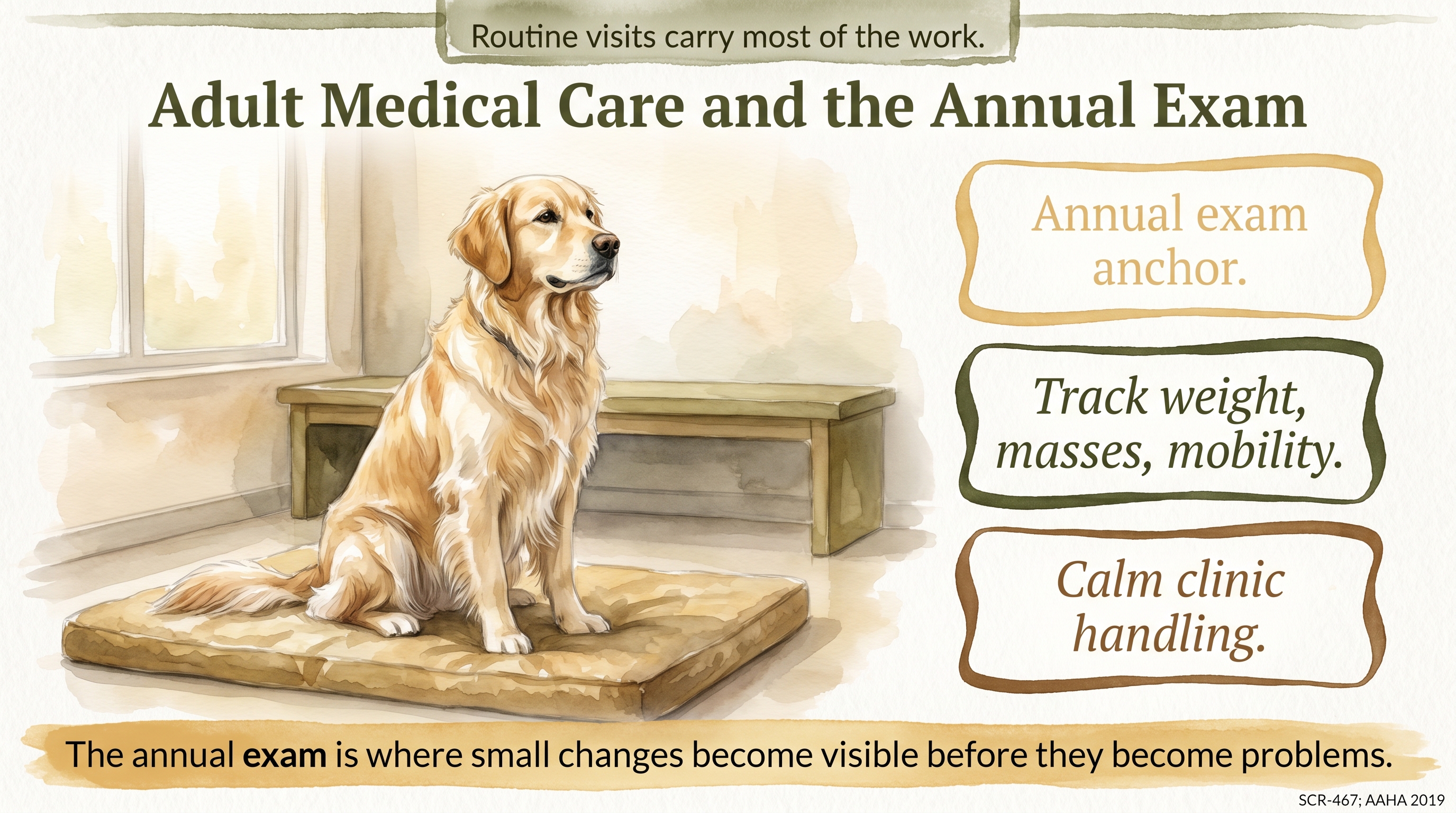
The annual exam is where small changes become visible before they become problems.
Key Takeaways
- The annual exam is the anchor of adult medical care because it brings routine observation, screening judgment, and continuity together.
- In Goldens, serial attention to weight, new masses, mobility, and age-appropriate screening matters because the breed carries substantial later-life disease burden.
- Calm clinic handling improves the dog's experience and often improves the quality of the visit itself.
- The breeder can support perspective, but the veterinarian remains the medical authority for adult-care decisions.
The Evidence
- veterinary wellness guidancedogs
Routine wellness examinations support earlier recognition of changes in weight, dental status, mobility, organ function, and emerging disease risk across adulthood and aging. - Golden longevity and cancer contextGolden Retrievers
Because Goldens carry substantial cancer burden and meaningful later-life disease risk, careful serial physical examination and age-appropriate screening conversations are clinically important. - cardiac screening methodologydogs and Golden Retrievers
Cardiac findings such as murmurs may warrant more specific evaluation, and echocardiographic methodology matters when deciding how cardiac concerns should be investigated.
- JB breeder observationGolden Retrievers
Annual veterinary care works best for families when it is approached as calm ongoing stewardship rather than as a once-a-year emergency drill.
No published study directly tests the practical implications of adult medical care and the annual exam for domestic dog raising programs. The application to household dog raising remains an interpretive synthesis rather than a directly tested intervention finding.
SCR References
Sources
- Creevy, K. E., Grady, J., Little, S. E., Moore, G. E., Strickler, B. G., Thompson, S., & Webb, J. A. (2019). 2019 AAHA canine life stage guidelines. Journal of the American Animal Hospital Association, 55(6), 267-290. https://doi.org/10.5326/JAAHA-MS-6999
- American Animal Hospital Association. (2023). 2023 AAHA senior care guidelines for dogs and cats. Journal of the American Animal Hospital Association, 59(1), 1-21. https://doi.org/10.5326/JAAHA-MS-7343
- Fleming, J. M., Creevy, K. E., & Promislow, D. E. L. (2011). Mortality in North American dogs from 1984 to 2004: An investigation into age-, size-, and breed-related causes of death. Journal of Veterinary Internal Medicine, 25(2), 187-198. https://doi.org/10.1111/j.1939-1676.2011.0695.x
- Orthopedic Foundation for Animals. (n.d.). Cardiac disease. https://ofa.org/diseases/cardiac-disease/
- Creevy, K. E., Grady, J., Little, S. E., Moore, G. E., Strickler, B. G., Thompson, S., & Webb, J. A. (2019). 2019 AAHA canine life stage guidelines. Journal of the American Animal Hospital Association, 55(6), 267-290. https://doi.org/10.5326/JAAHA-MS-6999
- Labadie, J. D., Elser, B., Brown, D. C., Vogel, C., Armstrong, J., O'Brien, D. P., Krick, E., Schliekelman, P., Thamm, D. H., & Trepanier, L. A. (2022). Cancer mortality in a cohort of Golden Retrievers: A prospective study from the Golden Retriever Lifetime Study. PLOS ONE, 17(6), e0269425. https://doi.org/10.1371/journal.pone.0269425