Vaccination Science
Compound evidence detail1 SCR / 2 parts
- Documentedthe WSAVA Vaccination Guidelines Group canonical framework - canine distemper, adenovirus, parvovirus, and rabies as core; leptospirosis, Bordetella, canine influenza, and Lyme as risk-stratified non-core; the puppy-series final dose timed at 16 weeks of age or later because earlier doses can fail in puppies with persisting maternal antibody; the three-year minimum protective duration for the core modified-live formulations; and rabies vaccination's legal-mandate status not validated for titer substitution in most jurisdictions
- Documentedserologic titer testing for canine distemper, adenovirus, and parvovirus as a valid but incomplete post-vaccination protection assessment that does not replace rabies vaccination and is best used in informed conversation with a veterinarian
Vaccination is one of the clearest examples of preventive medicine working exactly the way people hope medicine will work. When the schedule is followed appropriately, serious infectious disease risk drops dramatically. The confusion families run into usually comes from one of two places: not understanding why the puppy series takes multiple visits, or hearing internet-era skepticism imported from human anti-vaccine culture. The science on routine canine core vaccination is much stronger than the confusion around it. Documented
What It Means
The Core Versus Non-Core Distinction
Modern canine vaccination starts with a simple framework.
Core vaccines are the ones recommended for essentially all dogs because the diseases are severe and the protection is foundational. In practice that means distemper; parvovirus; adenovirus; and rabies, which is also shaped by law as well as medicine.
Non-core vaccines are recommended based on geography, environment, and lifestyle. Common examples include leptospirosis, Bordetella, Lyme, and canine influenza.
The point is not that non-core vaccines are optional in some vague anti-vaccine sense. The point is that they are risk-based rather than universal.
Why the Puppy Series Exists
Families often ask why a puppy needs repeated doses if vaccines work so well. Observed-JB The answer is maternal derived antibodies, usually shortened to MDA.
The dam gives the puppy passive antibody protection early in life. That is helpful, but it creates a timing problem. Those maternal antibodies can also neutralize vaccine antigen before the puppy's own immune system has a chance to respond.
So the puppy series is not repetition for its own sake. It is a timing strategy designed to ensure that at least one dose lands after maternal interference has dropped low enough for the puppy to mount durable active immunity.
That is why the series is about immunologic timing, not weakness of the vaccine.
The Typical Core Schedule
The exact timing can vary a little by veterinarian and local risk, but the modern pattern is familiar first doses in early puppyhood; repeat boosters through the vulnerable maternal-antibody window; a final puppy-series dose at or after 16 weeks; a one-year booster; and then longer revaccination intervals for core vaccines. Documented
This is also why the 16-week milestone matters so much. It closes most of the maternal-antibody gap.
Why Core Boosters Are Not Annual Forever
One of the important changes in modern vaccine guidance is the recognition that core duration of immunity is longer than older annual habits implied. Documented
For properly immunized dogs core protection lasts years, not just months; annual revaccination for core antigens is usually unnecessary; and three-year revaccination intervals are now standard in many protocols after the one-year booster. Observed-JB
That shift is evidence-based, not casual under-vaccination.
Titer Testing
Titer testing sits in the middle of a real professional difference in emphasis.
The general idea is simple: measure antibody evidence of protection instead of automatically vaccinating again. The practical nuance is that titers are more straightforward for some core antigens than for others, and point-of-care test performance is not identical across distemper, parvovirus, and adenovirus.
So a good family-level summary is titer testing can be a useful option in some settings; it is not a universal replacement for schedule-based decisions; and it is worth discussing rather than assuming.
Why It Matters for Your Dog
Non-Core Vaccines Need Real Risk Assessment
This is where geography and lifestyle matter more than ideology.
A New England Golden may reasonably have non-core vaccine conversations around Lyme, because the tick reality is real; leptospirosis, depending on wildlife and water exposure; and Bordetella, depending on training classes, boarding, daycare, or shows.
The right question is not "Do you believe in this vaccine?" The right question is "Does my dogs actual risk profile justify it?"
The Socialization Question
One of the most practically useful evidence points already formalized in the SCR is that vaccinated puppies attending carefully controlled socialization classes were not at greater parvovirus risk than vaccinated puppies who did not attend. Documented
That matters because it helps families escape a false choice between protect health; and socialize developmentally on time.
With controlled exposure, those goals do not have to be enemies.
Adverse Events
No medical intervention is risk-free, but routine canine vaccine adverse events are uncommon and usually mild. Families should know that the realistic frame is vaccines work; serious adverse reactions are rare; and the diseases they prevent are much worse than the usual vaccine downside.
That is the adult, evidence-led way to think about risk.
Why This Page Matters for Golden Families
Golden families often juggle multiple realities at once breeder vaccine history; first-year socialization needs; non-core New England exposure questions; and internet advice of uneven quality.
This page is meant to create grounding. Vaccination should be a serious conversation, but not an anxious or ideological one.
When to See a Veterinarian
Call or see your veterinarian promptly if a puppy develops facial swelling; hives; repeated vomiting after vaccination; collapse; breathing difficulty; and marked lethargy that does not lift quickly.
Most mild soreness or a quieter day is not an emergency. Progressive swelling, respiratory signs, or systemic illness are.
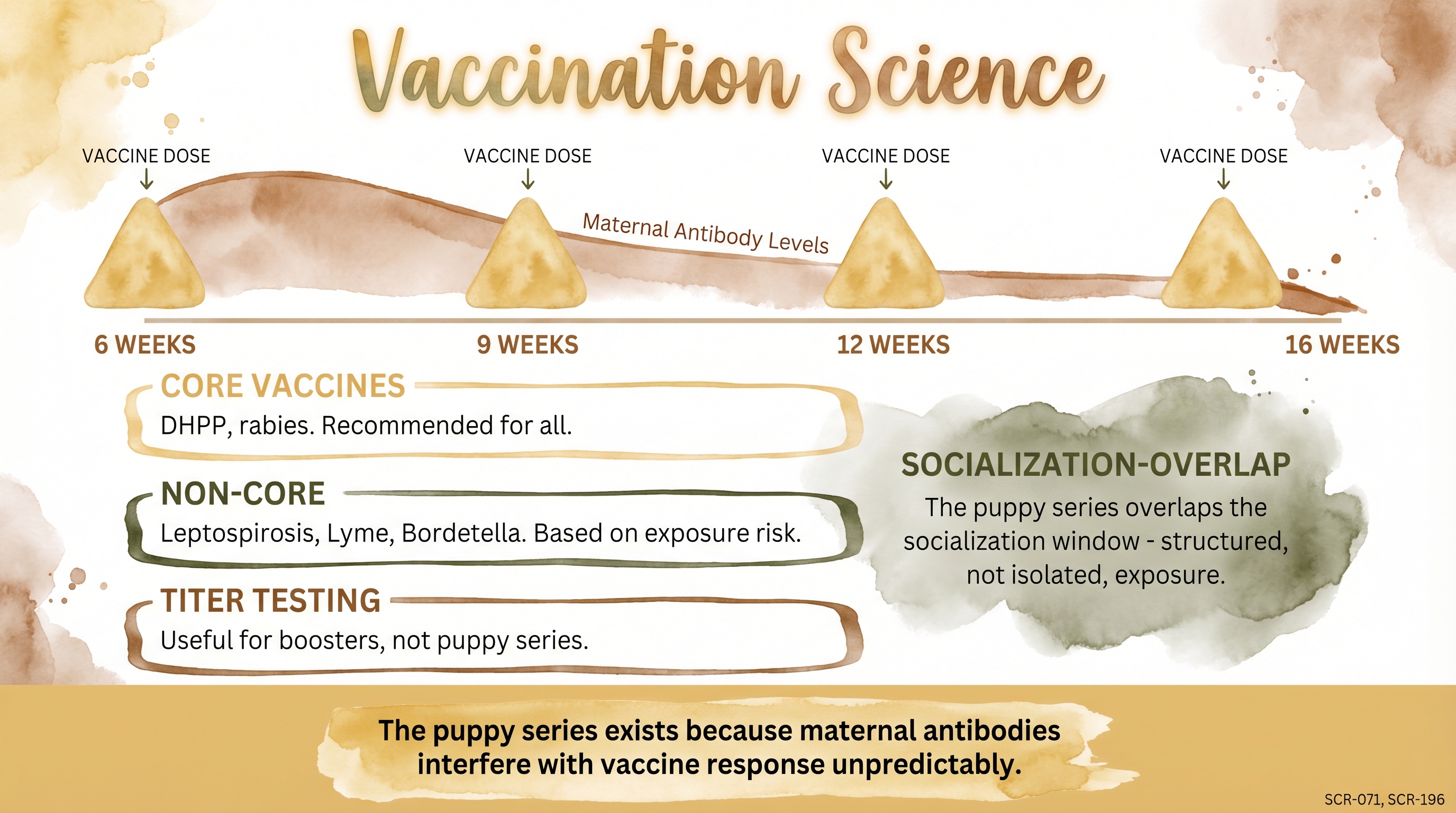
The puppy series exists because maternal antibodies interfere with vaccine response unpredictably.
Key Takeaways
- The puppy vaccine series is driven by maternal-antibody timing, not by weakness of the vaccines themselves.
- Core vaccines are universal; non-core vaccines are risk-based and should follow geography and lifestyle.
- Modern core-booster intervals are longer than the old annual habit because duration-of-immunity evidence improved the schedule.
- Controlled early socialization can coexist with evidence-based vaccination rather than forcing families into isolation during the whole series.
The Evidence
This entry uses observed claim-level tags beyond the dedicated EvidenceBlocks below. These tags mark JB program observation or practice-derived claims that need dedicated EvidenceBlock coverage in a later content pass.
- Puppy-health source synthesisdogs
The puppy core-vaccine series exists because maternal antibodies interfere variably with vaccine response, making repeated timing windows necessary rather than redundant. - Guideline consensusdogs
Modern AAHA and WSAVA guidance supports core vaccination for all dogs, final puppy-series dosing at or after 16 weeks, and multi-year revaccination intervals after the one-year booster. - SCR-071 supportdogs
Vaccinated puppies in carefully controlled socialization classes were not at greater parvovirus risk than vaccinated puppies not attending such classes.
- Puppy-health source synthesisdogs
Titer testing can be useful for some post-puppy core decisions, but test characteristics differ by antigen and the professional emphasis is not identical across guidelines. - Non-core vaccine logicdogs
Non-core vaccination decisions should be driven by geography and lifestyle rather than by a universal yes-or-no attitude toward all optional vaccines.
- domestic dogs
No published study directly tests which preventive-care approach for vaccination science produces the best long-term outcome across all Golden Retriever households and clinical settings.
SCR References
Sources
- American Animal Hospital Association. (2022). 2022 AAHA canine vaccination guidelines. https://www.aaha.org/resources/2022-aaha-canine-vaccination-guidelines/
- Creevy, K. E., Grady, J., Little, S. E., Moore, G. E., Strickler, B. G., Thompson, S., & Webb, J. A. (2019). 2019 AAHA canine life stage guidelines. Journal of the American Animal Hospital Association, 55(6), 267-290. https://doi.org/10.5326/JAAHA-MS-6999
- Ellis, J., Marziani, E., Aziz, C., Brown, C. M., Cohn, L. A., Lea, C., Moore, G. E., & Taneja, N. (2022). 2022 AAHA canine vaccination guidelines. Journal of the American Animal Hospital Association, 58(5), 213-230. https://www.aaha.org/resources/2022-aaha-canine-vaccination-guidelines/