The First Veterinary Visit
The first veterinary visit is one of the most important examples of a month-one event that is medical and social at the same time. A clinic appointment is not only about a physical exam. It is also the puppy's first encounter with strange smells, unfamiliar handling, and a new adult who will touch the body in ways the family cannot fully choreograph. JB therefore treats the visit as part of the soft landing rather than as an interruption to it. Observed-JB
What It Means
Families often think of the first vet visit in only one frame: check the puppy, meet the local clinic, and review vaccines and deworming. Observed-JB
All of that matters.
But from the puppy's point of view, another layer matters just as much: car ride, waiting room, exam table, restraint by a stranger, and needles or thermometers or oral handling.
That is a lot for a young nervous system in its first month.
The Visit Is Practice for the Next Ten Years
This is the deepest practical reason the page exists.
The first clinic experience is not a one-off hurdle. It is part of the dog's long-term learning about veterinary care itself. Observed-JB If the first appointment becomes a noisy social event or a fearful scramble, that can color later visits. If the first appointment feels calm, contained, and matter-of-fact, the family begins building a far better baseline.
Calm Starts Before the Parking Lot
The appointment does not begin when the exam-room door closes.
It begins when the family leaves the house.
That means: the car ride should stay low-key, loading and unloading should be deliberate, the adults should keep their voices ordinary, and nobody should perform reassurance in a way that communicates alarm.
Many puppies read the humans long before they understand the clinic.
If the adults become tense, chirpy, apologetic, or theatrically soothing, the puppy learns that the environment deserves alarm.
Waiting Rooms Matter
The modern clinic waiting room can easily become too much: strange dogs, excited clients, staff movement, unfamiliar scents, and noise from several directions.
JB's practical posture is simple: arrive early enough to settle a little, choose space over socializing, keep the puppy near the family, not on public display, and ask for a quieter exam room when the clinic can accommodate it.
This is not anti-social behavior. It is state management.
The Family's Job in the Exam Room
The family cannot control every part of the appointment, but it controls more than it thinks.
Its job is to bring the same relational language the puppy already knows: calm body, low voice, matter-of-fact touch, no frantic petting, and no emotional speeches during routine procedures.
Handling continuity helps enormously here. Puppies who have had paws, mouths, ears, bellies, and brief restraint touched calmly at home often arrive with a much better starting point for veterinary handling than families realize. Observed-JB
What the Visit Is Not
It is not a party.
It is not the moment for the puppy to meet every receptionist, every client, and every dog in the lobby.
That common human instinct is understandable. People are proud of the puppy. Clinics feel communal. But turning the appointment into a social showcase can attach the wrong kind of arousal to a place the dog will revisit for the rest of its life. Observed-JB
The Timing Question
There is also an evidence boundary worth keeping clean. The common advice to have the puppy seen very soon after arrival is a strong practice norm and often a breeder-contract expectation, but the literature does not give a controlled trial defining the perfect post-rehoming day for a first exam in well-bred puppies entering prepared homes.
That means JB can be sensible without pretending there is an exact science here.
The wiser point is not "which exact day is proven best."
It is "whatever day the visit occurs, handle it calmly."
Why It Matters for Your Dog
The first veterinary visit matters because it sets a tone that can compound for years.
A puppy that learns the clinic is a place where adults stay readable, transport is orderly, and body handling remains calm will usually carry a more workable expectation into later care. A puppy that learns the clinic is an overwhelming event can begin rehearsing the opposite.
The practical benefits are obvious: easier wellness visits, easier vaccine appointments, easier injury checks, and easier aging care later in life.
But the emotional benefit matters too. A dog that can accept veterinary handling more easily lives a less stressful medical life.
This is why month-one JB thinking extends into places families might assume are outside philosophy. Even a vet visit can either preserve signal continuity or break it.
A calm appointment does not mean a perfect appointment. The puppy may still protest or wiggle. The point is not to eliminate all discomfort. The point is to stop humans from adding more emotional noise than the event itself already contains.
That is how stewardship and soft landing meet.
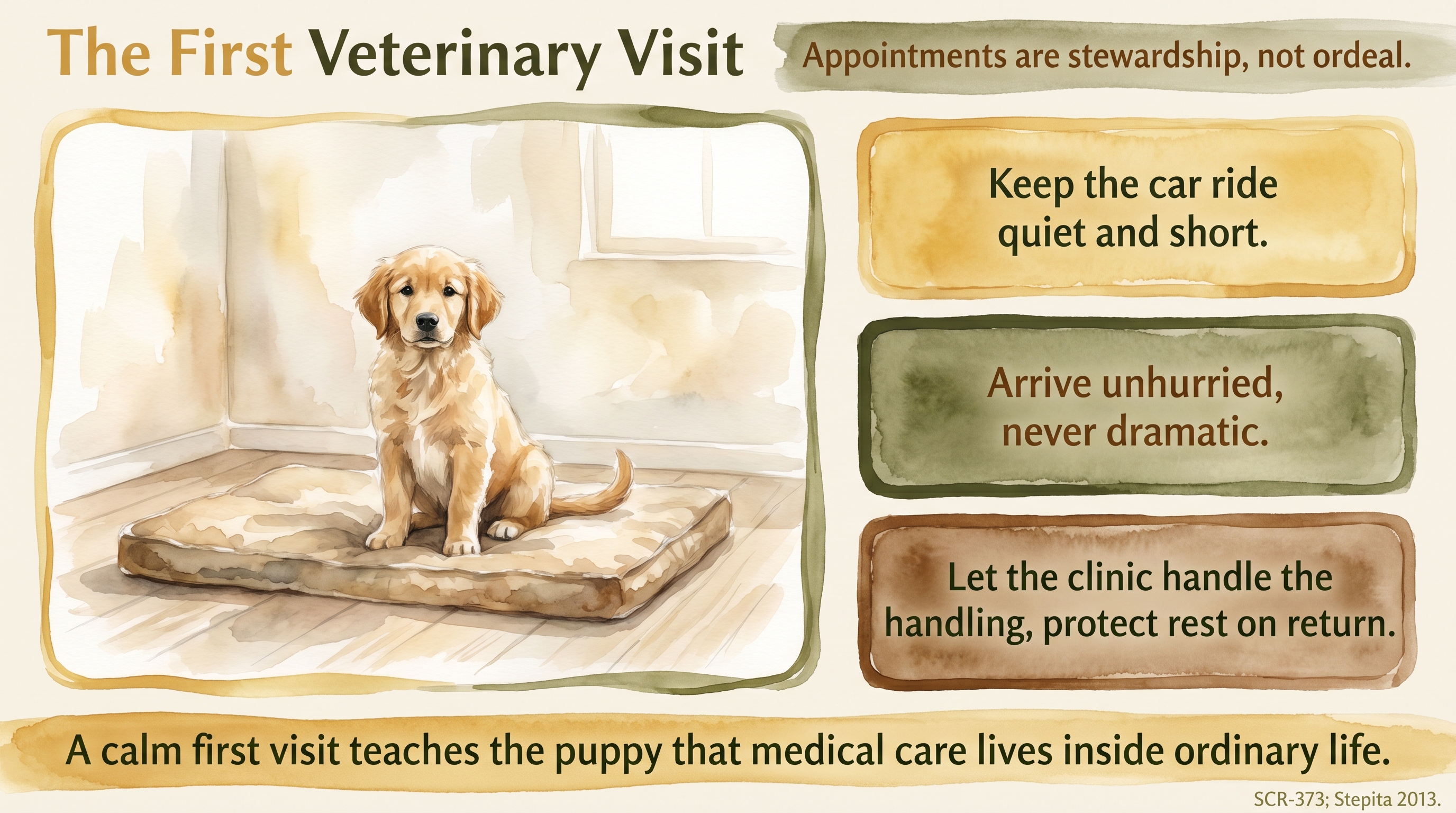
A calm first visit teaches the puppy that medical care lives inside ordinary life.
Key Takeaways
- The first veterinary visit is both a medical appointment and a social-learning event for the puppy.
- The family can improve the visit substantially by keeping transport, waiting-room behavior, and exam-room support calm and ordinary.
- The goal is not to make the clinic exciting or perfectly pleasant; it is to make it readable, contained, and low-drama.
- A calmer first clinic experience helps build a better baseline for every veterinary visit that follows over the dog's lifetime.
The Evidence
- WSAVA (2024); AAHA (2022); Schultz (2006); Stepita et al. (2013)domestic dogs
The first-month veterinary relationship is a normal part of puppy care, but no controlled trial defines the exact optimal post-rehoming day for a first exam in breeder-raised puppies. - Vaterlaws-Whiteside & Hartmann (2017); Stolzlechner et al. (2022); Mariti et al. (2020); Freedman et al. (1961)domestic dogs
Predictable caregiver behavior and calmer handling support better adjustment during novel and potentially stressful events.
- JB family-coaching observationfamily-raised puppies
Low-arousal transport, quiet waiting-room behavior, and matter-of-fact support from the family during the exam produce better clinic baselines than turning the first visit into a major social event.
No published study directly tests the specific Just Behaving guidance on first veterinary visit. This entry relies on broader canine evidence, breeder observation, and practical synthesis.
SCR References
Sources
- Squires, R. A., Crawford, C., Marcondes, M., & Whitley, N. (2024). 2024 guidelines for the vaccination of dogs and cats - compiled by the Vaccination Guidelines Group (VGG) of the World Small Animal Veterinary Association (WSAVA). Journal of Small Animal Practice, 65(5), 277-316. https://doi.org/10.1111/jsap.13718
- Ellis, J., Marziani, E., Aziz, C., Brown, C. M., Cohn, L. A., Lea, C., Moore, G. E., & Taneja, N. (2022). 2022 AAHA Canine Vaccination Guidelines. Journal of the American Animal Hospital Association, 58(5), 213-230. https://doi.org/10.5326/JAAHA-MS-Canine-Vaccination-Guidelines
- Schultz, R. D. (2006). Duration of immunity for canine and feline vaccines: a review. Veterinary Microbiology, 117(1), 75-79. https://doi.org/10.1016/j.vetmic.2006.04.013
- Stepita, M. E., Bain, M. J., & Kass, P. H. (2013). Frequency of CPV infection in vaccinated puppies that attended puppy socialization classes. Journal of the American Animal Hospital Association, 49(2), 95-100. https://doi.org/10.5326/JAAHA-MS-5825
- Vaterlaws-Whiteside, H., & Hartmann, A. (2017). Improving puppy behavior using a new standardized socialization program. Applied Animal Behaviour Science, 197, 55-61.
- Stolzlechner, L., Bonorand, A., & Riemer, S. (2022). Optimising Puppy Socialisation-Short- and Long-Term Effects of a Training Programme during the Early Socialisation Period. Animals, 12(22), 3067. https://doi.org/10.3390/ani12223067
- Mariti, C., Lenzini, L., Carlone, B., Zilocchi, M., Ogi, A., & Gazzano, A. (2020). Does attachment to man already exist in 2 months old normally raised dog puppies? A pilot study. Dog Behavior, 6(1), 1-11. https://doi.org/10.4454/db.v6i1.96
- Freedman, D. G., King, J. A., & Elliot, O. (1961). Critical period in the social development of dogs. Science, 133(3457), 1016-1017.