Gonadectomy Timing: The Evidence Base
Compound evidence detail3 SCRs / 7 parts
- Documentedthe directional finding from the Hart UC Davis cohorts that Golden Retrievers neutered before approximately 6 months show roughly four- to fivefold higher combined joint-disorder incidence (HD, CCL, ED aggregated) versus intact dogs of the same breed - acknowledged as a referral-hospital retrospective signal that establishes direction and approximate magnitude rather than population-level absolute risk
- Estimatedthe per-disease component breakdowns drawn from the same retrospective cohorts - hip dysplasia roughly three- to fourfold elevated, cranial cruciate ligament rupture rising from approximately 0% intact to 5-9% in early-neutered subgroups, and elbow dysplasia roughly 6% versus 2% - all carrying small-cell-size confidence-interval limits and referral-population caveats
- Documentedthe individual cancer-by-timing signals from the Hart Golden-Retriever cohorts - male lymphoma peaking at 6-11-month neutering (relative risk approximately 2.88), female hemangiosarcoma rising in late-spayed females (relative risk approximately 6.10), female mast-cell-tumor rising from 0% intact to roughly 6% late-spayed (relative risk approximately 4.46) - each presented with its retrospective-cohort confidence interval intact
- Heuristicthe composite synthesis that no single Golden Retriever gonadectomy timing window simultaneously minimizes joint, cancer, and reproductive risks - presented as a family-veterinarian trade-space conversation rather than as a prescriptive timing recommendation
- EstimatedUSMI prevalence figures across spayed large-breed female populations and the body-weight odds ratio derived from multi-breed retrospective and case-control samples
- Observed-JBthe Golden-Retriever-specific timing pattern in which incontinence clusters in females spayed before approximately 6-12 months versus intact and late-spayed cohorts
- Estimatedthe VetCompass target-trial-emulation odds reduction for later neutering, presented as a recent causal-inference result whose magnitude remains under refinement
Gonadectomy timing is one of the clearest examples of veterinary advice changing because the evidence changed. For years, the default family message was simple: spay or neuter early, often around six months, and do not overcomplicate it. That simplicity had practical appeal, but it turned out not to fit all breeds equally well. Golden Retrievers are one of the breeds where the old default aged poorly under direct outcome data. Mixed Evidence
What It Means
What This Page Is and Is Not
This page is an evidence overview, not an instruction to choose one exact age. The science no longer supports a single universal number for every breed, sex, and household. It also does not support pretending the decision is medically neutral.
The honest frame is this the timing question has real orthopedic, oncologic, urinary, and behavioral implications; those implications differ by breed and sex; and Goldens are one of the breeds where the trade-offs are especially meaningful.
Why the Conversation Changed
The modern shift happened when researchers stopped treating all dogs as one population and began asking breed-specific timing questions. That matters because the endocrine role of ovaries and testes during development is not an abstract detail. Gonadal hormones influence growth-plate closure, tissue maturation, and some aspects of later physiologic profile.
Once studies began looking directly at large breeds and then specifically at Golden Retrievers, it became much harder to defend a simple early-age default as if it carried the same risk profile everywhere. Documented
The Main Golden Findings
The current SCR supports several core conclusions that every Golden family should know.
Early gonadectomy is associated with increased joint-disorder risk in Goldens. Cancer signals in Goldens vary by sex, timing, and cancer type rather than moving in one simple direction. Acquired urinary incontinence is disproportionately a spayed-female problem, especially in larger dogs. And the common belief that gonadectomy reliably fixes aggression is not supported by the evidence.
That combination is why the decision has become a real trade-space rather than a ritual.
Why Breed and Sex Matter
One of the biggest mistakes in this topic is borrowing population-level guidance from other breeds and treating it as if Goldens must behave the same way.
They do not.
A small-breed dog may show little orthopedic consequence from early gonadectomy. Documented A Golden may show much more. Male lymphoma signals and female hemangiosarcoma signals do not look identical. Urinary incontinence is primarily a female issue. Hormone-sparing alternatives introduce another branch of the conversation entirely.
So the evidence base itself now pushes toward individualized rather than universal timing discussion.
What the Evidence Does Not Support
It is also important to say what the evidence does not reliably support.
The literature does not support the old confident claim that gonadectomy broadly solves behavior problems. Documented The SCR is explicit that aggression reduction is not a reliable outcome. It also supports a more cautionary behavioral story around fearfulness and noise sensitivity after early gonadectomy in some datasets.
That does not mean every gonadectomized dog becomes fearful. It does mean the behavioral-benefit sales pitch should be treated skeptically.
Why It Matters for Your Dog
Why This Became Politically Charged
Families often encounter this topic in a polarized form one side treats any delay as irresponsible; and the other side treats any surgery as obviously harmful.
Neither posture fits the evidence well.
The stronger scientific posture is more patient. It recognizes real benefits to sterilization in some domains, real costs in others, and meaningful differences depending on whether the dog is a Golden male, a Golden female, a multi-dog household dog, or a dog in circumstances where accidental breeding risk is unusually high. Documented
The Goldens-Specific Bottom Line
For Goldens, the literature no longer supports "just do it early and do not think too hard about it." The data are too breed-specific and too consequence-specific for that.
What the evidence supports more comfortably is a substantive breed-aware conversation with a veterinarian; explicit discussion of sex-specific and timing-specific trade-offs; awareness that the joint-disorder signal is especially strong in this breed; awareness that the cancer story is real but not linear; and awareness that urinary incontinence and behavior claims should not be ignored.
That is a more demanding answer than the old default. It is also a more honest one.
Hormone-Sparing Alternatives
The conversation has become more nuanced partly because traditional ovariohysterectomy and castration are no longer the only theoretical options. Hormone-sparing procedures such as ovary-sparing spay and vasectomy are now part of the literature.
The key point is not that they are automatically the right choice. The key point is that the field is now openly asking whether sterilization and hormone removal always need to be bundled into the same decision.
That is a major conceptual shift from older practice.
What Families Should Do With This Page
This page is meant to improve the quality of the conversation, not to end it.
A useful next-step conversation with a veterinarian includes the dogs breed and sex, household management realities, tolerance for heat-cycle management in females, orthopedic priorities, cancer and urinary concerns, and whether hormone-sparing options are realistically available. Documented
That is a real medical decision. It deserves more than inherited habit.
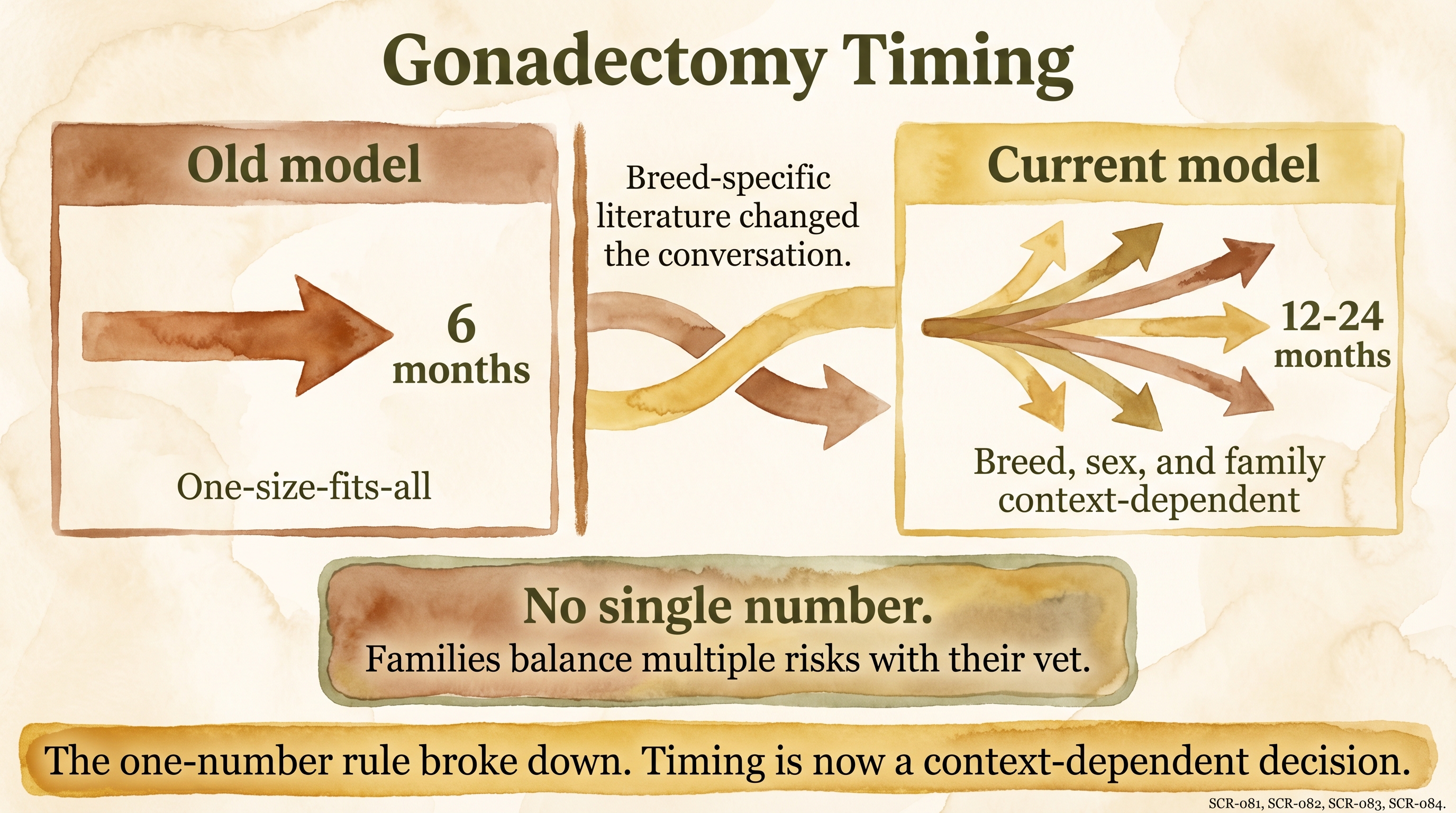
The one-number rule broke down - timing is now a context-dependent decision.
Key Takeaways
- The old one-size-fits-all early-spay-neuter model is not a good fit for Golden Retrievers under current evidence.
- In Goldens, timing matters because joint, cancer, urinary, and behavioral effects do not all move in the same direction or with the same strength.
- The evidence does not support treating gonadectomy as a reliable fix for aggression and does raise caution around some fear-related outcomes.
- The right next step is a breed-specific veterinary conversation rather than defaulting to habit or ideology.
The Evidence
- SCR-081 supportGolden Retrievers
Early gonadectomy is associated with a markedly higher joint-disorder burden in Goldens than intact baseline. - SCR-082 supportGolden Retrievers
Cancer effects in Goldens are timing-, sex-, and cancer-specific rather than following one simple earlier-versus-later rule. - SCR-083 supportdogs
Gonadectomy does not reliably reduce aggression across the broad dog population. - SCR-084 supportdogs
Early gonadectomy is associated in multiple datasets with higher fearfulness and noise-related problems. - SCR-086 supportdogs
Hormone-sparing procedures can preserve more intact-like health profiles than traditional gonadectomy in available outcome data.
- SCR-085 supportdogs and Golden Retrievers
Urinary incontinence risk is meaningfully relevant in larger spayed females, with Golden-specific clustering in earlier-spayed groups, but the exact prevalence language remains more estimated than fully settled. - Spay-neuter source synthesisGolden Retrievers
The overall timing decision is best understood as a trade-space rather than a single answer because different outcome domains move in different directions.
- domestic dogs
No published study directly resolves every practical trade-off families face when using gonadectomy timing: the evidence base across sex, breed, household, and management contexts.
SCR References
Sources
- Torres de la Riva, G., Hart, B. L., Farver, T. B., Oberbauer, A. M., Messam, L. L. M., Willits, N., & Hart, L. A. (2013). Neutering dogs: Effects on joint disorders and cancers in Golden Retrievers. PLOS ONE, 8(2), e55937. https://doi.org/10.1371/journal.pone.0055937
- Hart, B. L., Hart, L. A., Thigpen, A. P., & Willits, N. H. (2014). Long-term health effects of neutering dogs: Comparison of Labrador Retrievers with Golden Retrievers. PLOS ONE, 9(7), e102241. https://doi.org/10.1371/journal.pone.0102241
- Hart, B. L., Hart, L. A., Thigpen, A. P., & Willits, N. H. (2020). Assisting decision-making on age of neutering for 35 breeds of dogs: Associated joint disorders, cancers, and urinary incontinence. Frontiers in Veterinary Science, 7, 388. https://doi.org/10.3389/fvets.2020.00388
- Forsee, K. M., Davis, G. J., Mouat, E. E., Salmeri, K. R., & Bastian, R. P. (2013). Evaluation of the prevalence of urinary incontinence in spayed female dogs: 566 cases (2003-2008). Journal of the American Veterinary Medical Association, 242(7), 959-962. https://doi.org/10.2460/javma.242.7.959
- Farhoody, P., Mallawaarachchi, I., Tarwater, P. M., Serpell, J. A., Duffy, D. L., & Zink, C. (2018). Aggression toward familiar people, strangers, and conspecifics in gonadectomized and intact dogs. Frontiers in Veterinary Science, 5, 18. https://doi.org/10.3389/fvets.2018.00018
- Zink, M. C., Farhoody, P., Elser, S. E., Ruffini, L. D., Gibbons, T. A., & Rieger, R. H. (2014). Evaluation of the risk and age of onset of cancer and behavioral disorders in gonadectomized Vizslas. Journal of the American Veterinary Medical Association, 244(3), 309-319. https://doi.org/10.2460/javma.244.3.309
- Zink, C., Delgado, M. M., & Stella, J. L. (2023). Vasectomy and ovary-sparing spay in dogs: Comparison of health and behavior outcomes with gonadectomized and sexually intact dogs. Journal of the American Veterinary Medical Association, 261(3), 366-374. https://doi.org/10.2460/javma.22.08.0382