Neutering Timing: The Golden Retriever Conversation
This is one of the first adolescence questions families ask with real urgency: when should we neuter?
The honest JB answer is not a single age. It is a conversation.
Golden Retriever families often arrive having heard two competing simplifications. One says neuter early because it is cleaner, safer, and behaviorally easier. The other says never neuter early because it ruins the dogs joints and causes cancer. Neither simplification respects the actual literature. Documented The Golden Retriever data is important and genuinely worth taking seriously. It is also retrospective, population-limited, and more complicated than internet certainty usually admits. This page stays at the correct ceiling: [Ambiguous].
What It Means
Why This Question Matters More in Goldens
Golden Retrievers sit in a breed zone where growth, orthopedic vulnerability, and some tracked cancer outcomes matter enough that timing cannot be treated as trivial. The best-known studies, especially the UC Davis hospital cohort work associated with Hart and colleagues, reported meaningful associations between neutering timing and later health outcomes in Goldens.
The orthopedic signal is the clearest place to begin. In those cohorts, early neutering, especially before six months, was associated with higher rates of joint disorders, including cranial cruciate ligament injury and hip or elbow disorder categories. Documented For many families, that alone is enough to move the conversation away from routine pediatric neutering.
The cancer signal is where the trade-space gets more complex. Some Golden-specific data suggests that certain cancers rise in specific sex and timing windows, including a lymphoma signal in males neutered around the pubertal window and hemangiosarcoma or mast cell tumor signals in females spayed later. This is not a neat early-bad late-good story. It is a trade-space story.
What the Literature Can Say
The strongest defensible statements are that early gonadectomy in large-breed dogs raises legitimate orthopedic concern, Golden Retriever-specific retrospective studies found timing-linked associations worth taking seriously, the cancer findings are important but not monotonic, and no single timing choice removes all possible trade-offs. Documented
That last point is the one families most need. Many families ask for the safest answer as though the literature offers one clean square on the board. It does not. Instead, it offers probabilities, associations, and breed-sensitive considerations that must be weighed in the context of the individual dog and the individual household.
What the Studies Cannot Fully Solve
Most of the influential Golden work is retrospective and hospital-based. That means it looks backward at dogs who entered a veterinary system, often a referral or teaching-hospital system, and compares outcomes across timing groups. Those data are useful. They are not the same as randomized prospective trials. Confounders remain.
Among the questions that remain difficult to control cleanly: which dogs entered the hospital system and why, how caregiver resources and veterinary vigilance differed across groups, whether heavier dogs were more likely to be neutered earlier or later, whether exercise patterns, body condition, or environment contributed to the observed outcomes, and how well hospital-cohort findings map onto every pet Golden living in a family home. Documented
JB should not talk as if those limitations erase the signal. They do not. But they do keep the signal in its proper rhetorical place.
Where Professional Guidance Is Moving
Without making the literature sound more settled than it is, it is fair to say that many veterinarians working with large-breed dogs now take delayed neutering more seriously than they did a decade ago. AAHA life-stage guidance and sports-medicine thinking have helped move the discussion away from automatic early surgery and toward skeletal maturity, breed-specific risk, and family context.
For many Golden Retriever families, this means the default conversation has shifted from "why wait?" to "what are the trade-offs if we wait, and can our household manage them?"
That shift is important. It reflects caution, not ideology.
The Family Context Matters
The decision is never only epidemiological. It is practical.
An intact male in one household is manageable. In another, with multiple dogs, close neighborhood exposure, weak containment, or family stress around marking and roaming, it may be far harder. Ambiguous
An intact female may be entirely manageable for one family and a major complication for another depending on living arrangements, access to intact males, tolerance for heat-cycle management, and local constraints.
Some families live under rescue, housing, or program requirements that constrain the timing question. Some dogs develop medical findings that alter the calculus. Some households can manage an intact dog responsibly for years. Some cannot.
JB takes those realities seriously. The philosophy does not ask people to ignore their actual life in order to perform purity.
The JB Position
JB does not issue a single universal neutering recommendation for Goldens.
JB does say three narrower things.
First, the family deserves an informed conversation rather than a reflex.
Second, neutering before six months, absent a compelling medical reason, is hard to defend in this breed given the orthopedic signal and the direction of current large-breed concern. Ambiguous
Third, the final decision belongs to the family and the veterinarian who knows the individual dog, with the breeder available as part of the discussion.
Structured Leadership is not only about behavior. It is also about making irreversible decisions slowly, warmly, and with enough information to understand what is being traded away.
That is why JB talks about the conversation rather than the rule. This is not a place for slogans.
What This Is Not
This page is not a claim that every early-neutered Golden will develop orthopedic disease, a claim that leaving a dog intact is automatically the healthiest choice, a denial that intact management can be difficult for real families, a substitute for veterinary advice on an individual dog, or proof that surgery can replace raising as a behavioral strategy.
That last point matters. Families sometimes hope neutering will settle adolescence, reduce training needs, or solve social immaturity. The literature does not support that level of behavioral promise. JB does not treat surgery as a shortcut to maturity.
Why It Matters for Your Dog
The reason to handle this question carefully is not because there is one perfect answer hiding in the data. It is because the stakes are real enough that the decision should not be casual.
A Golden Retriever is a large, athletic, cancer-vulnerable breed with a long developmental runway. Timing decisions intersect with joints, hormones, behavior, family logistics, and future health uncertainty. A family that understands that complexity is already making a better decision than one that follows habit.
The literature is genuinely unsettled. Families are not wrong for making different choices within that uncertainty. What JB asks is simply that the choice be made with eyes open, not on autopilot.
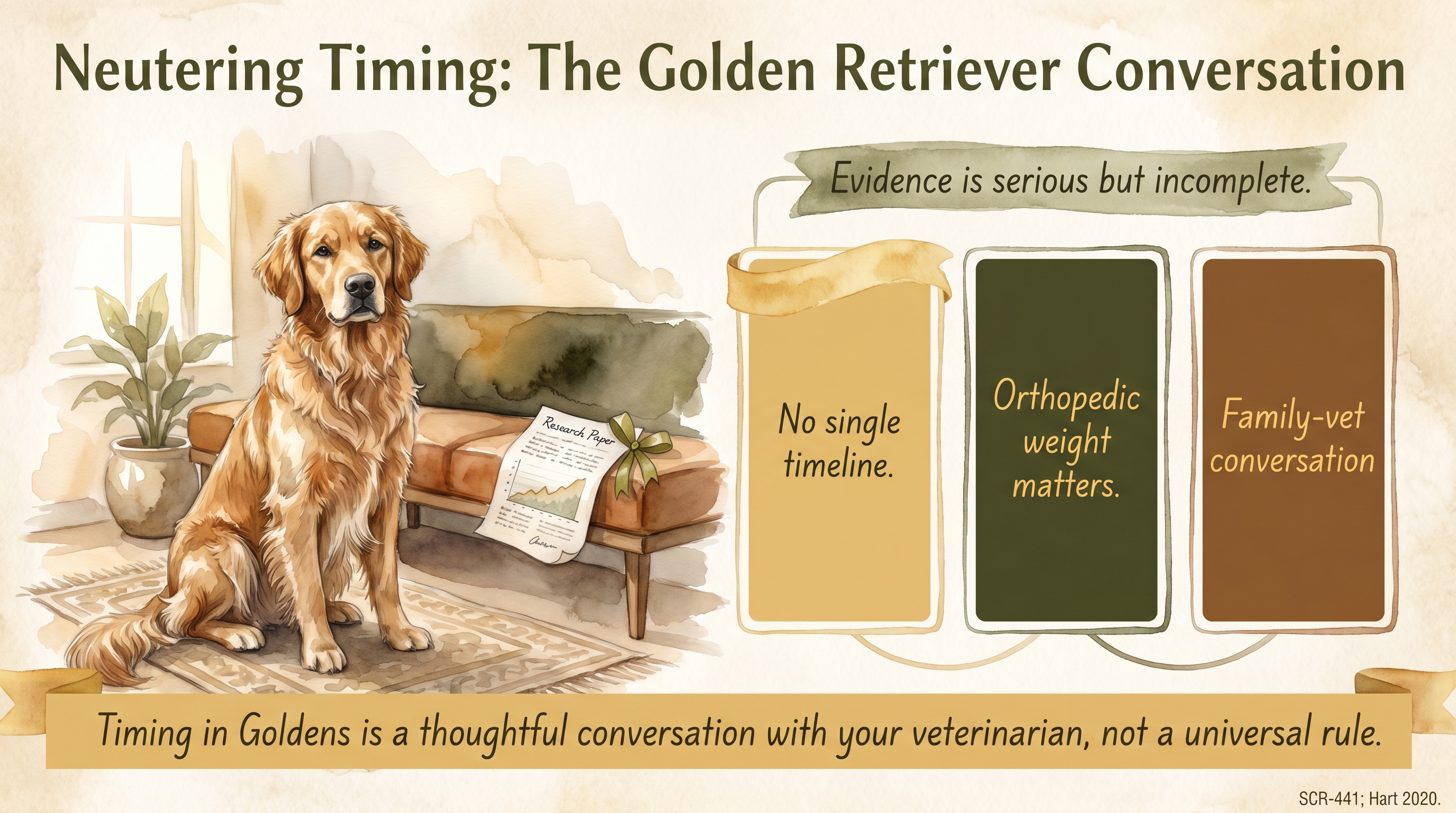
Timing in Goldens is a thoughtful conversation with your veterinarian, not a universal rule.
Key Takeaways
- Golden Retriever neutering timing is an important question, but the literature does not support a simplistic one-size-fits-all answer.
- Early timing raises legitimate orthopedic concern in this breed, while later timing can involve different trade-offs.
- The best-known studies are useful and serious, but they are retrospective and limited enough that ambiguity must remain visible.
- JB recommends an informed family-veterinarian conversation rather than a single universal rule.
The Evidence
- Hart et al. cohortsGolden Retrievers
Golden-specific retrospective studies found elevated joint-disorder associations with early gonadectomy and timing-linked associations with some cancer outcomes. - large-breed guidance trenddomestic dogs
Large-breed counseling increasingly emphasizes skeletal maturity, breed effects, and individualized timing rather than automatic pediatric gonadectomy.
- retrospective hospital-cohort limitationdomestic dogs
The most cited Golden Retriever studies are retrospective and hospital-based, which leaves confounding, referral bias, and generalizability limits in place. - non-monotonic risk patternGolden Retrievers
The signal is not simply early bad and late good. Different outcomes appear to cluster at different timing windows by sex and condition.
- JB synthesisGolden Retriever family dogs
The most defensible family guidance is informed discussion, avoidance of routine pre-six-month neutering absent medical necessity, and individualized decision-making with veterinary support.
No direct canine research located for this specific topic. Current understanding relies on related research, clinical observation, and cross-species inference.
SCR References
Sources
- Torres de la Riva, G., Hart, B. L., Farver, T. B., Oberbauer, A. M., Messam, L. L. M., Willits, N., & Hart, L. A. (2013). Neutering dogs: Effects on joint disorders and cancers in Golden Retrievers. PLoS ONE, 8(2), e55937. https://doi.org/10.1371/journal.pone.0055937
- Hart, B. L., Hart, L. A., Thigpen, A. P., & Willits, N. H. (2014). Long-term health effects of neutering dogs: Comparison of Labrador Retrievers with Golden Retrievers. PLoS ONE, 9(7), e102241. https://doi.org/10.1371/journal.pone.0102241
- Hart, B. L., Hart, L. A., Thigpen, A. P., & Willits, N. H. (2020). Assisting decision-making on age of neutering for 35 breeds of dogs: Associated joint disorders, cancers, and urinary incontinence. Frontiers in Veterinary Science, 7, 388. https://doi.org/10.3389/fvets.2020.00388
- Hart, B. L., Hart, L. A., Thigpen, A. P., & Willits, N. H. (2020). Assisting decision-making on age of neutering for 35 breeds of dogs: Associated joint disorders, cancers, and urinary incontinence. Frontiers in Veterinary Science, 7, 388. https://doi.org/10.3389/fvets.2020.00388
- Pegram, C., Brodbelt, D. C., Church, D. B., Hall, J. L., Owen, L., Chang, Y.-M., & O'Neill, D. G. (2021). Associations between neutering and early-onset urinary incontinence in UK bitches under primary veterinary care. Journal of Small Animal Practice, 62(12), 1028-1038. https://doi.org/10.1111/jsap.13450