Cancer Risk by Spay/Neuter Timing
Compound evidence detail1 SCR / 2 parts
- Documentedthe individual cancer-by-timing signals from the Hart Golden-Retriever cohorts - male lymphoma peaking at 6-11-month neutering (relative risk approximately 2.88), female hemangiosarcoma rising in late-spayed females (relative risk approximately 6.10), female mast-cell-tumor rising from 0% intact to roughly 6% late-spayed (relative risk approximately 4.46) - each presented with its retrospective-cohort confidence interval intact
- Heuristicthe composite synthesis that no single Golden Retriever gonadectomy timing window simultaneously minimizes joint, cancer, and reproductive risks - presented as a family-veterinarian trade-space conversation rather than as a prescriptive timing recommendation
The cancer side of the spay-neuter timing conversation is the part most likely to be flattened into slogans. "Spaying prevents cancer" is too simple. "Spaying causes cancer" is also too simple. In Golden Retrievers, the better conclusion is narrower and more demanding: the cancer effects of gonadectomy are timing-specific, sex-specific, and cancer-specific, and they do not move in one clean direction. Documented
What It Means
Why This Topic Is Harder Than the Joint Story
The orthopedic side of the timing literature has a relatively strong directional message in Goldens. Documented The cancer side is more complicated.
That is because different cancers behave differently one cancer may show its strongest signal at one timing window; another may show a different signal in the opposite sex; and the background incidence of a cancer may already be high in the breed.
So the question is not "Does gonadectomy change cancer?" The real question is "Which cancers, in which sex, at which timing window, and by how much?"
What the Golden Data Shows
The SCR now codifies the most important summary: Golden cancer risk by gonadectomy timing is non-monotonic.
That means there is no simple "earlier is always worse" or "later is always worse" rule. Instead, the most cited Golden data show male lymphoma signal peaking in the 6 to 11 month neutering window, female hemangiosarcoma signal peaking in later-spayed females, female mast cell tumor signal appearing more strongly in later-spayed females, and mammary cancer baseline in intact Golden females remaining relatively low compared with the cancers the breed is most famous for. Estimated
This is exactly why the page exists. The shape of the risk is not intuitive.
The Lymphoma Signal
In males, one of the most discussed findings is the rise in lymphoma signal in the mid-pubertal neutering window compared with intact baseline. Documented
That does not mean every neutered male is heading toward lymphoma. It means the timing association is strong enough that it belongs in an honest cancer conversation rather than being waved away as statistical noise.
The Female Hemangiosarcoma and Mast Cell Story
Female Goldens show a different pattern. The more striking timing signals in the source literature involve hemangiosarcoma and mast cell tumors, especially in later-spayed females. Documented
This is one reason the spay-timing conversation becomes difficult for families looking for a clean answer. Delaying surgery may reduce some concerns while not obviously improving every cancer outcome.
That is also why the disease-specific detail matters more than generalized "cancer risk" language.
Why It Matters for Your Dog
Mammary Cancer Needs Proportion
Historically, mammary cancer prevention was one of the strongest arguments for early spay. That is a real part of the broader veterinary history, but Goldens complicate the shorthand.
The current SCR captures the central proportional point: the intact-female mammary baseline in Goldens is relatively low, around 1 to 2 percent in the source framework, while the breed's dominant cancer burdens sit elsewhere. Estimated
That does not make mammary risk imaginary. It does mean a Golden-specific conversation cannot be reduced to an older mammary-cancer template developed without enough breed specificity.
Why the Pattern Is Called Non-Monotonic
Non-monotonic sounds technical, but the plain-language meaning is simple: the risk curve does not move smoothly in one direction.
If earlier surgery increased every cancer and later surgery decreased every cancer, decision-making would be easier. If the reverse were true, it would also be easier. But that is not the pattern the Golden data support.
Instead some signals concentrate in one sex; some signals concentrate in one timing window; and some cancer categories matter more in Goldens than the classic mammary frame.
This is exactly why the oncologic side of the decision has to be discussed as part of a trade-space rather than as one answer.
What This Page Does Not Prove
This page does not prove that gonadectomy is the dominant cause of Golden cancer; that every individual dog inherits the population-level pattern; and that one timing decision can minimize all cancer risks at once.
It does support that timing belongs in the conversation and that the old oversimplified cancer framing is no longer adequate.
How Families Should Use the Information
Families should use this page to improve questions, not to pretend they can calculate a single perfect answer at home.
Useful questions include which cancer risks are most relevant to my dogs sex and breed, how much weight should we place on orthopedic versus oncologic concerns, how should we think about mammary and pyometra benefits relative to Golden-specific cancer patterns, and would a hormone-sparing option meaningfully change the decision space.
Those are better questions than "Is it safer earlier or later?"
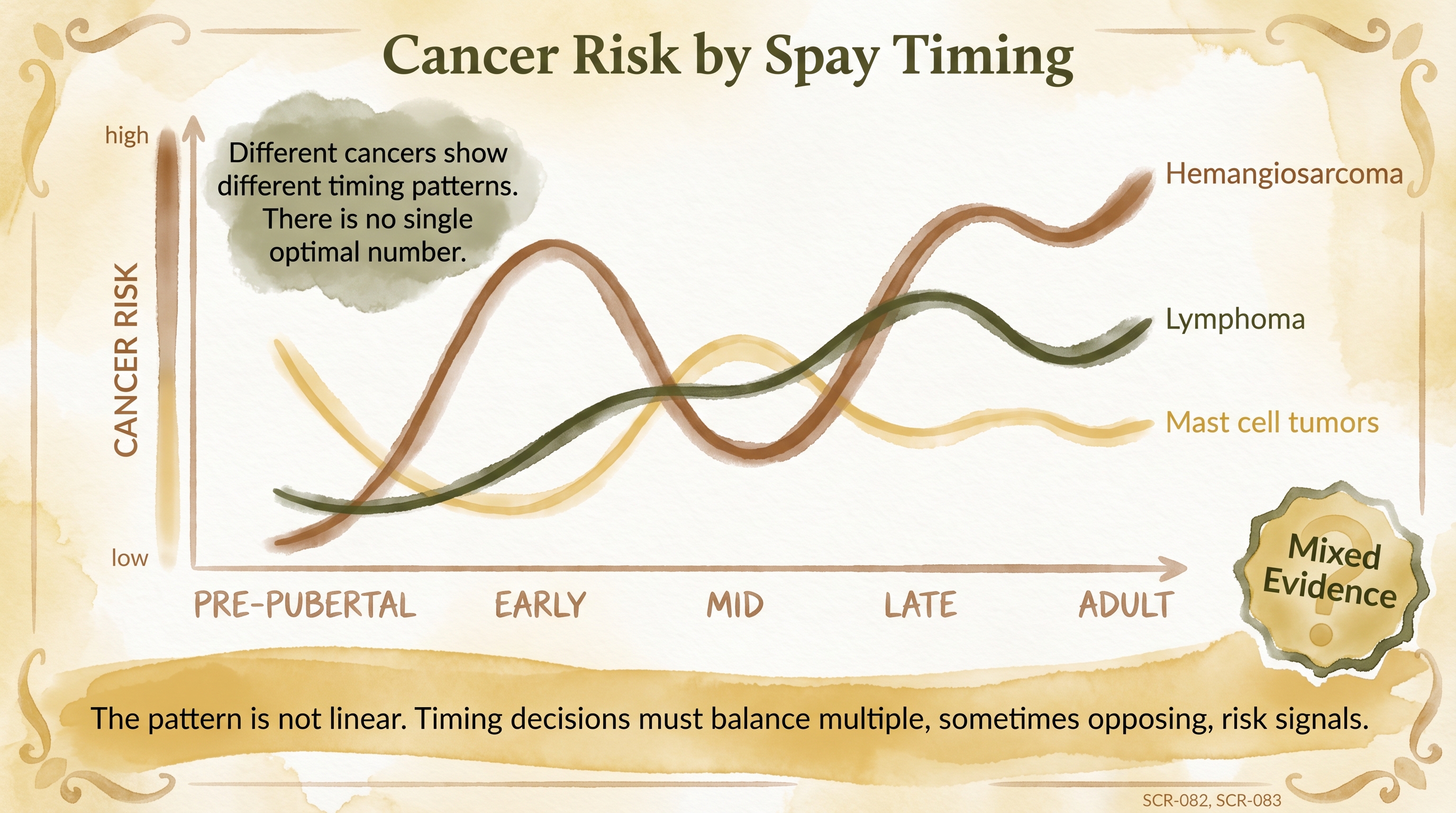
The pattern is not linear - timing decisions must balance multiple, sometimes opposing, risk signals.
Key Takeaways
- The Golden Retriever cancer-timing story is real, but it is not linear or one-directional.
- Different cancers show different sex-specific and timing-specific patterns, which is why broad slogans fail here.
- Mammary cancer still belongs in the conversation, but it should be weighed against the cancers Goldens are most burdened by rather than treated as the whole story.
- This page improves the quality of the discussion. It does not produce one perfect universal age for every Golden.
The Evidence
This entry uses estimated claim-level tags beyond the dedicated EvidenceBlocks below. These tags mark approximate ranges or timing claims that should remain bounded by the cited sources.
- SCR-082 supportGolden Retrievers
Cancer effects of gonadectomy in Goldens are timing-, sex-, and cancer-type-specific rather than moving in one simple direction. - Golden timing cohortsGolden Retrievers
Male lymphoma, female hemangiosarcoma, and female mast cell tumor signals do not peak in the same way, which is why the pattern is described as non-monotonic. - Golden mammary contextGolden Retrievers
The mammary-cancer baseline in intact Golden females is low enough that old one-size-fits-all prevention rhetoric does not map neatly onto this breed.
- Oncologic decision logicGolden Retrievers
The evidence supports including timing in the cancer conversation, but it does not yield one universally optimal timing window that minimizes every cancer risk simultaneously. - Population-versus-individual cautiondogs
Associations observed at the cohort level improve decision quality without becoming deterministic predictions for an individual dog.
No published study directly tests the specific Just Behaving guidance on cancer risk by spay timing. This entry relies on broader canine evidence, breeder observation, and practical synthesis.
SCR References
Sources
- Torres de la Riva, G., Hart, B. L., Farver, T. B., Oberbauer, A. M., Messam, L. L. M., Willits, N., & Hart, L. A. (2013). Neutering dogs: Effects on joint disorders and cancers in Golden Retrievers. PLOS ONE, 8(2), e55937. https://doi.org/10.1371/journal.pone.0055937
- Hart, B. L., Hart, L. A., Thigpen, A. P., & Willits, N. H. (2014). Long-term health effects of neutering dogs: Comparison of Labrador Retrievers with Golden Retrievers. PLOS ONE, 9(7), e102241. https://doi.org/10.1371/journal.pone.0102241
- Hart, B. L., Hart, L. A., Thigpen, A. P., & Willits, N. H. (2020). Assisting decision-making on age of neutering for 35 breeds of dogs: Associated joint disorders, cancers, and urinary incontinence. Frontiers in Veterinary Science, 7, 388. https://doi.org/10.3389/fvets.2020.00388
- Schneider, R., Dorn, C. R., & Taylor, D. O. N. (1969). Factors influencing canine mammary cancer development and postsurgical survival. Journal of the National Cancer Institute, 43(6), 1249-1261. https://doi.org/10.1093/jnci/43.6.1249
- Beauvais, W., Cardwell, J. M., & Brodbelt, D. C. (2012). The effect of neutering on the risk of mammary tumours in dogs: A systematic review. Journal of Small Animal Practice, 53(6), 314-322. https://doi.org/10.1111/j.1748-5827.2011.01220.x