The Spay/Neuter Trade-Space
Compound evidence detail4 SCRs / 10 parts
- Documentedthe directional finding from the Hart UC Davis cohorts that Golden Retrievers neutered before approximately 6 months show roughly four- to fivefold higher combined joint-disorder incidence (HD, CCL, ED aggregated) versus intact dogs of the same breed - acknowledged as a referral-hospital retrospective signal that establishes direction and approximate magnitude rather than population-level absolute risk
- Estimatedthe per-disease component breakdowns drawn from the same retrospective cohorts - hip dysplasia roughly three- to fourfold elevated, cranial cruciate ligament rupture rising from approximately 0% intact to 5-9% in early-neutered subgroups, and elbow dysplasia roughly 6% versus 2% - all carrying small-cell-size confidence-interval limits and referral-population caveats
- Documentedthe individual cancer-by-timing signals from the Hart Golden-Retriever cohorts - male lymphoma peaking at 6-11-month neutering (relative risk approximately 2.88), female hemangiosarcoma rising in late-spayed females (relative risk approximately 6.10), female mast-cell-tumor rising from 0% intact to roughly 6% late-spayed (relative risk approximately 4.46) - each presented with its retrospective-cohort confidence interval intact
- Heuristicthe composite synthesis that no single Golden Retriever gonadectomy timing window simultaneously minimizes joint, cancer, and reproductive risks - presented as a family-veterinarian trade-space conversation rather than as a prescriptive timing recommendation
- EstimatedUSMI prevalence figures across spayed large-breed female populations and the body-weight odds ratio derived from multi-breed retrospective and case-control samples
- Observed-JBthe Golden-Retriever-specific timing pattern in which incontinence clusters in females spayed before approximately 6-12 months versus intact and late-spayed cohorts
- Estimatedthe VetCompass target-trial-emulation odds reduction for later neutering, presented as a recent causal-inference result whose magnitude remains under refinement
- Documentedthe established trade-offs - the Hart UC Davis retrospective directional findings on joint disorder and cancer signals in early-neutered Golden Retrievers (with explicit retrospective single-population caveat), the cumulative pyometra risk in intact females across reproductive lifespan, and the mammary-tumor risk that rises with each completed estrus cycle - presented together as a balanced documented trade-space rather than selectively
- Ambiguousany single optimal-timing answer for Golden Retriever gonadectomy - the synthesis across joint, cancer, and reproductive risks represents a weighted clinical judgment that has not been resolved by an outcome-validated controlled comparison and remains an individualized family-veterinarian conversation rather than a settled prescription
- Heuristicany specific breeder-contract clause prescribing a fixed Golden Retriever spay or neuter age - reflective of program-level judgment rather than outcome-validated by published canine health-outcome studies; contract language should reflect that the evidence supports individualized decisions
The reason this subcategory exists at all is that spay and neuter timing in Golden Retrievers is no longer a one-variable question. It is a trade-space. Joints, cancer, urinary continence, behavior claims, sterilization goals, household management, and available surgical options all intersect. Once you see that clearly, the old demand for one universally correct age stops feeling medically serious. Mixed Evidence
What It Means
What a Trade-Space Means
A trade-space is not confusion for its own sake. It means different benefits and costs move in different directions, and no single option optimizes every domain at once.
In Goldens, the main domains are joint-disorder risk; cancer-pattern risk; urinary-incontinence risk; behavior claims and counterclaims; unwanted-litter prevention; and availability of hormone-sparing alternatives. Documented
That list alone explains why the decision can no longer be handled as one inherited number.
The Orthopedic Side
The joint-disorder evidence is one of the clearest parts of the entire conversation. Early gonadectomy in Goldens is associated with substantially higher orthopedic risk than intact baseline.
That fact does not settle the whole question, but it does remove one comfortable fiction: early timing is not structurally neutral in this breed.
The Cancer Side
Cancer complicates the picture rather than simplifying it. The strongest Golden data show a non-monotonic pattern, with different timing signals by sex and cancer type. Documented
That means a family cannot honestly say earlier timing is always cancer safer; and later timing is always cancer safer.
The better conclusion is narrower. Timing belongs in the oncologic conversation, but the cancer story does not provide one clean universal answer.
Mammary Cancer and Pyometra Still Matter
One reason older advice held on so strongly is that spay does reduce or eliminate some female reproductive-disease concerns, including uterine disease risk and the classic pyometra problem. Mammary-risk reduction also remains part of the traditional argument, especially at earlier timing.
Those are real considerations. The reason they no longer settle the matter alone in Goldens is that the breed-specific orthopedic and oncologic data add competing considerations that used to be underweighted or not yet available. Documented
So the modern conversation is not "those benefits do not exist." It is "those benefits are no longer the only medically serious factors on the table."
Urinary Incontinence Belongs in the Conversation
Urinary incontinence is especially relevant for larger spayed females. The SCR supports a real association between spayed large-breed status and increased acquired incontinence burden, with Golden-specific clustering in earlier-spayed females observed in the source framework.
That does not mean every early-spayed female will leak urine. It does mean the issue is common enough and breed-relevant enough to deserve direct discussion rather than after-the-fact surprise.
Why It Matters for Your Dog
Behavior Claims Need Downgrading
This is one of the most important corrections in the entire topic.
The evidence does not support the common promise that gonadectomy reliably improves aggression. It also raises meaningful concern around fearfulness and noise sensitivity after early gonadectomy in some canine datasets.
That does not mean behavior should never factor into the decision. Documented It means behavior should not be treated as a simple pro-gonadectomy argument.
Hormone-Sparing Options Change the Shape of the Decision
Hormone-sparing procedures matter because they separate two questions that older practice bundled together should this dog be sterilized; and should this dog lose gonadal hormone exposure.
That separation matters because some households primarily need reproductive control, not necessarily endocrine removal. The evidence around hormone-sparing procedures suggests a more intact-like long-term profile in several outcome domains, though access and surgical familiarity are still uneven.
Household Reality Still Matters
A trade-space is not only medical literature. It is also life.
Important practical factors include whether the household can manage an intact female in heat, whether accidental breeding risk is realistically controllable, whether the dog lives in a multi-dog or boarding-heavy environment, and whether local veterinary access includes hormone-sparing options. Documented
These factors do not erase the science. They shape how the science is applied.
Why Blanket Rules Age Badly
This is the real lesson of the last fifteen years of literature. Blanket rules age badly when the underlying evidence base becomes more differentiated.
For Goldens, that means a universal contract or clinic default requiring pre-12-month gonadectomy sits on increasingly weak footing because it hard-codes one side of a now well-documented trade-space. Heuristic That is different from saying no family should ever choose that path. It means the evidence no longer supports pretending the trade-off does not exist.
The Most Honest Conclusion
The most honest conclusion is not indecision. It is disciplined nuance.
A Golden Retriever family should have a substantive, breed-specific conversation with their veterinarian that includes joints, cancer, urinary continence, household management, available procedure options, and the families tolerance for risk on each side of the decision. Documented
That is what current evidence has earned.
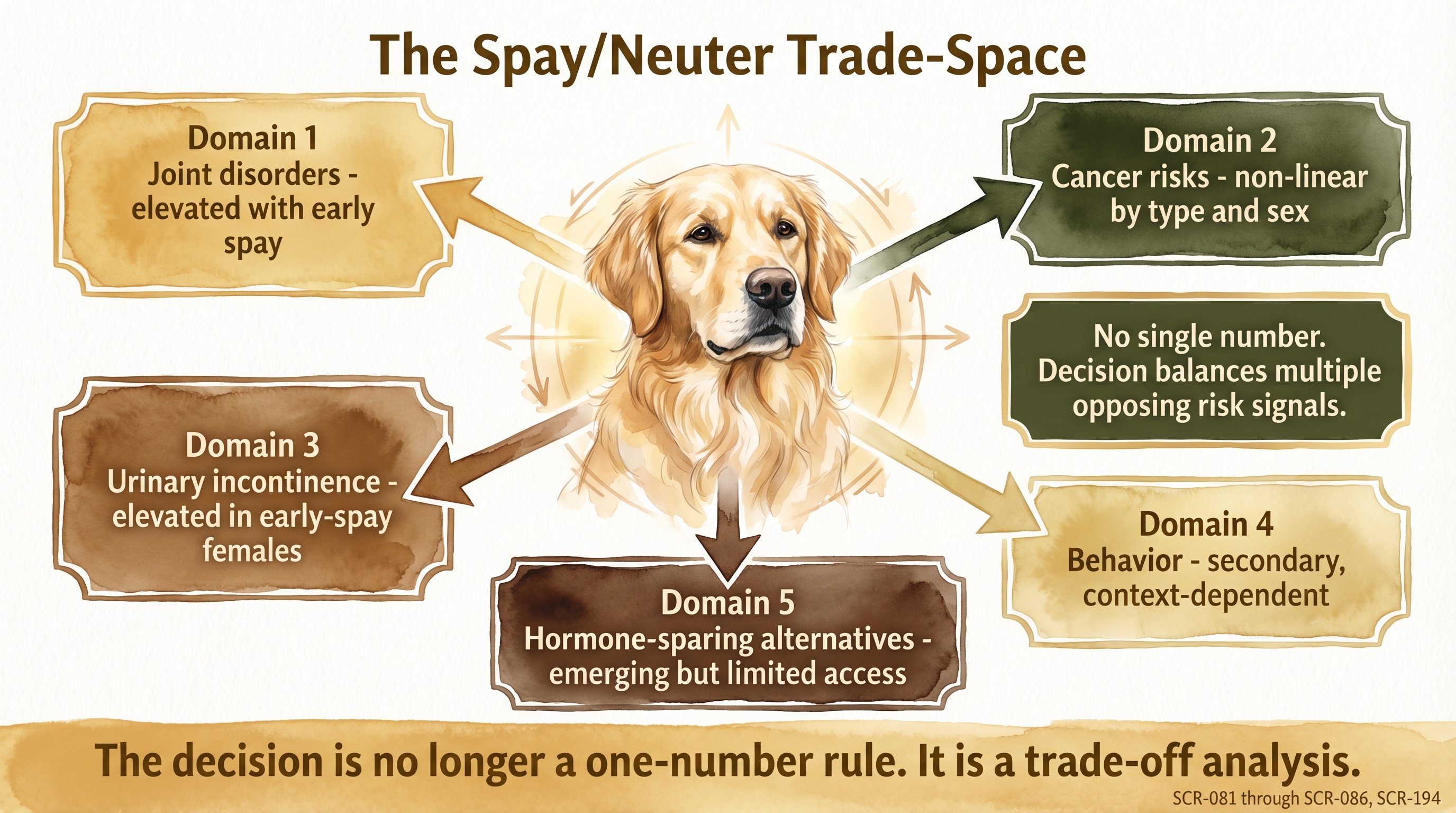
The decision is no longer a one-number rule - it is a trade-off analysis.
Key Takeaways
- The Golden Retriever spay-neuter decision is a trade-space, not a one-number rule, because orthopedic, cancer, urinary, behavioral, and household factors all matter.
- The clearest evidence signal is increased joint-disorder risk with early timing, while the cancer picture is real but more complex and non-linear.
- Behavior claims should be handled cautiously because aggression reduction is not reliably supported and fear-related costs may increase in some dogs.
- The honest modern standard is a breed-specific veterinary conversation rather than a blanket early-age mandate.
The Evidence
This entry uses heuristic claim-level tags beyond the dedicated EvidenceBlocks below. These tags mark JB interpretive application rather than direct study findings.
- SCR-081 supportGolden Retrievers
Early gonadectomy is associated with substantially higher joint-disorder burden in Goldens. - SCR-082 supportGolden Retrievers
Cancer effects are timing-, sex-, and cancer-specific rather than one-directional. - SCR-083 supportdogs
Gonadectomy does not reliably reduce aggression. - SCR-084 supportdogs
Early gonadectomy is associated in multiple datasets with higher fearfulness and noise sensitivity. - SCR-086 supportdogs
Hormone-sparing procedures preserve a more intact-like profile than traditional gonadectomy in available canine outcome data.
- SCR-085 supportdogs and Golden Retrievers
Urinary incontinence is a meaningful part of the female Golden trade-space, though exact prevalence wording remains more estimated than fully settled. - Spay-neuter source synthesisGolden Retrievers
The broader trade-space framing is the right page-level summary because different domains move in different directions and carry different evidence strengths. - Textbook clinical contextfemale dogs
Spay also changes uterine-disease and pyometra risk by eliminating the uterus from the future medical picture, which remains part of the real-world decision even when it is not the only factor.
- domestic dogs
No published study directly resolves every practical trade-off families face when using the spay/neuter trade-space across sex, breed, household, and management contexts.
SCR References
Sources
- Torres de la Riva, G., Hart, B. L., Farver, T. B., Oberbauer, A. M., Messam, L. L. M., Willits, N., & Hart, L. A. (2013). Neutering dogs: Effects on joint disorders and cancers in Golden Retrievers. PLOS ONE, 8(2), e55937. https://doi.org/10.1371/journal.pone.0055937
- Hart, B. L., Hart, L. A., Thigpen, A. P., & Willits, N. H. (2014). Long-term health effects of neutering dogs: Comparison of Labrador Retrievers with Golden Retrievers. PLOS ONE, 9(7), e102241. https://doi.org/10.1371/journal.pone.0102241
- Hart, B. L., Hart, L. A., Thigpen, A. P., & Willits, N. H. (2020). Assisting decision-making on age of neutering for 35 breeds of dogs: Associated joint disorders, cancers, and urinary incontinence. Frontiers in Veterinary Science, 7, 388. https://doi.org/10.3389/fvets.2020.00388
- Forsee, K. M., Davis, G. J., Mouat, E. E., Salmeri, K. R., & Bastian, R. P. (2013). Evaluation of the prevalence of urinary incontinence in spayed female dogs: 566 cases (2003-2008). Journal of the American Veterinary Medical Association, 242(7), 959-962. https://doi.org/10.2460/javma.242.7.959
- Farhoody, P., Mallawaarachchi, I., Tarwater, P. M., Serpell, J. A., Duffy, D. L., & Zink, C. (2018). Aggression toward familiar people, strangers, and conspecifics in gonadectomized and intact dogs. Frontiers in Veterinary Science, 5, 18. https://doi.org/10.3389/fvets.2018.00018
- Zink, M. C., Farhoody, P., Elser, S. E., Ruffini, L. D., Gibbons, T. A., & Rieger, R. H. (2014). Evaluation of the risk and age of onset of cancer and behavioral disorders in gonadectomized Vizslas. Journal of the American Veterinary Medical Association, 244(3), 309-319. https://doi.org/10.2460/javma.244.3.309
- Zink, C., Delgado, M. M., & Stella, J. L. (2023). Vasectomy and ovary-sparing spay in dogs: Comparison of health and behavior outcomes with gonadectomized and sexually intact dogs. Journal of the American Veterinary Medical Association, 261(3), 366-374. https://doi.org/10.2460/javma.22.08.0382
- Smith, F. O. (2006). Canine pyometra. Theriogenology, 66(3), 610-612. https://doi.org/10.1016/j.theriogenology.2006.04.023