Obesity in Dogs
Compound evidence detail1 SCR / 3 parts
- Documentedthe Kealy diet-restriction longitudinal evidence for longevity gain, the WSAVA nine-point body-condition scoring framework, the documented gap between owner-reported and veterinary-assessed body condition, and the canine comorbidities associated with elevated body fat
- Documentedthe specific approximately 1.8-year median longevity gain in lean-fed versus ad-libitum-fed Labrador Retrievers from the Kealy cohort - this exact figure derives from Labrador Retrievers and downstream citations must always carry the Labrador-Retriever qualifier rather than being presented as a universal canine or Golden Retriever lifespan constant
- Documentedthe documented prevalence of overweight and obesity among Goldens in veterinary-practice survey populations, supporting body condition management as a meaningful prevention lever for the breed
Obesity is the most common preventable health condition in pet dogs, and it is one of the easiest problems for families to normalize because it happens gradually. The dog does not look "sick." The dog looks cute, well loved, and maybe just a little sturdy. Then the waist disappears, the ribs vanish under fat cover, the joints carry more strain, the metabolism shifts, and the dog begins living in a body that is working harder than it should. In Golden Retrievers, this drift is especially common because the breed is famously food motivated and because many families are rewarded socially for seeing a heavy Golden as healthy. Documented
What It Means
What Obesity Means in Dogs
In medical terms, obesity is not just "more weight than ideal." It is excess body fat sufficient to harm health. That matters because body weight alone can mislead. Documented A large-framed dog and an overweight dog are not the same thing.
This is why body condition scoring matters more than a single number on the scale. Two dogs can weigh the same and carry that weight very differently.
How Common It Is
Prevalence estimates vary by study design, but the broad message is stable: overweight and obesity are now normal enough in the pet-dog population that many families no longer recognize what an ideal body looks like. Documented
That perceptual drift matters. Once heaviness becomes normal in the family's eye, prevention gets much harder because no one thinks there is a problem to prevent.
What Excess Body Fat Does
Excess adipose tissue is not inert. It changes physiology. Documented consequences of overweight and obesity in dogs include reduced lifespan, earlier and worse osteoarthritis burden, worsened mobility, metabolic dysfunction, respiratory strain, and increased load on vulnerable joints.
In some disease areas, the obesity effect is direct and strong. In other areas, it is more about worsening the physiologic background in which disease unfolds. Either way, the dog pays for excess weight every day.
The Strongest Evidence in the Entire Topic
The single most important evidence point in this page is already in the SCR: maintaining dogs lean extends lifespan and delays chronic disease. That is one of the clearest modifiable findings in canine medicine.
The famous controlled Labrador study did not starve one group and pamper the other. Documented It compared dogs kept consistently lean with paired littermates allowed to remain heavier. The lean dogs lived longer and developed chronic disease later.
That does not prove every Golden will gain exactly the same number of months from identical restriction. It does support the broader clinical truth very strongly: lean body condition is one of the highest-yield things a family can do for a dog's long-term health. Documented
Why Goldens Drift Heavy So Easily
Goldens are vulnerable for several reasons they are highly food motivated; they are socially reinforced for looking plush and substantial; many families interpret begging as need; activity often drops faster than calorie intake as the dog matures; and spay or neuter can reduce maintenance energy needs and increase food-seeking behavior.
That last point matters. Gonadectomy timing is its own separate trade-space, but one effect is clear enough: altered hormonal state can make weight control harder if feeding does not change along with metabolism.
Why It Matters for Your Dog
The Body Condition Problem
Families often ask how much to feed. That is a useful question, but a better one is whether the dog's body condition is correct.
Ideal dogs generally show ribs that are easy to feel with light fat cover, a visible waist from above, and an abdominal tuck from the side.
Overconditioned dogs lose those features gradually. Because the change is gradual, many families stop seeing it.
Why Puppies Matter Too
Obesity is not only an adult problem. Growth-phase overfeeding matters because early body condition shapes orthopedic load, growth trajectory, and later weight pattern. Documented Large-breed puppies should not be raised as round, soft babies for aesthetic reasons. A lean puppy is a safer puppy.
This is one of the places where the Prevention Pillar maps directly onto veterinary science. The joint, metabolic, and lifespan residue of chronic overfeeding is far easier to prevent than to reverse later.
What Weight Management Actually Requires
Good weight management usually depends on honest body condition scoring; measured food rather than casual pouring; treat accounting; matching intake to current activity; and regular monitoring instead of guessing from memory.
The hard part is emotional, not mathematical. Families often express love through food. Goldens make that temptation worse because they are so affiliative and so persuasive.
The Right Tone for Families
This page should never be read as blame. The problem is cultural as much as individual. Many families have genuinely never seen what a correctly conditioned adult Golden looks like.
The answer is recalibration, not shame. Once the eye is retrained, weight management becomes much more practical.
When to See a Veterinarian
Veterinary support is warranted for steady weight gain, inability to feel ribs easily, loss of visible waist, declining stamina, difficulty adjusting portions without clear guidance, weight gain after spay or neuter, and lameness or mobility decline in an overweight dog.
Weight management works best when it is treated as a health conversation early rather than a crisis after the dog is already significantly heavy.
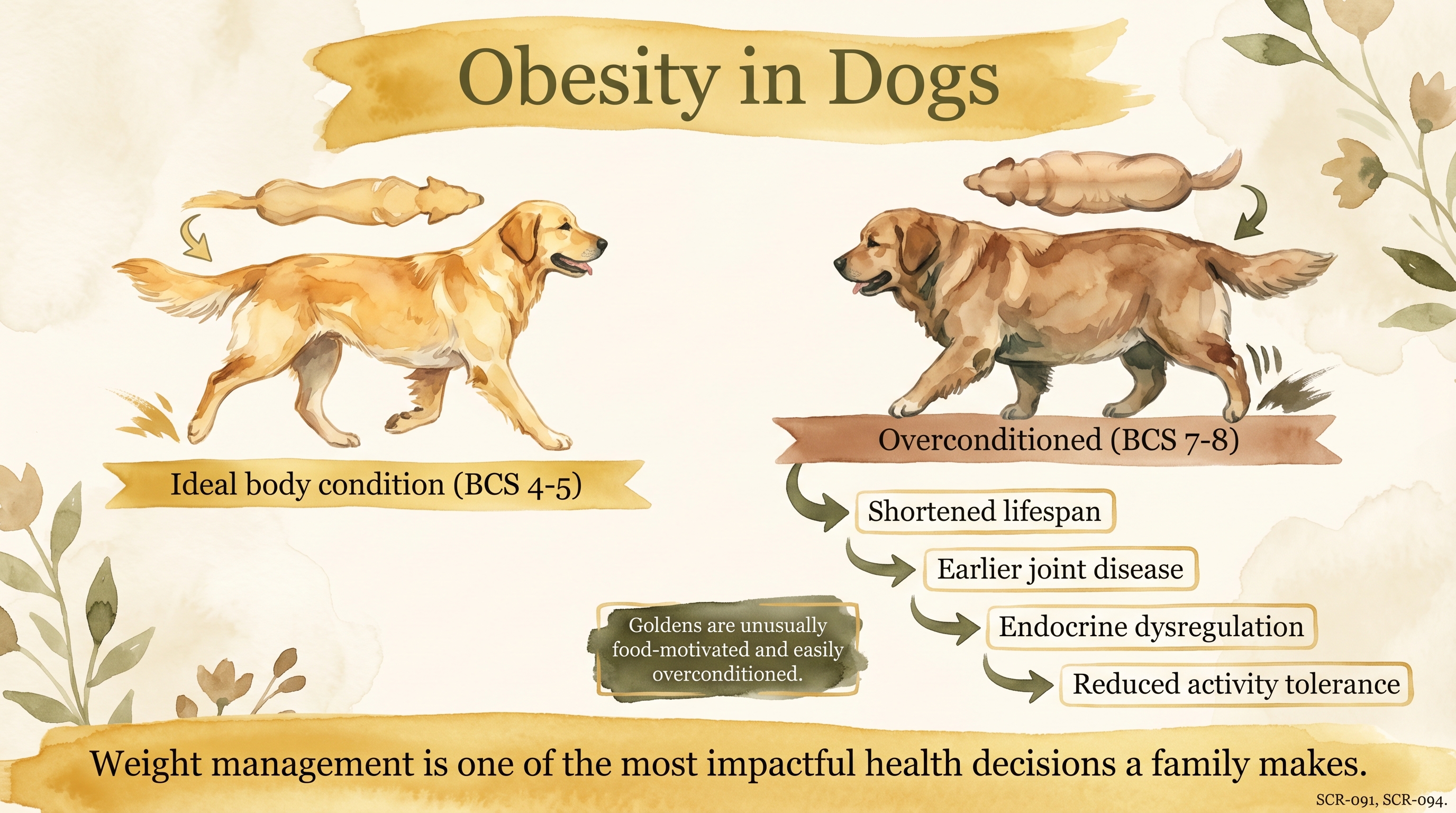
Weight management is one of the most impactful health decisions a family makes.
Key Takeaways
- Obesity is the most common preventable health problem in pet dogs and is easy to normalize because it develops gradually.
- Lean body condition is one of the strongest documented ways to improve canine healthspan and lifespan.
- Goldens are especially prone to becoming overconditioned because they are food motivated and often culturally rewarded for looking heavy.
- The right practical tool is body condition scoring, not trusting that the scale or the eye alone will catch the drift early enough.
The Evidence
- SCR-075 supportdogs
Maintaining dogs in a lean body condition extends lifespan and delays chronic disease, including osteoarthritis. - Diet-disease literaturedogs
Canine obesity is a highly prevalent chronic condition associated with impaired quality of life and metabolic consequences. - WSAVA nutrition guidancedogs
Routine body condition assessment is the practical clinical tool that keeps prevention visible instead of relying on vague visual impressions.
- Golden longevity source synthesisGolden Retrievers
Goldens are especially vulnerable to overconditioning because breed temperament, owner indulgence, and altered post-gonadectomy metabolism often overlap. - Puppy-development nutrition literaturelarge-breed dogs
Early growth-phase overfeeding increases orthopedic burden and creates downstream metabolic vulnerability, even though not every long-term obesity mechanism has been directly proven in Goldens.
- domestic dogs
No published study directly compares the most effective long-term management paths for obesity in dogs in dogs across breeds and ordinary home settings.
SCR References
Sources
- World Small Animal Veterinary Association. (n.d.). Global nutrition guidelines. https://wsava.org/global-guidelines/global-nutrition-guidelines/
- World Small Animal Veterinary Association Global Nutrition Committee. (2021). Global nutrition toolkit. https://wsava.org/wp-content/uploads/2021/04/WSAVA-Global-Nutrition-Toolkit-English.pdf
- Kealy, R. D., Lawler, D. F., Ballam, J. M., Mantz, S. L., Biery, D. N., Greeley, E. H., Lust, G., Segre, M., Smith, G. K., & Stowe, H. D. (2002). Effects of diet restriction on life span and age-related changes in dogs. Journal of the American Veterinary Medical Association, 220(9), 1315-1320. https://doi.org/10.2460/javma.2002.220.1315
- Smith, G. K., Paster, E. R., Powers, M. Y., Lawler, D. F., Biery, D. N., Shofer, F. S., McKelvie, P. J., & Kealy, R. D. (2006). Lifelong diet restriction and radiographic evidence of osteoarthritis of the hip joint in dogs. Journal of the American Veterinary Medical Association, 229(5), 690-693. https://doi.org/10.2460/javma.229.5.690
- McGreevy, P. D., Thomson, P. C., Pride, C., Fawcett, A., Grassi, T., & Jones, B. (2005). Prevalence of obesity in dogs examined by Australian veterinary practices and the risk factors involved. Veterinary Record, 156(22), 695-702. https://doi.org/10.1136/vr.156.22.695
- Marshall, W. G., Hazewinkel, H. A. W., Mullen, D., De Meyer, G., Baert, K., & Carmichael, S. (2010). The effect of weight loss on lameness in obese dogs with osteoarthritis. Veterinary Research Communications, 34(3), 241-253. https://doi.org/10.1007/s11259-010-9348-7
- Kealy, R. D., Lawler, D. F., Ballam, J. M., Lust, G., Biery, D. N., Smith, G. K., & Mantz, S. L. (2002). Effects of diet restriction on life span and age-related changes in dogs. Journal of the American Veterinary Medical Association, 220(9), 1315-1320. https://doi.org/10.2460/javma.2002.220.1315
- O'Neill, D. G., Church, D. B., McGreevy, P. D., Thomson, P. C., & Brodbelt, D. C. (2013). Longevity and mortality of owned dogs in England. The Veterinary Journal, 198(3), 638-643. https://doi.org/10.1016/j.tvjl.2013.09.020