Joint Disorder Risk by Spay/Neuter Timing
Compound evidence detail1 SCR / 2 parts
- Documentedthe directional finding from the Hart UC Davis cohorts that Golden Retrievers neutered before approximately 6 months show roughly four- to fivefold higher combined joint-disorder incidence (HD, CCL, ED aggregated) versus intact dogs of the same breed - acknowledged as a referral-hospital retrospective signal that establishes direction and approximate magnitude rather than population-level absolute risk
- Estimatedthe per-disease component breakdowns drawn from the same retrospective cohorts - hip dysplasia roughly three- to fourfold elevated, cranial cruciate ligament rupture rising from approximately 0% intact to 5-9% in early-neutered subgroups, and elbow dysplasia roughly 6% versus 2% - all carrying small-cell-size confidence-interval limits and referral-population caveats
The orthopedic side of the spay-neuter timing literature is the part that moved the entire conversation in Golden Retrievers. Before the breed-specific data arrived, many families and many veterinarians treated timing as if it had only modest structural consequences. In Goldens, that turned out to be too casual. The joint-disorder signal is not theoretical in this breed. It is one of the most important reasons the old early-gonadectomy default no longer feels adequate. Documented
What It Means
Why Hormones Matter to the Skeleton
Ovarian and testicular hormones influence skeletal maturation, especially the timing of growth-plate closure. When those hormones are removed before maturity, long-bone growth can continue under altered timing conditions.
That matters because joint stability and limb proportions are not separate from growth timing. They are part of the same developmental system.
The simplest family-level summary is hormones help govern closure timing; closure timing affects developing structure; and altered structure can change later orthopedic risk.
That is not a philosophical claim. It is the developmental logic underneath the timing question.
What the Golden Data Shows
The SCR supports the strongest headline plainly: early gonadectomy in Golden Retrievers is associated with a much higher joint-disorder incidence than intact baseline. Documented
The most cited Golden figures come from UC Davis referral-hospital data and are large enough to matter even with the usual retrospective limitations. In males neutered before six months, combined joint disorders were reported around 25 to 27 percent versus roughly 5 percent in intact males. In females spayed before six months, combined joint disorders were reported around 18 to 20 percent versus roughly 4.5 to 5 percent in intact females.
Those numbers are striking because the shift is not tiny. It is the kind of difference that changes clinical and breeder conversations.
Which Joint Problems Are Involved
The joint-disorder bucket in this literature includes hip dysplasia, cranial cruciate ligament rupture, and elbow dysplasia.
Not every subcategory is equally strong in every dataset, and the SCR itself warns against treating every detailed sub-breakdown as equally robust. But the overall direction and magnitude of the orthopedic association are strong enough to be documented. Documented
That is the key point. Even if some fine-grained subanalyses carry wider uncertainty, the overall orthopedic signal is real. Documented
Why Large Breeds Care More
This is one reason breed size matters so much in the timing discussion. Small breeds generally do not show the same magnitude of joint-disorder concern. Goldens do.
That is because the large-breed developmental problem is not only about weight. It is about how a large, still-maturing skeleton responds when hormone timing changes before normal maturity has been reached.
The puppy-health side of the SCR reinforces this broader idea from a different angle: growth-plate timing governs what a large-breed body can safely tolerate during development. Documented Timing decisions and orthopedic protection are therefore part of the same larger developmental story.
Why It Matters for Your Dog
Why Goldens Are Especially Important Here
Golden Retrievers are not simply another large breed inside this literature. They are one of the breeds in which the early-timing orthopedic penalty appears especially pronounced.
That does not mean every early-neutered Golden will develop joint disease. It means the odds move enough that the timing decision becomes clinically meaningful rather than cosmetic.
This also explains why so many modern Golden breeders and more breed-aware veterinarians place heavy weight on the orthopedic side of the trade-space even when other outcomes remain more complicated.
What This Does Not Mean
This page should not be read as saying hormones are the only driver of orthopedic disease; every intact dog is orthopedically safe; and screening, body condition, and activity management stop mattering.
They still matter enormously.
Hip and elbow genetics still matter. Growth management still matters. Lean body condition still matters. Exercise decisions during development still matter. Gonadectomy timing is one variable in the orthopedic story, not the only one.
Limits and Cautions
The major studies here are retrospective. Documented That means they carry the usual limitations referral populations are not perfect mirrors of the whole breed; why families chose specific timing is not always known; and association is stronger than mechanism proof at the individual level.
Still, the magnitude of the Golden signal is large enough that the core clinical takeaway survives those limitations.
What Families Should Do With This Information
The practical use of this page is not panic. It is calibration.
A Golden family should leave this page understanding that early gonadectomy is not orthopedically neutral in this breed; growth and hormone timing are developmentally linked; and timing should be discussed alongside orthopedic priorities, not after them.
That is the real value of the evidence.
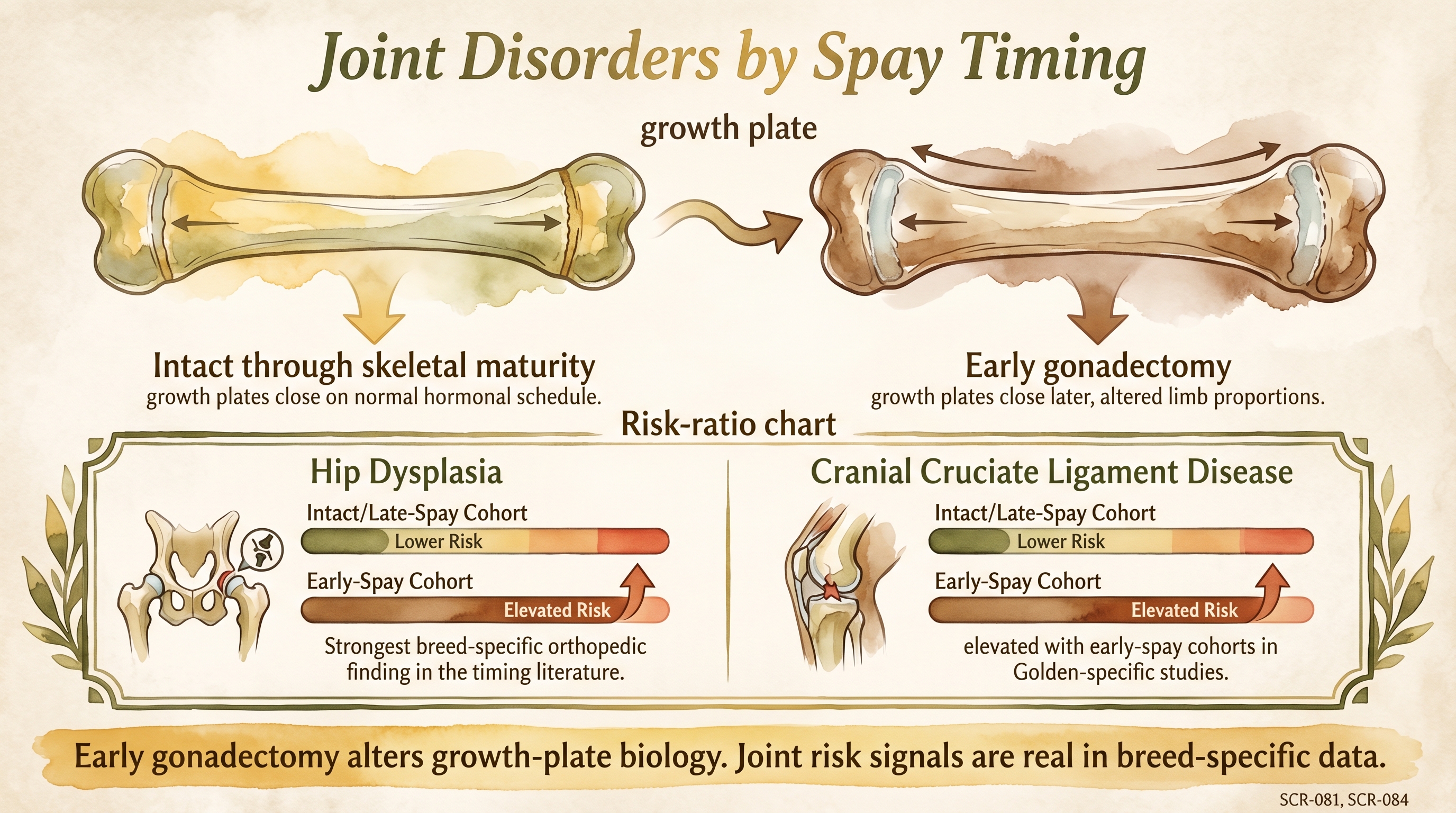
Early gonadectomy alters growth-plate biology - joint risk signals are real in breed-specific data.
Key Takeaways
- In Golden Retrievers, early gonadectomy is associated with a substantial increase in overall joint-disorder risk compared with intact baseline.
- The developmental logic runs through growth-plate timing, which is one reason large breeds are more affected than many small breeds.
- The strongest claim is the overall orthopedic signal, not every fine-grained subtype number taken in isolation.
- Timing is only one part of orthopedic risk, so screening, lean body condition, and sensible growth management still matter greatly.
The Evidence
- SCR-081 supportGolden Retrievers
Early gonadectomy in Goldens is associated with roughly four- to fivefold higher combined joint-disorder incidence relative to intact baseline in the most cited breed-specific data. - SCR-096 supportlarge-breed dogs
Growth-plate timing matters for large-breed orthopedic vulnerability, which is why developmental interventions during maturity windows cannot be treated casually. - Orthopedic source synthesisGolden Retrievers
The most reliable page-level claim is the overall joint-disorder increase, while some detailed subtype breakdowns deserve more caution because of smaller cell sizes.
- Hip-elbow screening literaturedogs
Genetic screening and breeder selection remain central because gonadectomy timing does not override underlying orthopedic susceptibility. - Canine health-management logicdogs
Body condition and developmental activity management continue to affect orthopedic outcomes even when the timing effect is acknowledged.
- domestic dogs
No published study directly resolves every practical trade-off families face when using joint disorder risk by spay/neuter timing across sex, breed, household, and management contexts.
SCR References
Sources
- Smith, G. K., Biery, D. N., & Gregor, T. P. (1990). New concepts of coxofemoral joint stability and the development of a clinical stress-radiographic method for quantitating hip joint laxity in the dog. Journal of the American Veterinary Medical Association, 196(1), 59-70.
- Runge, J. J., Kelly, S. P., Gregor, T. P., Kotwal, S., & Smith, G. K. (2010). Distraction index as a risk factor for osteoarthritis associated with hip dysplasia in four large dog breeds. Journal of Small Animal Practice, 51(5), 264-269. https://doi.org/10.1111/j.1748-5827.2010.00937.x
- Kealy, R. D., Lawler, D. F., Ballam, J. M., Mantz, S. L., Biery, D. N., Greeley, E. H., Lust, G., Segre, M., Smith, G. K., & Stowe, H. D. (2002). Effects of diet restriction on life span and age-related changes in dogs. Journal of the American Veterinary Medical Association, 220(9), 1315-1320. https://doi.org/10.2460/javma.2002.220.1315
- Smith, G. K., Paster, E. R., Powers, M. Y., Lawler, D. F., Biery, D. N., Shofer, F. S., McKelvie, P. J., & Kealy, R. D. (2006). Lifelong diet restriction and radiographic evidence of osteoarthritis of the hip joint in dogs. Journal of the American Veterinary Medical Association, 229(5), 690-693. https://doi.org/10.2460/javma.229.5.690
- Hedhammar, A., Wu, F. M., Krook, L., Schryver, H. F., de Lahunta, A., Whalen, J. P., Kallfelz, F. A., Nunez, E. A., Hintz, H. F., Sheffy, B. E., & Ryan, G. D. (1974). Overnutrition and skeletal disease: An experimental study in growing Great Dane dogs. Cornell Veterinarian, 64(Suppl 5), 1-160.
- Torres de la Riva, G., Hart, B. L., Farver, T. B., Oberbauer, A. M., Messam, L. L. M., Willits, N., & Hart, L. A. (2013). Neutering dogs: Effects on joint disorders and cancers in Golden Retrievers. PLOS ONE, 8(2), e55937. https://doi.org/10.1371/journal.pone.0055937
- Hart, B. L., Hart, L. A., Thigpen, A. P., & Willits, N. H. (2014). Long-term health effects of neutering dogs: Comparison of Labrador Retrievers with Golden Retrievers. PLOS ONE, 9(7), e102241. https://doi.org/10.1371/journal.pone.0102241
- von Pfeil, D. J. F., & DeCamp, C. E. (2009). The epiphyseal plate: Physiology, anatomy, and trauma. Compendium: Continuing Education for Veterinarians, 31(8), E1-E11. https://pubmed.ncbi.nlm.nih.gov/19753989/