Urinary Incontinence in Dogs
Compound evidence detail2 SCRs / 8 parts
- EstimatedUSMI prevalence figures across spayed large-breed female populations and the body-weight odds ratio derived from multi-breed retrospective and case-control samples
- Observed-JBthe Golden-Retriever-specific timing pattern in which incontinence clusters in females spayed before approximately 6-12 months versus intact and late-spayed cohorts
- Estimatedthe VetCompass target-trial-emulation odds reduction for later neutering, presented as a recent causal-inference result whose magnitude remains under refinement
- DocumentedGolden Retriever over-representation in ectopic-ureter case series, anchored on the Holt and Moore 1995 175-case epidemiologic review and consistent with subsequent treatment-cohort occurrence patterns
- Documentedcanine-wide surgical and clinical findings - cystoscopic-guided laser ablation as current standard of care for intramural EU, intramural predominance at 91-96% across cohorts, urogenital comorbidity patterns, and Kaplan-Meier late-relapse trajectories
- Observed-JBthe Golden Retriever familial and heritable basis acknowledged by the GRCA and active Cambridge research, presented as ongoing inheritance-pattern investigation rather than as a documented genetic mechanism
- DocumentedEntlebucher Mountain Dog genetics including 65% heritability, 6 GWAS loci (Wiedmer 2015), and the 24% to 1.4% phenotype-screening reduction (Merz 2022), all within-EMD findings
- Heuristicany extension of EMD genetic architecture or screening success to Golden Retrievers - the breeds have different genetic architectures and EMD findings cannot be extrapolated to GR without breed-specific replication
Urinary incontinence is one of the clearest examples of a sign families can misread if they think in behavioral language first. A dog leaking urine while asleep, dribbling continuously, or wetting bedding despite otherwise normal behavior is not "being stubborn." That dog is showing a medical sign. In Golden Retrievers, two patterns matter most: ectopic ureters in the young dog and urethral sphincter mechanism incompetence, especially in the spayed adult female. Mixed Evidence
What It Means
What Urinary Incontinence Means
Urinary incontinence means involuntary urine leakage. The dog is not making a normal intentional elimination choice. That is why the pattern is different from ordinary house-soiling or training breakdown.
The leakage may be continuous; intermittent; most obvious during sleep or relaxation; and most obvious after rising from bed. Mixed Evidence
The timing of leakage often gives clues to the cause.
Ectopic Ureters in the Young Dog
In juvenile dogs, especially female Goldens, the major structural cause is ectopic ureters. Mixed Evidence The abnormal ureteral insertion means urine bypasses normal bladder storage and leaks instead.
That pattern usually looks like a puppy who never really becomes dry; wet bedding; dribbling despite effortful housetraining; and recurrent urinary infection. Observed-JB
This matters because training pressure is exactly the wrong response to a structural continence problem.
USMI in the Adult Spayed Female
In adult dogs, especially medium-to-large spayed females, the most common pattern is urethral sphincter mechanism incompetence, often shortened to USMI. Observed-JB These dogs frequently look normal in every other respect. They just leak urine, usually when relaxed or sleeping.
This is the classic dog who wakes up from a nap on a wet bed; leaks during deep relaxation; and otherwise appears fully housetrained and healthy.
The pathophysiology is not just "low estrogen." The source material in this project makes clear that the hormonal story is broader and includes downstream receptor-level and tissue effects.
Why Spay Timing Matters Here
The spay-timing literature in dogs supports that urinary incontinence disproportionately affects spayed larger females, and the Golden-specific data in the SCR shows early-spayed females clustering the problem more clearly than intact or later-spayed groups.
This is not a slogan-level claim that "spay causes incontinence in all dogs." It is a risk-trade-off claim. The risk is real, the magnitude varies by dataset, and Goldens are one of the breeds where timing conversations should not be shallow.
The Link to UTIs
Incontinence is not only a nuisance. Chronic leakage can help create ascending infection risk by reducing the integrity of the lower urinary barrier. That is one reason recurrent UTI and incontinence often show up in the same conversation.
When a dog keeps getting UTIs, the question should include whether the dog is also leaking urine between intentional voids. Mixed Evidence
Why It Matters for Your Dog
How Diagnosis Works
The first job is to confirm the pattern and rule out common mimics such as urinary tract infection; polydipsia-driven accidents; ectopic ureters; neurologic problems; and anatomic vulvar issues.
The workup may include history, urinalysis and culture, imaging, continence-pattern assessment, and referral diagnostics in selected cases.
In adults, USMI is often a diagnosis built by ruling out other causes and matching the classic signalment and leakage pattern.
Treatment
Treatment depends on the cause.
For ectopic ureters, treatment may be procedural or surgical, as covered on the dedicated page.
For USMI, common medical management includes phenylpropanolamine and estriol in selected female dogs.
Not every dog responds equally, and not every leak is fully eliminated. But many dogs improve substantially with proper medical management.
Prognosis
The prognosis depends on the underlying cause.
USMI often becomes a chronic-management problem rather than an emergency. Ectopic ureters may improve significantly after corrective treatment but are not always perfectly cured, especially when concurrent sphincter dysfunction is present.
The practical value of diagnosis is enormous even when cure is imperfect, because once the leakage is understood medically the dog can be managed fairly and effectively.
The Family Lesson
Incontinence is a strong example of why calm observation matters more than emotional interpretation.
The dog is not making a moral decision. The dog is leaking urine. Once that framing is correct, the next step becomes obvious: evaluation, diagnosis, and support.
When to See a Veterinarian
Veterinary evaluation is warranted for any new involuntary urine leakage, wet bedding after sleep, continuous dribbling in a puppy, recurrent urinary infections, urine scalding or skin irritation, and leakage in an otherwise fully housetrained adult dog.
The clearer the pattern of involuntary leakage, the lower the threshold should be for a medical workup.
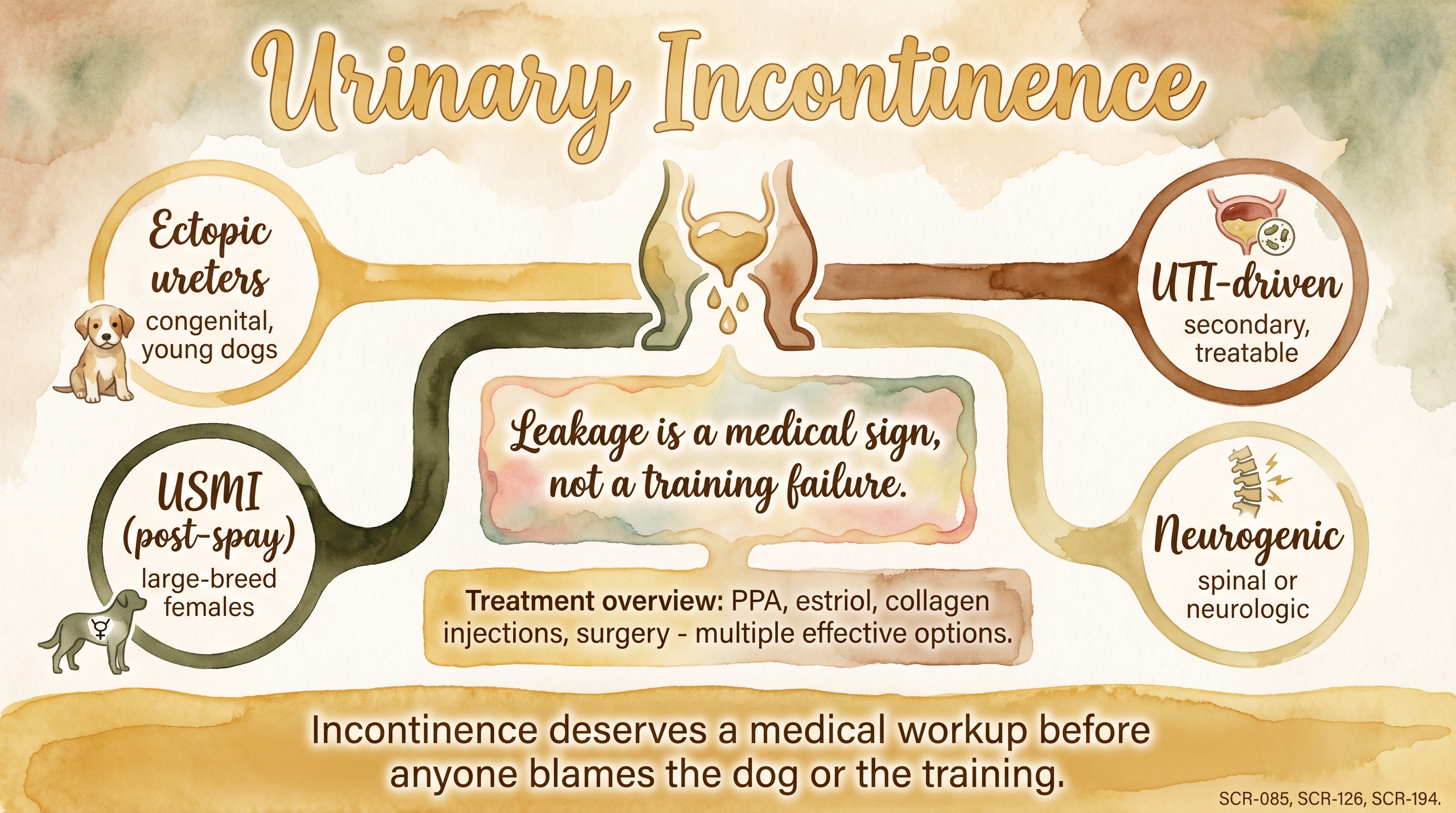
Incontinence deserves a medical workup before anyone blames the dog or the training.
Key Takeaways
- Urinary incontinence is involuntary leakage, not a training failure or a stubborn behavior pattern.
- In Goldens, the two big causes to understand are ectopic ureters in young dogs and USMI in adult spayed females.
- Leakage and recurrent UTI often overlap because continence problems can weaken the normal lower-urinary barrier.
- A dog who leaks while sleeping, dribbles continuously, or never becomes dry deserves a medical workup rather than more pressure.
The Evidence
This entry uses observed claim-level tags beyond the dedicated EvidenceBlocks below. These tags mark JB program observation or practice-derived claims that need dedicated EvidenceBlock coverage in a later content pass.
- SCR-090 supportGolden Retrievers
Goldens are strongly predisposed to ectopic ureters, making continuous juvenile leakage a real breed-specific medical concern. - SCR-085 supportdogs and Golden Retrievers
Urinary incontinence disproportionately affects spayed larger females, with Golden-specific clustering in earlier-spayed groups. - Veterinary urology literaturedogs
USMI is a major cause of passive leakage in adult spayed females and often improves with medical management rather than training intervention.
- Spay-timing literaturedogs
Spaying increases incontinence risk compared with intact status, but the exact incremental effect of timing has historically varied across datasets and study designs. - Continence-outcome literaturedogs
Even after ectopic-ureter correction, residual incontinence may persist because multiple continence mechanisms can be compromised.
- domestic dogs
No published study directly compares the most effective long-term management paths for urinary incontinence in dogs in dogs across breeds and ordinary home settings.
SCR References
Sources
- Forsee, K. M., Davis, G. J., Mouat, E. E., Salmeri, K. R., Bastian, R. P., & Davis, G. J. (2013). Evaluation of the prevalence of urinary incontinence in spayed female dogs: 566 cases (2003-2008). Journal of the American Veterinary Medical Association, 242(7), 959-962. https://doi.org/10.2460/javma.242.7.959
- Byron, J. K., Taylor, K. H., Phillips, G. S., & Stahl, M. S. (2017). Urethral sphincter mechanism incompetence in 163 neutered female dogs: Diagnosis, treatment, and relationship of weight and age at neuter to development of disease. Journal of Veterinary Internal Medicine, 31(2), 442-448. https://doi.org/10.1111/jvim.14678
- Holt, P. E., & Moore, A. H. (1995). Canine ureteral ectopia: An analysis of 175 cases and comparison of surgical treatments. Veterinary Record, 136(14), 345-349. https://doi.org/10.1136/vr.136.14.345
- Forsee, K. M., Davis, G. J., Mouat, E. E., Salmeri, K. R., Bastian, R. P., & Smeak, D. D. (2013). Evaluation of the prevalence of urinary incontinence in spayed female dogs: 566 cases (2003-2008). Journal of the American Veterinary Medical Association, 242(7), 959-962. https://doi.org/10.2460/javma.242.7.959
- Visser, J., Fieten, H., van Velzen, H. W., Zaal, M. D., & Kummeling, A. (2022). Prognostic factors for continence after surgical correction of ectopic ureters of 51 dogs with long-term follow-up. Acta Veterinaria Scandinavica, 64, 37. https://doi.org/10.1186/s13028-022-00648-9