First-Year Health Milestones
Compound evidence detail1 SCR / 2 parts
- Documentedthe WSAVA and AAHA puppy first-year wellness schedule - core vaccine series with final dose at 16 weeks or later (per SCR-196), heartworm and broad-spectrum parasite prevention initiation (per SCR-197), comprehensive physical examinations integrated with the vaccine schedule, age-appropriate nutritional and body-condition monitoring (per SCR-187 and SCR-193), dental-care introduction, and an explicit gonadectomy-timing trade-space conversation (per SCR-194)
- Heuristicthe precise visit count and dollar-budget range for the first year - program-level guidance reflective of practice norms rather than outcome-validated cohort data, with downstream presentation requiring geographic and practice-variation caveats
The first year of a Golden Retrievers health care is not one giant veterinary event. It is a sequence of developmental checkpoints. Families do much better when they know what belongs in each phase, because that changes the experience from reactive scrambling into calm preparation. This page is not a substitute for your own veterinarians schedule. It is a map of the major milestones most families should expect. Documented
What It Means
The First Weeks Home
The earliest goals are simple establish the veterinary relationship; continue the vaccine plan appropriately; start parasite prevention on the right schedule; and get a baseline physical exam and fecal guidance.
This is also the stage when families begin learning how their puppy tolerates handling, transport, and the clinical environment. Documented Calmness matters here. A trusted veterinarian is built before the first crisis, not during it.
The Vaccine Window
The puppy vaccine series is one of the main organizing structures of the first year. Families will usually move through several visits tied to core vaccine completion; non-core vaccine decisions based on geography and lifestyle; and rabies timing.
This is also the stage where controlled socialization matters. The SCR already supports the point that vaccinated puppies in carefully managed classes were not at greater parvovirus risk than vaccinated puppies who stayed out of class. Documented So the first-year roadmap should not collapse into a false choice between health protection and timely development.
Parasite Prevention Starts Early Too
The first year is also when prevention routines become normal. Depending on veterinary plan and geography, this can include heartworm prevention, flea and tick prevention, and fecal testing and deworming guidance. Documented
This is one reason first-year cost surprises families. Routine care is not only vaccines. It is multiple overlapping prevention systems arriving at once.
Growth-Stage Priorities
Golden puppies are not just small adults. Growth-plate timing matters, which means the first year also includes orthopedic common sense avoid repetitive high-impact activity; monitor body condition closely; feed for large-breed growth rather than roundness; and treat sudden lameness seriously even when the puppy still wants to play. Documented
This is the period where prevention has unusually high value because the skeleton is still maturing.
Nutrition and Body Condition
The first year is when many long-term habits are set what food the puppy tolerates; how portions are adjusted; whether the family learns body-condition scoring early; and whether treat inflation becomes normal.
A healthy Golden puppy should grow steadily, not drift into overconditioning because chubbiness feels reassuring. Documented
Why It Matters for Your Dog
Dental Habits Start Here
The first year is also when dental prevention becomes realistic. Families can start mouth handling; gentle tooth-brushing routines; monitoring retained baby teeth; and normalizing oral checks as part of calm care.
This matters because early tolerance is much easier to build than late cooperation.
The Spay-Neuter Timing Conversation
This conversation belongs in the first year even if the surgery does not. A family should not discover the timing literature only after a date has already been chosen out of habit.
For Goldens, the first-year plan should include discussing breed-specific timing evidence, thinking through household management realities, and understanding that joint, cancer, and urinary effects all matter.
The point is not to force a decision early. It is to prevent uninformed defaulting.
Typical Cost Reality
Families are often told what a puppy costs to buy and much less often what a puppy costs to medically steward in year one.
Routine first-year spending usually includes repeated wellness visits, vaccine appointments, fecal tests, preventives, and possible diagnostics for minor puppy problems.
And that is before any emergency or unexpected orthopedic, GI, or skin issue enters the picture. Honest planning reduces resentment and panic later.
The Relationship Piece
One of the least visible milestones is also one of the most important: finding a veterinarian you trust before your dog is sick.
That relationship is easier to build when visits are still routine; questions are still small; and no one is making decisions under fear.
The first year is not only a series of medical checkpoints. It is the setup phase for a decade of future care.
When to See a Veterinarian
A standard milestone plan should accelerate if your puppy shows repeated vomiting or diarrhea, persistent cough, unexplained lameness, recurrent ear or skin trouble, failure to gain appropriately, urinary leakage, and marked behavior change after seeming stable.
The calendar is useful, but the dog in front of you always outranks the calendar.
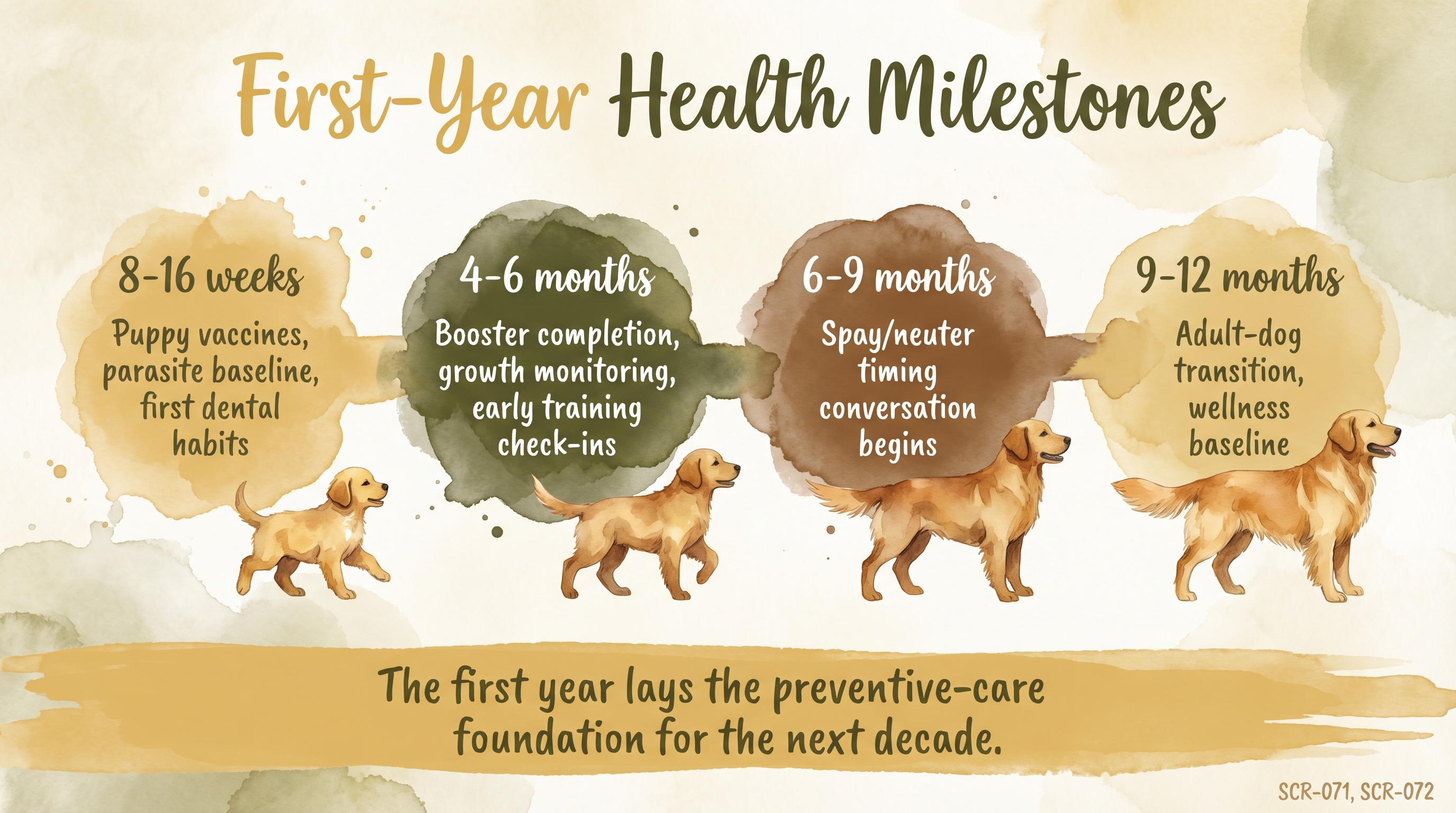
The first year lays the preventive-care foundation for the next decade.
Key Takeaways
- The first year is a sequence of wellness milestones, not one initial puppy exam followed by autopilot.
- Vaccines, parasite prevention, orthopedic common sense, body-condition discipline, and dental habit-building all belong in this same year.
- For Goldens, the spay-neuter timing conversation should happen in the first year even if the surgery date does not.
- The most important hidden milestone is building trust with a veterinarian before any true emergency arrives.
The Evidence
- Puppy-health source synthesisdogs
The first year of care is structured around vaccine timing, parasite prevention, wellness exams, and early veterinary partnership rather than one isolated puppy visit. - SCR-071 supportdogs
Controlled early socialization can coexist with evidence-based vaccine timing because vaccinated class attendees were not at greater parvovirus risk. - SCR-096 supportlarge-breed dogs
Growth-plate timing matters through much of puppyhood, which is why activity and orthopedic common sense belong on the first-year roadmap.
- Wellness-practice logicdogs
Routine first-year care often costs more than families expect because vaccines, preventives, diagnostics, and development-specific decisions all cluster into the same period. - JB health-planning synthesisdogs
The best first-year outcomes usually come from early trust with a veterinarian rather than treating the clinic as a place visited only in crisis.
- domestic dogs
No published study directly tests which preventive-care approach for first-year health milestones produces the best long-term outcome across all Golden Retriever households and clinical settings.
SCR References
Sources
- Creevy, K. E., Grady, J., Little, S. E., Moore, G. E., Strickler, B. G., Thompson, S., & Webb, J. A. (2019). 2019 AAHA canine life stage guidelines. Journal of the American Animal Hospital Association, 55(6), 267-290. https://doi.org/10.5326/JAAHA-MS-6999
- American Animal Hospital Association. (2022). 2022 AAHA canine vaccination guidelines. https://www.aaha.org/resources/2022-aaha-canine-vaccination-guidelines/
- Companion Animal Parasite Council. (n.d.). CAPC guidelines. https://capcvet.org/guidelines/
- World Small Animal Veterinary Association. (n.d.). Global nutrition guidelines. https://wsava.org/global-guidelines/global-nutrition-guidelines/
- von Pfeil, D. J. F., & DeCamp, C. E. (2009). The epiphyseal plate: Physiology, anatomy, and trauma. Compendium: Continuing Education for Veterinarians, 31(8), E1-E11. https://pubmed.ncbi.nlm.nih.gov/19753989/