Emergency Red Flags
Compound evidence detail1 SCR / 2 parts
- Documentedthe canonical canine emergency red flags - unproductive retching with abdominal distention (possible GDV), collapse or pale gums (possible internal hemorrhage, hypovolemia, or cardiac disease), repeated vomiting with inability to retain water, suspected toxin ingestion, difficulty breathing or cyanosis, prolonged or cluster seizures, severe trauma, acute limb-use loss, inability to urinate, and heatstroke - each linked in canine emergency-medicine reference texts to a critical underlying problem warranting prompt veterinary evaluation rather than watchful waiting
- Observed-JBthe documented reduction in time-to-care that comes from family preparation in advance - knowing the nearest emergency hospital, a backup hospital, and a poison control number - recognized across emergency-medicine practice but not quantified in a published controlled outcome trial
This page exists for one reason: some signs should end the wait-and-watch debate immediately. Families do not need to diagnose the exact disease at home. They do need to recognize when time matters more than certainty. Golden Retrievers are not the highest-risk breed for every emergency, but they are large enough, active enough, and cancer-burdened enough that every family should know the red flags before the day they need them. Documented
What It Means
Use This Page as a Triage Reference
If your dog has any of the signs below, the right question is usually not "What is this exactly?" Observed-JB It is "Do I need emergency veterinary care right now?"
In the situations below, the answer is often yes.
Why It Matters for Your Dog
Prepare Before the Emergency
The best time to find emergency care is before you need it.
Every Golden family should know the nearest emergency hospital, the backup emergency hospital, the route and drive time, the phone number, and whether the hospital is open 24 hours. Documented
The worst time to learn your regular veterinarian is closed is when your dog is already crashing.
The Calmness Principle Here
This page is about urgency, not panic. Calm transport and quick action help more than frantic guessing. If you know enough to recognize a red flag, you know enough to seek help.
When to See a Veterinarian
Go Now: Breathing Trouble
Emergency care is warranted for open-mouth breathing when not hot or exercising, marked abdominal effort to breathe, blue, gray, or very pale gums, and collapse with breathing difficulty.
Respiratory problems can deteriorate quickly. Do not wait overnight on these signs.
Go Now: GDV or Severe Abdominal Crisis
Treat this as an emergency if your dog shows repeated unproductive retching, a suddenly distended or tight abdomen, intense restlessness, drooling with obvious distress, and attempts to vomit with nothing coming up.
This is the classic bloat or gastric-dilatation-volvulus picture families need to remember once and never forget.
Go Now: Collapse, Fainting, or Sudden Extreme Weakness
Emergency assessment is needed for collapse, fainting, inability to stand, sudden profound weakness, and sudden pale gums.
In Goldens, this matters especially because catastrophic internal-bleeding events, including some hemangiosarcoma presentations, can look like sudden weakness before families know the dog was sick at all.
Go Now: Repeated Vomiting or Cannot Keep Water Down
Seek urgent care if your dog vomits repeatedly over a short period; cannot keep water down; seems painful or bloated; is becoming weak or dehydrated; and has vomit with blood or coffee-ground material.
This can move from simple GI upset to dehydration or something much more serious quickly.
Go Now: Known Toxin Exposure
Do not wait if your dog may have ingested xylitol; rodenticide; chocolate in meaningful quantity; grapes or raisins; human medications; and antifreeze.
If you know the toxin, tell the clinic before arrival. Call poison control if directed, but do not let phone time delay transport when a true toxin is involved.
Go Now: Cannot Urinate or Is Straining Repeatedly
Repeated straining with little or no urine, obvious pain, or a male dog trying and failing to urinate is urgent. Urinary obstruction is not something to monitor at home.
Even without a full obstruction, painful or repeated straining deserves rapid evaluation.
Go Now: Seizure Longer Than a Few Minutes or Repeated Seizures
Emergency care is warranted for any seizure lasting several minutes, repeated seizures close together, and failure to recover normally between seizures.
Keep the dog safe from injury, but do not put your hands near the mouth during the event.
Go Now: Severe Bleeding or Major Trauma
Emergency care is needed for major wounds, hit-by-car trauma, falls with obvious pain or instability, uncontrolled bleeding, and suspected fracture with severe distress.
Transport calmly and keep movement limited where possible.
Go Now: Extreme Pain
Families should trust obvious pain signals more than they often do. Emergency or same-day evaluation is warranted for crying out repeatedly, rigid or hunched posture, unwillingness to move, marked abdominal guarding, and obvious distress that is not settling.
Pain is itself a red flag even before the cause is clear.
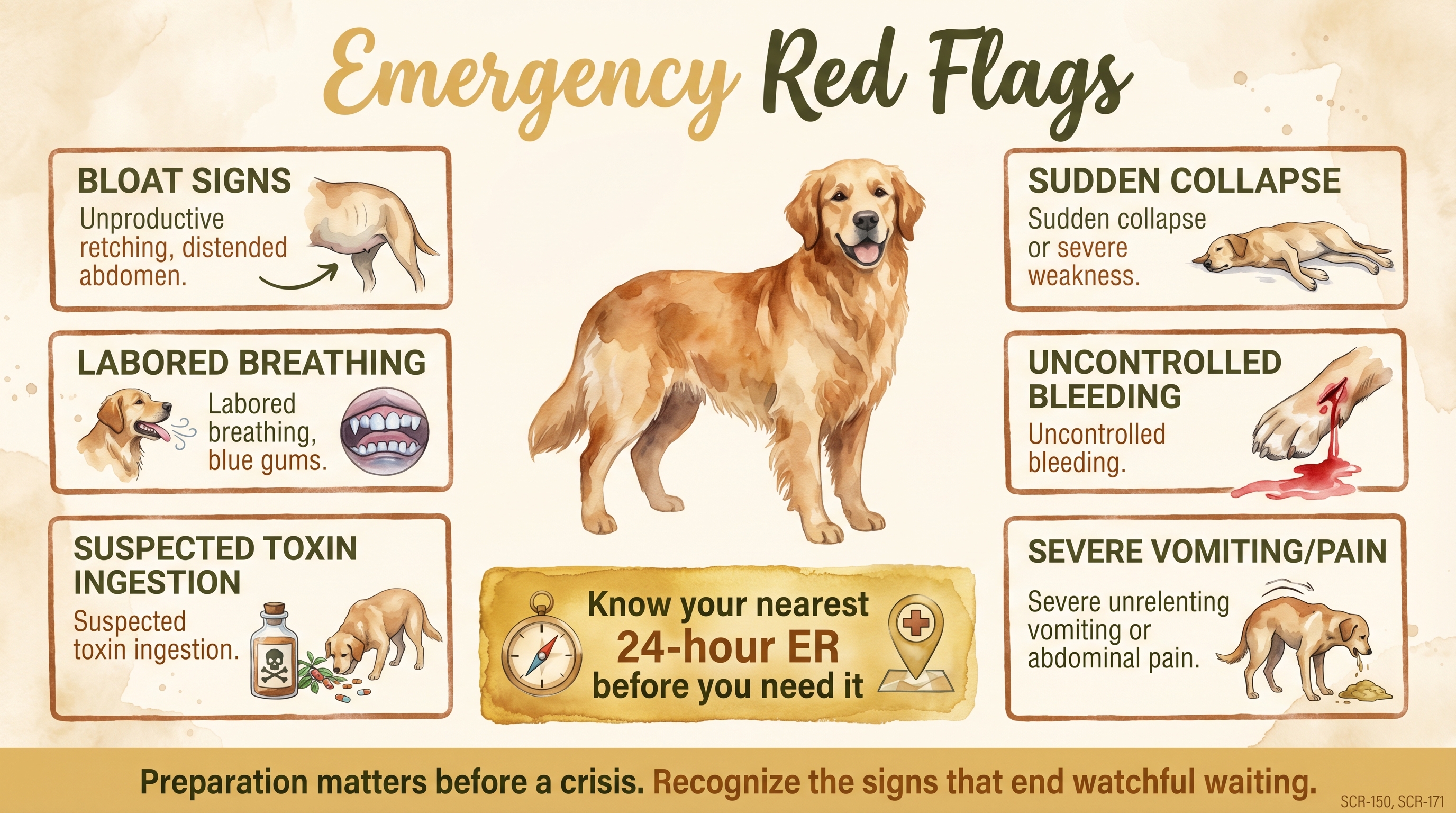
Preparation matters before a crisis - recognize the signs that end watchful waiting.
Key Takeaways
- Families do not need to diagnose the exact emergency at home. They need to recognize when time matters more than certainty.
- Breathing trouble, bloat signs, collapse, toxin exposure, urinary obstruction, repeated seizures, and severe trauma all belong in the emergency bucket.
- Sudden pale-gum weakness in a Golden should be taken especially seriously because catastrophic internal disease can present that way.
- Knowing your emergency clinic options in advance is part of preventive care, not an optional extra.
The Evidence
This entry uses observed claim-level tags beyond the dedicated EvidenceBlocks below. These tags mark JB program observation or practice-derived claims that need dedicated EvidenceBlock coverage in a later content pass.
- Common-puppy-health source synthesisdogs
Breathing distress, bloat signs, collapse, prolonged vomiting, toxin ingestion, urinary obstruction, prolonged seizure, and major trauma are classic veterinary emergencies rather than watch-and-wait problems. - Emergency-medicine logicdogs
The core triage skill for families is recognizing when speed matters more than certainty, especially in deep-chested and large-breed dogs.
- Golden-health synthesisGolden Retrievers
Golden later-life cancer burden means sudden weakness or pale-gum collapse should not be dismissed casually because some serious internal events can present abruptly. - Family-safety planningdogs
Advance knowledge of emergency-hospital options meaningfully improves response quality even though it is a preparedness step rather than a disease-specific treatment.
No published study directly tests the specific Just Behaving guidance on emergency red flags. This entry relies on broader canine evidence, breeder observation, and practical synthesis.
SCR References
Sources
- Creevy, K. E., Grady, J., Little, S. E., Moore, G. E., Strickler, B. G., Thompson, S., & Webb, J. A. (2019). 2019 AAHA canine life stage guidelines. Journal of the American Animal Hospital Association, 55(6), 267-290. https://doi.org/10.5326/JAAHA-MS-6999
- Companion Animal Parasite Council. (n.d.). CAPC guidelines. https://capcvet.org/guidelines/
- American Heartworm Society. (2024). Current canine guidelines for the prevention, diagnosis, and management of heartworm infection in dogs. https://www.heartwormsociety.org/veterinary-resources/american-heartworm-society-guidelines
- Boundary approved by Queue1-DecisionTree: the existing AAHA life-stage / preventive-care citations provide partial family-facing triage context, while SCR-201's canonical emergency-medicine source is Drobatz et al., Textbook of Small Animal Emergency Medicine. No separate peer-reviewed primary-source list matching this page's full red-flag set was located. The row remains a veterinary-emergency boundary note, not a substitute for emergency veterinary evaluation.