Parasite Prevention in Dogs
Compound evidence detail1 SCR / 2 parts
- Documentedthe year-round canine heartworm prevention standard advanced by the Companion Animal Parasite Council and the American Heartworm Society given heartworm's geographic expansion and the cost-and-morbidity asymmetry between prevention and adulticide treatment; the strong efficacy of the isoxazoline class (afoxolaner, fluralaner, sarolaner, lotilaner) for flea and tick control; and the FDA class-wide labeling acknowledging neurologic adverse events in a small subset of treated dogs that warrant informed-choice disclosure
- Observed-JBgeographic variability in tick-borne disease exposure across the United States, recognized in current CAPC mapping but not stratified at the resolution that would let a single national protocol fit every region
Parasite prevention is not one product decision. It is three different preventive conversations bundled together: mosquito-borne heartworm, flea and tick control, and intestinal parasite management. Golden families in New England especially need to think beyond the old seasonal mindset because the parasite landscape has shifted. Ticks are a year-round concern more often than people realize, heartworm geography is not static, and intestinal parasites remain common enough in puppyhood that diagnostic and treatment literacy matter. Documented
What It Means
The Three Main Buckets
The easiest way to stay organized is to separate parasite prevention into three buckets.
Heartworm
Heartworm is mosquito-borne and potentially serious. Prevention is usually built around monthly macrocyclic lactone products or combination preventives.
The key family-level idea is simple prevention is far easier than treatment; treatment is more burdensome and medically consequential than many families assume; and geographic range and exposure risk have expanded rather than stayed fixed. Documented
Fleas and Ticks
For New England dogs, ticks are the center of gravity in this bucket. The main diseases families hear about most are Lyme disease; anaplasmosis; and ehrlichiosis.
The reason year-round prevention is now discussed more often is that tick activity does not vanish cleanly with older winter expectations. Mild periods and regional ecology keep exposure relevant longer than many people think.
Intestinal Parasites
This bucket includes roundworms, hookworms, whipworms, tapeworms, and protozoal issues like Giardia and Coccidia in younger dogs. Documented
This is where prevention overlaps with screening, sanitation, and evidence-based treatment rather than only continuous medication.
Product Categories
Most families encounter three broad product forms oral preventives; topical preventives; and combination products that cover more than one parasite class. Documented
The right choice depends on the dog, the household, local ecology, travel, and how reliably the product can actually be given. Documented
The best preventive is not the one with the most marketing. It is the one that fits the dogs real exposure pattern and will be used consistently.
The New England Tick Reality
In the Northeast, tick prevention is not optional background noise. It is one of the central realities of routine dog care.
A practical New England frame includes Lyme is endemic, anaplasmosis is common enough to matter, multiple tick species extend exposure windows, and wooded yards and suburban edges are not low-risk just because they are familiar.
This is why many veterinarians now talk about year-round tick control as a default baseline rather than a summer-only intervention.
The Isoxazoline Conversation
Modern parasite prevention often runs through the isoxazoline class because it is effective and convenient. Families should know two things at once these products are widely used because they work; and they do carry a real neurologic adverse-event warning in a small subset of dogs.
That does not mean the class should be treated as unacceptable. It does mean informed use is better than blind acceptance. A dog with a seizure history or neurologic concern deserves a more careful product conversation than a dog with no such history. Documented
Why It Matters for Your Dog
Heartworm Prevention Still Matters in the North
Some families still think heartworm prevention is a southern issue. That is outdated enough to be risky.
Heartworm depends on mosquito ecology, travel patterns, climate, and preventive consistency. The safe practical lesson is that a northern address does not exempt a dog from the heartworm conversation.
Puppies Need Prevention and Diagnostics
Puppy parasite management should not become a reflexive everything-all-at-once chemical pileup without thought. The stronger stewardship model is start necessary prevention on time; use fecal testing intelligently; treat documented intestinal burdens appropriately; and do not treat diagnostics as optional.
That is especially important in puppies with GI symptoms, because parasites and post-transition stress often overlap.
Environmental Management Still Matters
Medication is not the only preventive tool.
Families can reduce parasite pressure by prompt stool pickup; tick checks after outdoor exposure; keeping dogs out of obviously contaminated standing water; avoiding overgrown tick-heavy areas when possible; and maintaining communication with their veterinarian about local parasite trends.
This is not anti-medication. It is what good prevention looks like when it is not reduced to buying one chewable.
When to See a Veterinarian
See or call your veterinarian if your dog has vomiting or diarrhea that may fit parasite burden; visible worms or segments in stool; sudden lethargy after tick exposure; fever, joint pain, or loss of appetite after tick season or travel; coughing or exercise intolerance where heartworm or other disease needs consideration; and neurologic signs after starting a new preventive.
Urgent care is appropriate for significant weakness, repeated vomiting, collapse, or neurologic symptoms.
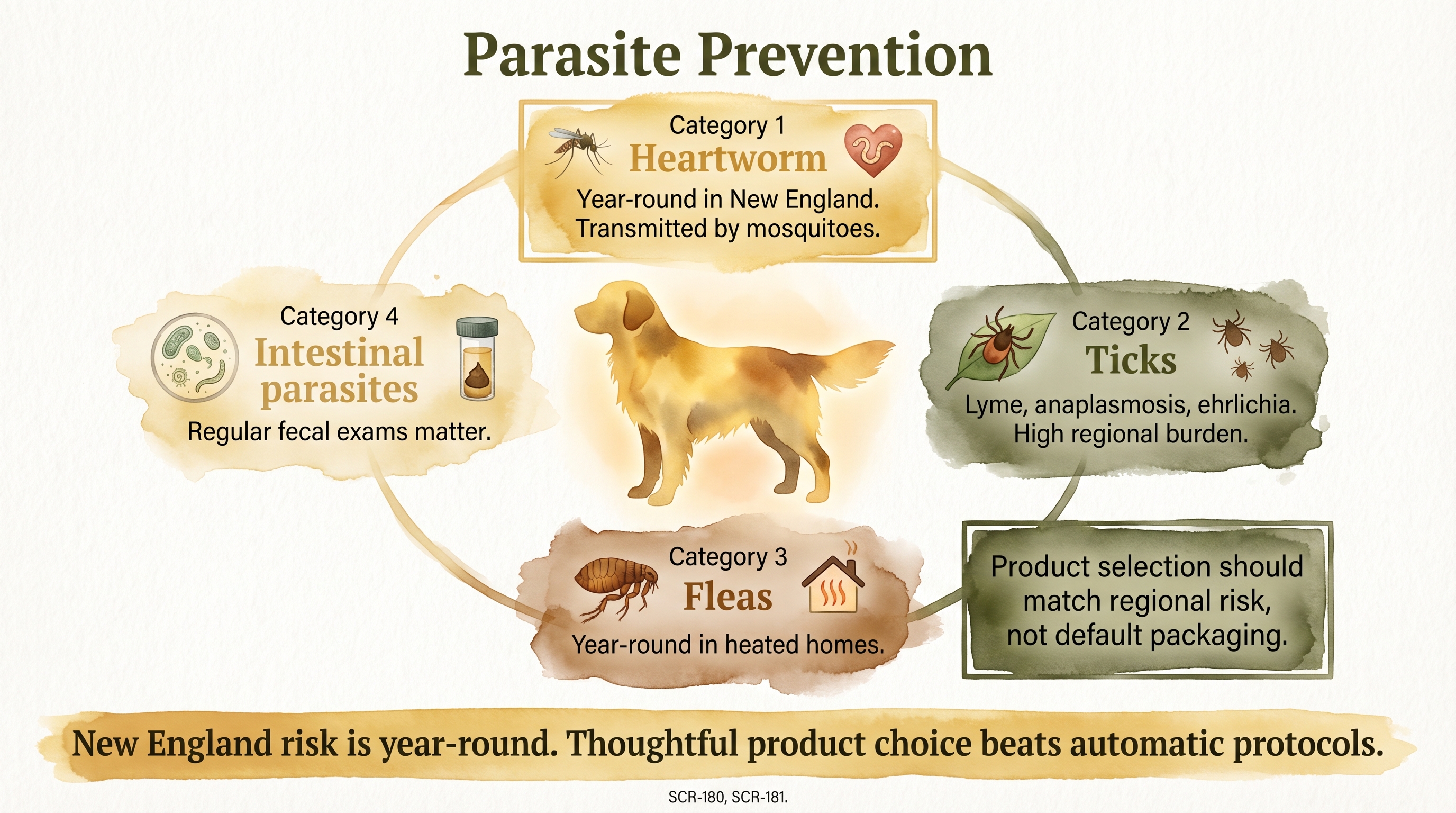
New England risk is year-round - thoughtful product choice beats automatic protocols.
Key Takeaways
- Parasite prevention means three separate conversations: heartworm, fleas and ticks, and intestinal parasites.
- For New England dogs, tick prevention is a major year-round issue rather than a narrow summer concern.
- Product choice should be informed, especially when neurologic history or side-effect sensitivity is part of the picture.
- Good prevention combines medication with diagnostics, stool hygiene, tick checks, and real veterinary follow-up.
The Evidence
- Puppy-health source synthesisdogs
Modern parasite prevention is built around heartworm control, flea-tick management, and diagnostics-guided intestinal parasite stewardship rather than one undifferentiated plan. - GI source synthesisdogs
Protozoal and intestinal parasite burdens remain common enough in puppies that fecal testing and environmental hygiene still matter alongside treatment decisions. - Regional veterinary practicedogs
In the Northeast, tick-borne disease exposure is strong enough that year-round prevention is now widely treated as the practical baseline rather than a summer-only concern.
- Puppy-health source synthesisdogs
Isoxazoline-class products are effective and widely used, but families should know they carry a documented neurologic adverse-event warning in a small number of dogs. - Preventive-stewardship logicdogs
The best product choice depends on the dogs exposure pattern, household reliability, and medical context rather than on convenience alone.
- domestic dogs
No published study directly tests which preventive-care approach for parasite prevention in dogs produces the best long-term outcome across all Golden Retriever households and clinical settings.
SCR References
Sources
- Companion Animal Parasite Council. (n.d.). CAPC guidelines. https://capcvet.org/guidelines/
- American Heartworm Society. (2024). Current canine guidelines for the prevention, diagnosis, and management of heartworm infection in dogs. https://www.heartwormsociety.org/veterinary-resources/american-heartworm-society-guidelines
- Creevy, K. E., Grady, J., Little, S. E., Moore, G. E., Strickler, B. G., Thompson, S., & Webb, J. A. (2019). 2019 AAHA canine life stage guidelines. Journal of the American Animal Hospital Association, 55(6), 267-290. https://doi.org/10.5326/JAAHA-MS-6999
- Companion Animal Parasite Council. (n.d.). CAPC guidelines: General guidelines for dogs and cats. Retrieved April 30, 2026, from https://capcvet.org/guidelines/general-guidelines/
- Creevy, K. E., Grady, J., Little, S. E., Moore, G. E., Strickler, B. G., Thompson, S., & Webb, J. A. (2019). 2019 AAHA canine life stage guidelines. Journal of the American Animal Hospital Association, 55(6), 267-290. https://doi.org/10.5326/JAAHA-MS-6999