Hemangiosarcoma
Compound evidence detail1 SCR / 2 parts
- Ambiguousany single percentage figure presented as a universal Golden Retriever cancer constant without naming the population, study design, or referral basis
- Documentedthe necropsy and referral cohort findings themselves; cancer as a leading cause of death in Golden Retrievers with honest sourcing and explicit dataset attribution
Hemangiosarcoma is the cancer Golden Retriever families dread most, and for understandable reasons. It is aggressive, often clinically silent until late, and sometimes first appears as an emergency rather than a gradually unfolding illness. The disease arises from vascular endothelial cells, which means it forms tumors built from abnormal blood-vessel tissue. Those tumors are fragile. When they rupture, a dog can bleed internally with little warning. Documented
What It Means
Why This Diagnosis Feels So Sudden
The most feared feature of hemangiosarcoma is not only that it is malignant. It is that the first recognizable crisis is often collapse.
The classic scenario involves a splenic mass that has grown quietly for some time. A dog may seem mostly normal, perhaps with subtle slowing, mild abdominal fullness, or intermittent tired days that are easy to explain away. Documented Then the mass bleeds. The dog becomes weak, pale, shaky, or collapses outright. By the time the family arrives at an emergency hospital, they are hearing about a splenic tumor, abdominal blood, and urgent surgery all in the same conversation.
That pattern is emotionally brutal because it compresses what would normally be months of adjustment into a single evening.
Where Hemangiosarcoma Usually Appears
In dogs, hemangiosarcoma most commonly arises in the spleen; the right atrium or right auricle of the heart; the liver; and the skin or subcutaneous tissues.
For Golden families, the spleen and heart presentations dominate the public understanding because they are the ones most often associated with catastrophic bleeding and sudden death. Observed-JB
Splenic hemangiosarcoma can bleed into the abdomen. Cardiac hemangiosarcoma, especially in the right atrium, can bleed into the pericardial sac around the heart and cause tamponade, a condition in which pressure from fluid prevents the heart from filling normally.
Why Goldens Matter in This Conversation
Goldens are one of the iconic hemangiosarcoma breeds. That does not mean every Golden will get it, and it does not mean mixed-breed dogs are spared. Ambiguous It does mean the breed is sufficiently overrepresented that hemangiosarcoma belongs in any honest Golden health discussion.
The current SCR also anchors a more specific point: Golden-specific genomic regions have been associated with meaningful hemangiosarcoma risk. Documented That does not make the disease genetically simple. It does reinforce that this is a real breed-burden problem, not just a collection of isolated tragedies.
What Families May Notice Before the Crisis
Early signs can be frustratingly subtle lower stamina; decreased enthusiasm for exercise; mild abdominal enlargement; intermittent weakness; pale gums after activity; and one or two "off" episodes that seem to pass.
These signs are not specific to hemangiosarcoma. That is part of the problem. They can look like ordinary aging, heat sensitivity, stomach upset, or a vague bad day. The disease is good at hiding in ambiguity.
How Diagnosis Usually Happens
Diagnosis often begins with imaging because a crisis or routine workup reveals a mass.
Common pieces of the workup include abdominal ultrasound, chest imaging, bloodwork, evaluation for free abdominal fluid, and echocardiography if cardiac involvement is suspected.
The hardest clinical truth here is that not every splenic mass is hemangiosarcoma. Some are benign hematomas or other non-malignant lesions. That distinction often cannot be made with certainty before surgery. Families are frequently asked to decide about splenectomy under uncertainty.
Definitive diagnosis comes from histopathology after surgical removal or tissue sampling. In real life, that means many families first hear "suspected hemangiosarcoma" and only later receive a confirmed diagnosis.
Why It Matters for Your Dog
Treatment Pathways
For splenic disease, splenectomy is often the first major step. Surgery may be lifesaving in the immediate sense because it removes the bleeding organ and stabilizes the dog. It is not usually curative if the tumor is malignant.
Chemotherapy is commonly discussed after surgery, most often doxorubicin-based protocols. The purpose is not normally cure. It is extension of survival time and, in many cases, preservation of reasonable quality of life for a period.
For cardiac cases, management may involve pericardiocentesis if there is tamponade, followed by oncology and cardiology discussions about whether surgery, chemotherapy, palliative care, or euthanasia is the most humane path.
This is one of the diseases where humane decision-making matters as much as aggressive medicine. A family is not failing if they choose comfort-focused care in a disease with a grim trajectory.
Prognosis
Hemangiosarcoma carries a poor prognosis overall. Median survival is short without intervention, and even with surgery plus chemotherapy it is often measured in months rather than years.
That does not mean every dog follows the median. Some do better for longer. Some are lost much sooner, especially if diagnosis occurs during a severe bleed or after significant metastasis.
Families do best when the prognosis is framed with clarity surgery may buy time; chemotherapy may buy additional time; neither is usually presented as a cure; and quality of life matters more than maximizing the calendar at any cost.
The Screening Problem
Families often ask the most painful question of all: could this have been found earlier?
Sometimes yes, but often not in a way that would have predictably changed the story. There is no universally accepted routine screening test that reliably finds internal hemangiosarcoma early enough in asymptomatic dogs to transform outcomes. Ultrasound can sometimes detect masses before rupture, especially if a dog is imaged for some other reason, but broad screening protocols for apparently healthy dogs remain an unsettled area.
This is why hemangiosarcoma research continues to focus on biomarkers, liquid biopsy concepts, and better early-detection tools. Documented The need is obvious. The fully solved answer is not here yet.
What This Means for Golden Families
The right posture is not panic. It is seriousness.
Golden families should know what hemangiosarcoma is, understand the collapse scenario, and recognize that older Goldens with vague episodic weakness deserve veterinary attention. They should also know that this disease is not caused by one missed supplement, one wrong dinner, or one single family mistake.
At the breed level, the larger lesson is that breeders must take cancer history seriously, track line outcomes honestly, and stop speaking as though passing early-life screenings settles the main health story.
When to See a Veterinarian
Veterinary evaluation is warranted for sudden weakness or collapse, pale or white gums, swollen or distended abdomen, repeated episodes of seeming faint or wobbly, rapid breathing or distress at rest, and unexplained lethargy in an older Golden.
Immediate emergency evaluation is appropriate for collapse, pale gums, marked weakness, or signs of abdominal distress.
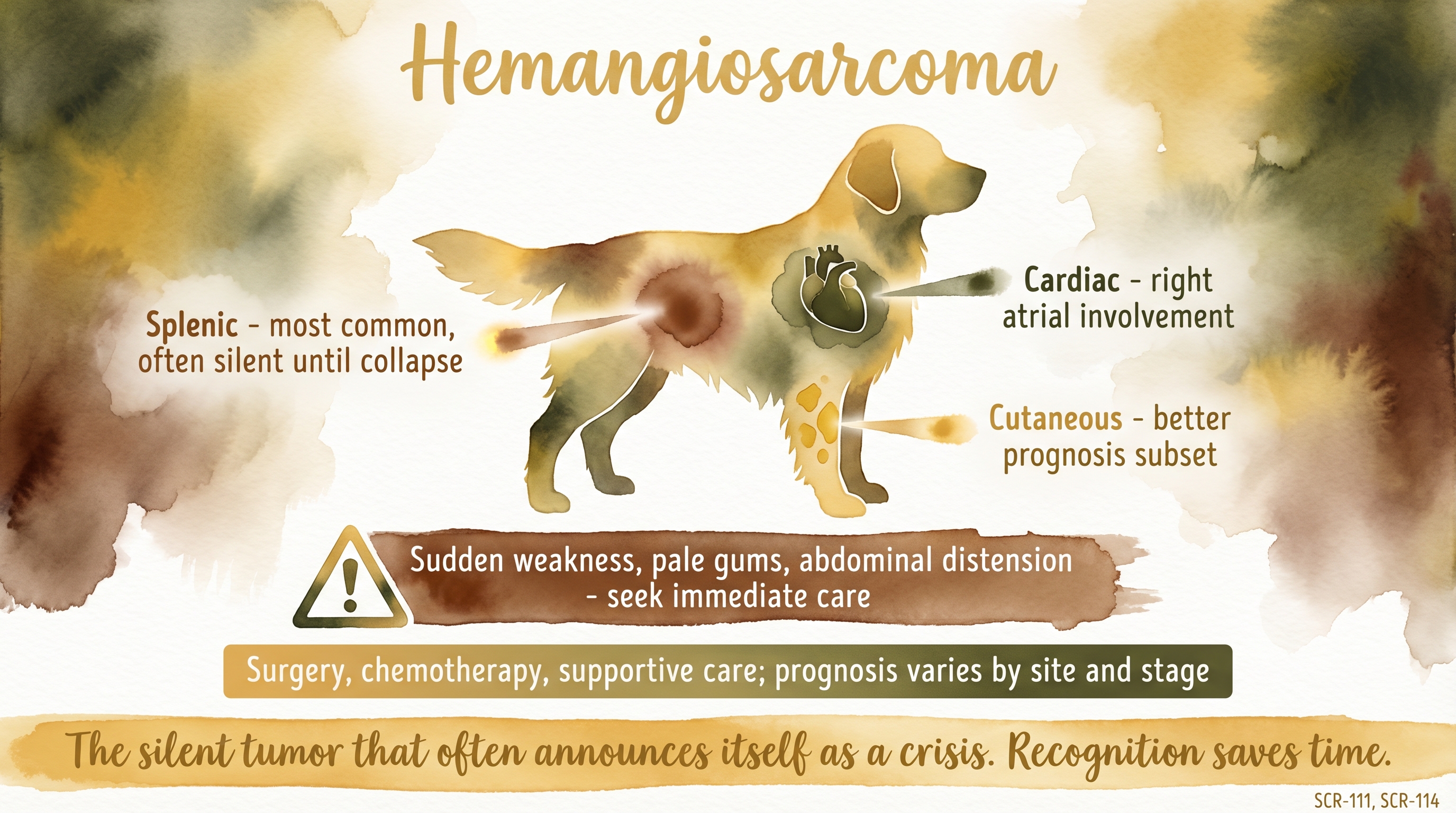
The silent tumor that often announces itself as a crisis - recognition saves time.
Key Takeaways
- Hemangiosarcoma is one of the most important and most devastating cancers in Golden Retrievers because it often presents as sudden internal bleeding.
- Diagnosis usually begins with imaging and stabilization, but definitive confirmation commonly comes only after surgery or histopathology.
- Treatment can extend time and preserve comfort for some dogs, but the overall prognosis remains poor and quality-of-life decisions are central.
- Golden families should know the red-flag signs, especially collapse, pale gums, abdominal distension, and intermittent weakness in older dogs.
The Evidence
This entry uses observed claim-level tags beyond the dedicated EvidenceBlocks below. These tags mark JB program observation or practice-derived claims that need dedicated EvidenceBlock coverage in a later content pass.
This entry uses ambiguous claim-level tags beyond the dedicated EvidenceBlocks below. These tags mark claims where the literature remains unsettled or multiple interpretations coexist.
- Golden cancer epidemiology sourcesGolden Retrievers
Hemangiosarcoma is one of the major cancers driving Golden Retriever mortality statistics. - Veterinary oncology literaturedogs
Splenic and cardiac hemangiosarcoma often present with internal bleeding, weakness, collapse, and poor overall prognosis. - SCR-111 supportGolden Retrievers
Golden-specific genomic regions account for a meaningful share of hemangiosarcoma risk architecture within the breed.
- Early-detection boundarydogs
There is still no universally accepted routine screening strategy that reliably catches internal hemangiosarcoma early enough to transform outcomes in asymptomatic dogs. - Family-level prediction limitGolden Retrievers
Known breed risk does not yet translate into individualized certainty about which dog will develop the disease and when.
SCR References
Sources
- Fleming, J. M., Creevy, K. E., & Promislow, D. E. L. (2011). Mortality in North American dogs from 1984 to 2004: An investigation into age-, size-, and breed-related causes of death. Journal of Veterinary Internal Medicine, 25(2), 187-198. https://doi.org/10.1111/j.1939-1676.2011.0695.x
- Guy, M. K., Page, R. L., Jensen, W. A., et al. (2015). The Golden Retriever Lifetime Study: Establishing an observational cohort study with translational relevance for human health. Philosophical Transactions of the Royal Society B, 370(1673), 20140230. https://doi.org/10.1098/rstb.2014.0230
- Christensen, J., Johnson, K., Ettinger, S., Garrett, L., Gordon, I., Ireifej, S., Love, A., & Wisecup, M. (2026). 2026 AAHA oncology guidelines for dogs and cats. Journal of the American Animal Hospital Association, 62(1), 1-37. https://doi.org/10.5326/JAAHA-MS-7549
- Re-sharpened by Queue1-DecisionTree: Ko, S., Jang, J., Yi, S. S., & Kwon, C. (2024). Early detection of canine hemangiosarcoma via cfDNA fragmentation and copy number alterations in liquid biopsies using machine learning. Frontiers in Veterinary Science. https://doi.org/10.3389/fvets.2024.1489402. This supports emerging canine HSA liquid-biopsy detection research, but does not verify a Golden Retriever-specific household screening protocol, does not verify SCR-111's chromosome-5 GWAS claim, and does not move SCR-067, SCR-111, or SCR-114.