Lymphoma in Golden Retrievers
Compound evidence detail2 SCRs / 5 parts
- Ambiguousany single percentage figure presented as a universal Golden Retriever cancer constant without naming the population, study design, or referral basis
- Documentedthe necropsy and referral cohort findings themselves; cancer as a leading cause of death in Golden Retrievers with honest sourcing and explicit dataset attribution
- Documentedlymphoma subtype classification, the approximately 12-month median survival on CHOP for large-cell B-cell multicentric disease, the materially different outcomes between T-cell and B-cell lymphoma, and the typical 4 to 8 week untreated disease course
- DocumentedGolden Retriever over-representation in lymphoma incidence relative to the mixed-breed canine base rate, presented as a directional epidemiologic signal rather than a fixed ratio
- Estimatedany specific numerical figure for Golden Retriever lifetime lymphoma incidence - dataset-dependent and not citable as a single universal breed constant
Lymphoma is one of the most common cancers diagnosed in Golden Retrievers, and it is one of the few major canine cancers that often announces itself before a crisis. Many families first notice enlarged lymph nodes rather than collapse or internal bleeding. That does not make the diagnosis easy, but it does mean lymphoma usually enters the story through investigation rather than emergency shock. Documented
What It Means
What Lymphoma Is
Lymphoma is a malignancy of lymphocytes, the immune cells that normally help defend the body. Because lymphocytes travel widely, lymphoma is not a disease of one organ only. It can involve lymph nodes, spleen, liver, bone marrow, gastrointestinal tract, skin, and mediastinal structures in the chest.
The most familiar form in dogs is multicentric lymphoma, in which multiple peripheral lymph nodes become enlarged. This is the form most families notice at home.
Other forms include gastrointestinal lymphoma, mediastinal lymphoma, cutaneous lymphoma, and extranodal disease affecting other tissues. Documented
Why Goldens Matter Here
Golden Retrievers are overrepresented in lymphoma discussions compared with the general dog population. Breed predisposition does not mean every enlarged lymph node in a Golden is lymphoma. It does mean lymphoma belongs high on the differential list when a middle-aged or older Golden presents with generalized lymphadenopathy.
The breed is also notable because some studies suggest Goldens may carry a meaningful burden of T-cell disease in addition to B-cell disease, and that matters prognostically. Documented In broad terms, B-cell lymphoma often carries a better expected response to standard chemotherapy than T-cell lymphoma.
What Families Usually Notice First
The classic first sign is painless enlargement of several lymph nodes at once. The nodes under the jaw, in front of the shoulders, and behind the knees are the easiest for families to feel.
Other signs may include reduced appetite, lethargy, weight loss, increased thirst or urination, vomiting or diarrhea if the gastrointestinal tract is involved, and breathing difficulty if disease is in the chest. Documented
The key practical point is that the nodes are often not painful. A dog can seem almost normal except for the obvious swellings. Documented That combination of large nodes and relatively preserved mood is why lymphoma surprises families who understandably expect cancer to look sicker.
How Diagnosis Is Made
One of the more merciful aspects of lymphoma is that diagnosis is often straightforward.
Fine-needle aspirate cytology of an enlarged lymph node is commonly diagnostic. It is quick, minimally invasive, and often does not require anesthesia. If cytology is inconclusive or if more detailed characterization is needed, veterinarians may use flow cytometry; immunophenotyping; PARR testing; biopsy; and staging imaging and bloodwork.
Those additional tests help determine subtype, stage, and treatment planning.
What Staging Means
Staging in lymphoma asks how widely the disease is distributed. It may include bloodwork, imaging, liver and spleen assessment, and sometimes bone marrow evaluation. Substage also matters substage a means the dog feels clinically well and substage b means the dog is clinically ill.
This distinction has real prognostic value. Dogs that are still feeling well at diagnosis often do better than dogs who are already systemically unwell.
Why It Matters for Your Dog
Treatment Landscape
The gold-standard treatment for multicentric lymphoma in dogs is combination chemotherapy, commonly CHOP-based protocols. These protocols are designed to induce remission, not usually cure. In canine oncology, remission means the detectable disease becomes clinically undetectable for a time.
Other approaches may include modified multi-agent protocols, single-agent chemotherapy, prednisone-based palliative care, and supportive management where full chemotherapy is not pursued.
One important family concern deserves saying clearly: many dogs tolerate chemotherapy much better than people expect. Veterinary oncology is usually quality-of-life oriented. The goal is not to push treatment at all costs. It is to balance time and comfort.
Prognosis
Prognosis depends on subtype, stage, immunophenotype, substage, and treatment chosen.
Broadly without treatment, survival is often measured in weeks; with standard chemotherapy, many dogs achieve remission measured in months; and B-cell disease often outperforms T-cell disease. Observed-JB
These are medians, not promises. Some dogs have shorter courses, some longer ones. Families benefit from hearing the prognosis in plain language: lymphoma is often treatable for a period, but the disease usually returns.
Why This Entry Matters for Golden Families
Lymphoma occupies a different emotional place than hemangiosarcoma.
Hemangiosarcoma often feels like catastrophe. Lymphoma often feels like a long, difficult set of choices. Families may have time to decide whether to stage, whether to pursue CHOP, whether to opt for a simpler protocol, or whether to choose palliative care. The emotional burden is therefore less about suddenness and more about sustained uncertainty.
This is why calm framing matters. A lymphoma diagnosis is serious. It is not automatically an immediate death sentence. Good veterinary oncology can sometimes provide meaningful good-quality time.
The Breeding and Population Angle
At the breed level, lymphoma is one more reason Goldens cannot be marketed with shallow health language. Passing early-life screenings does not erase later-life cancer risk. Programs that do not track cancer by line, age, and subtype are not watching the part of breed health that hurts families most.
The better approach is longitudinal honesty: know which lines show repeat lymphoma burden, understand that complex cancer inheritance rarely reduces to one DNA panel, and avoid pretending that lack of visible disease at age two predicts clean aging.
When to See a Veterinarian
Veterinary evaluation is warranted for enlarged lymph nodes, unexplained weight loss, persistent lethargy, decreased appetite, chronic vomiting or diarrhea, and increased thirst or urination without clear explanation.
If your Golden has several enlarged lymph nodes at once, especially if they are firm and painless, schedule an appointment promptly rather than waiting to see if they shrink on their own.
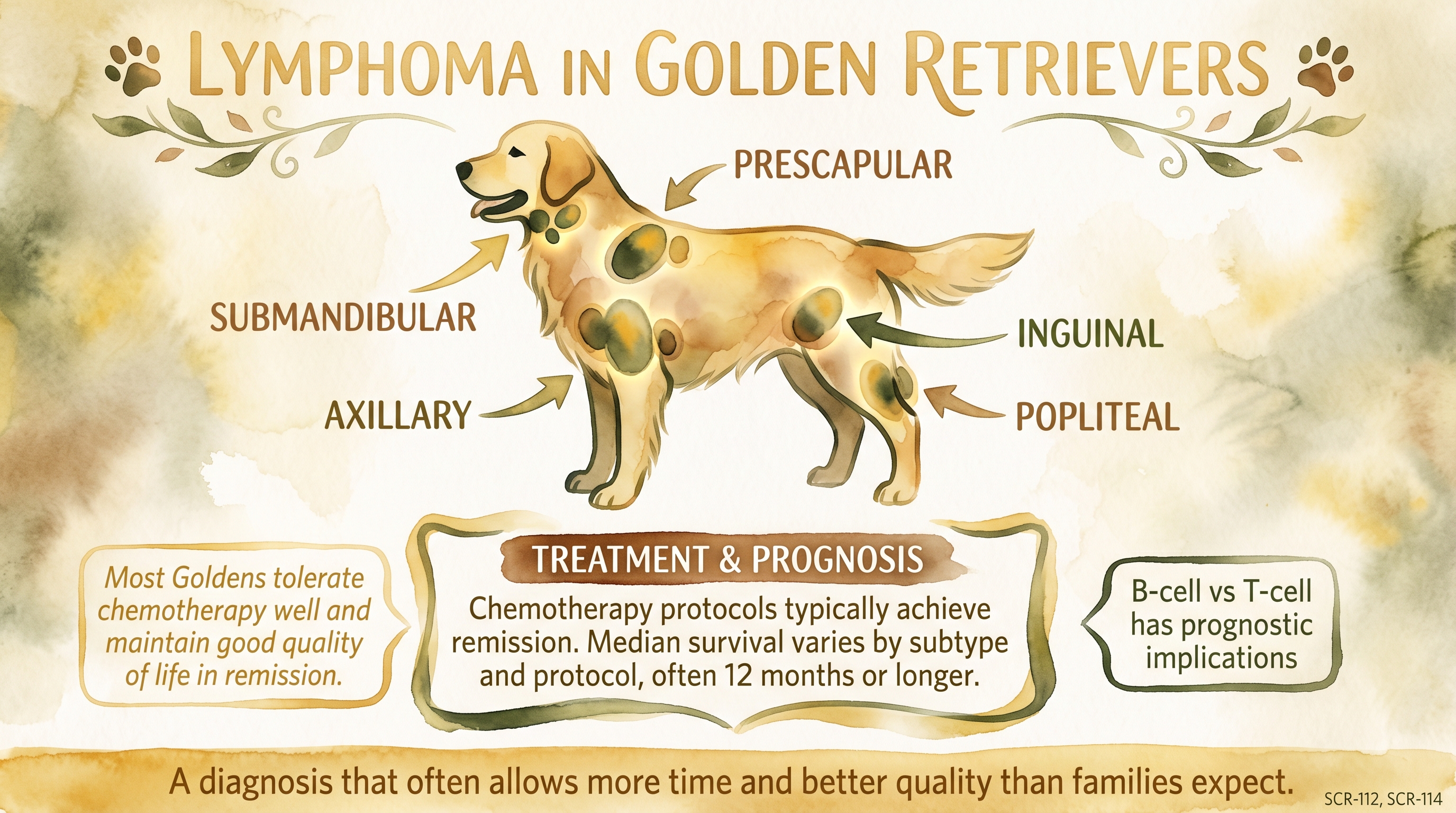
A diagnosis that often allows more time and better quality than families expect.
Key Takeaways
- Lymphoma is one of the most common cancers in Golden Retrievers and often presents as painless enlargement of several lymph nodes.
- Diagnosis is frequently more straightforward than families expect, often starting with fine-needle aspirate cytology.
- Chemotherapy is usually aimed at remission and quality time rather than cure, and many dogs tolerate treatment better than families fear.
- Prompt veterinary evaluation of enlarged lymph nodes or unexplained weight loss matters because lymphoma often enters the story before the dog looks severely ill.
The Evidence
This entry uses observed claim-level tags beyond the dedicated EvidenceBlocks below. These tags mark JB program observation or practice-derived claims that need dedicated EvidenceBlock coverage in a later content pass.
- Veterinary oncology literaturedogs
Multicentric lymphoma most commonly presents as painless generalized lymphadenopathy and is often diagnosed by fine-needle aspirate. - Golden cancer epidemiology sourcesGolden Retrievers
Lymphoma is one of the major cancers contributing to Golden Retriever cancer burden. - Canine lymphoma treatment literaturedogs
Combination chemotherapy can induce meaningful remission in many dogs, with prognosis influenced by immunophenotype and clinical stage.
- SCR placeholder noteGolden Retrievers
A dedicated lymphoma-specific SCR entry has not yet been formalized for all of the disease-course details summarized in this page. - Breed-level complexityGolden Retrievers
Golden predisposition is real, but the exact line-level genomic architecture remains more complex than one marker or one screening rule.
SCR References
Sources
- Fleming, J. M., Creevy, K. E., & Promislow, D. E. L. (2011). Mortality in North American dogs from 1984 to 2004: An investigation into age-, size-, and breed-related causes of death. Journal of Veterinary Internal Medicine, 25(2), 187-198. https://doi.org/10.1111/j.1939-1676.2011.0695.x
- Guy, M. K., Page, R. L., Jensen, W. A., et al. (2015). The Golden Retriever Lifetime Study: Establishing an observational cohort study with translational relevance for human health. Philosophical Transactions of the Royal Society B, 370(1673), 20140230. https://doi.org/10.1098/rstb.2014.0230
- Christensen, J., Johnson, K., Ettinger, S., Garrett, L., Gordon, I., Ireifej, S., Love, A., & Wisecup, M. (2026). 2026 AAHA oncology guidelines for dogs and cats. Journal of the American Animal Hospital Association, 62(1), 1-37. https://doi.org/10.5326/JAAHA-MS-7549
- Boundary approved by Queue1-DecisionTree: existing GRLS and oncology citations support Golden Retriever cancer-context framing, but the intended lymphoma treatment-literature package remains a broader SCR-181 PSV task. This page should retain the oncology-treatment boundary until a lymphoma-specific source review verifies the CHOP / prognosis source set at SCR level.