Osteosarcoma
Compound evidence detail2 SCRs / 4 parts
- Ambiguousany single percentage figure presented as a universal Golden Retriever cancer constant without naming the population, study design, or referral basis
- Documentedthe necropsy and referral cohort findings themselves; cancer as a leading cause of death in Golden Retrievers with honest sourcing and explicit dataset attribution
- Documentedcanine osteosarcoma's metaphyseal predilection in long bones (distal radius, proximal humerus, distal femur, proximal tibia), aggressive lytic-proliferative radiographic features with biopsy as definitive diagnosis, the amputation-plus-adjuvant-chemotherapy standard-of-care, and the approximately 10 to 12 month population median survival on standard therapy
- Documentedthe size-based over-representation of OSA in large and giant breeds including Golden Retrievers, drawn from multi-breed orthopedic-oncology cohorts
Osteosarcoma is the most common primary bone tumor in dogs, and it belongs on the Golden Retriever cancer map even though the breed is not the most extreme example in canine oncology. It is aggressive, painful, and often first looks like orthopedic lameness rather than "cancer." That matters because families sometimes delay evaluation, assuming the dog strained a shoulder, flared arthritic hips, or simply overdid exercise. Persistent lameness in an adult Golden deserves more seriousness than that. Documented
What It Means
What Osteosarcoma Is
Osteosarcoma is a malignant tumor of bone-forming cells. In dogs it most often arises in the appendicular skeleton, especially the metaphyseal regions of long bones. Observed-JB
The classic pattern remembered in veterinary medicine is away from the elbow; and toward the knee.
In practical terms, common sites include the distal radius, proximal humerus, distal femur, and proximal tibia.
Why It Hurts So Much
Bone cancer is not only dangerous because it metastasizes. It is dangerous because it destroys normal bone architecture and causes severe pain. As the tumor replaces healthy bone, the limb becomes weaker and more painful. Pathologic fracture can occur if the bone loses too much structural integrity.
This is why osteosarcoma often presents as a dog who suddenly seems lame and increasingly unwilling to bear weight. The pain burden is real and should never be minimized.
How It Presents
Common signs include progressive lameness, localized swelling over a limb, pain on palpation, reluctance to exercise, and sudden worsening after what seems like a minor movement.
Unlike a simple soft-tissue strain, osteosarcoma generally does not improve in a straightforward way with a few days of rest. If anything, it becomes more persistent and more concerning.
How Diagnosis Happens
Radiographs are often highly suggestive. Veterinarians look for aggressive bone lesions, cortical destruction, and periosteal reaction. Families may hear terms like "sunburst pattern" or "Codman triangle," though not every case looks textbook.
Further workup may include chest imaging for pulmonary metastasis, bloodwork, advanced imaging in selected cases, and cytology or biopsy when confirmation is needed.
The diagnostic tension is that osteosarcoma can look very convincing on radiographs, but tissue confirmation may still be important depending on the case and treatment plan.
Why It Matters for Your Dog
Treatment Options
Standard-of-care treatment for appendicular osteosarcoma has traditionally been amputation for local disease control and pain relief; and chemotherapy to address micrometastatic disease. Documented
This combination does not usually cure the disease, but it often improves comfort and extends survival relative to palliative care alone. Observed-JB
Other options may include limb-sparing in selected cases, stereotactic radiation or palliative radiation, and analgesic-focused palliative management.
The right choice depends on tumor location, the dog's overall function, metastatic status, financial realities, and the family's goals.
Prognosis
Osteosarcoma is considered a highly metastatic tumor. Even when lung metastases are not visible at diagnosis, many dogs are presumed to have microscopic spread already.
That is why amputation alone is rarely framed as definitive cure. It can dramatically improve pain, but the systemic disease risk remains. Documented
Median survival with combined treatment is often discussed in months, not years. As always, medians are not promises. Some dogs do better, some worse. Families generally cope best when they understand that treatment decisions here are usually about balancing pain control; function; time; and quality of life.
The Golden Retriever Context
For Goldens, osteosarcoma matters for two reasons.
First, it is part of the broader cancer burden that shortens healthy lifespan in the breed.
Second, the presenting sign can be confused with more familiar orthopedic issues. Documented A Golden with chronic dysplasia history may have new cancer pain mistakenly interpreted as "the same old joint problem." That is why significant change in lameness pattern deserves a new workup, not automatic recycling of an old explanation.
The Family Decision Point
This is one of the hardest cancers because the treatments can sound dramatic.
Amputation is emotionally difficult for many families to imagine, especially before they see how much pain relief it can provide in selected dogs. At the same time, not every dog is a good amputee candidate, and not every family wants aggressive treatment in a metastatic disease.
There is no universal moral script here. The humane question is not "did we do the maximum?" The humane question is "what choice gave this dog the best balance of comfort, dignity, and time?"
When to See a Veterinarian
Veterinary evaluation is warranted for unexplained limping that does not resolve quickly, lameness that worsens over days or weeks, swelling over a limb or near a joint, marked pain when a limb is touched, and sudden refusal to bear weight.
Prompt evaluation matters most in adult or older dogs, especially when the lameness is persistent rather than clearly improving.
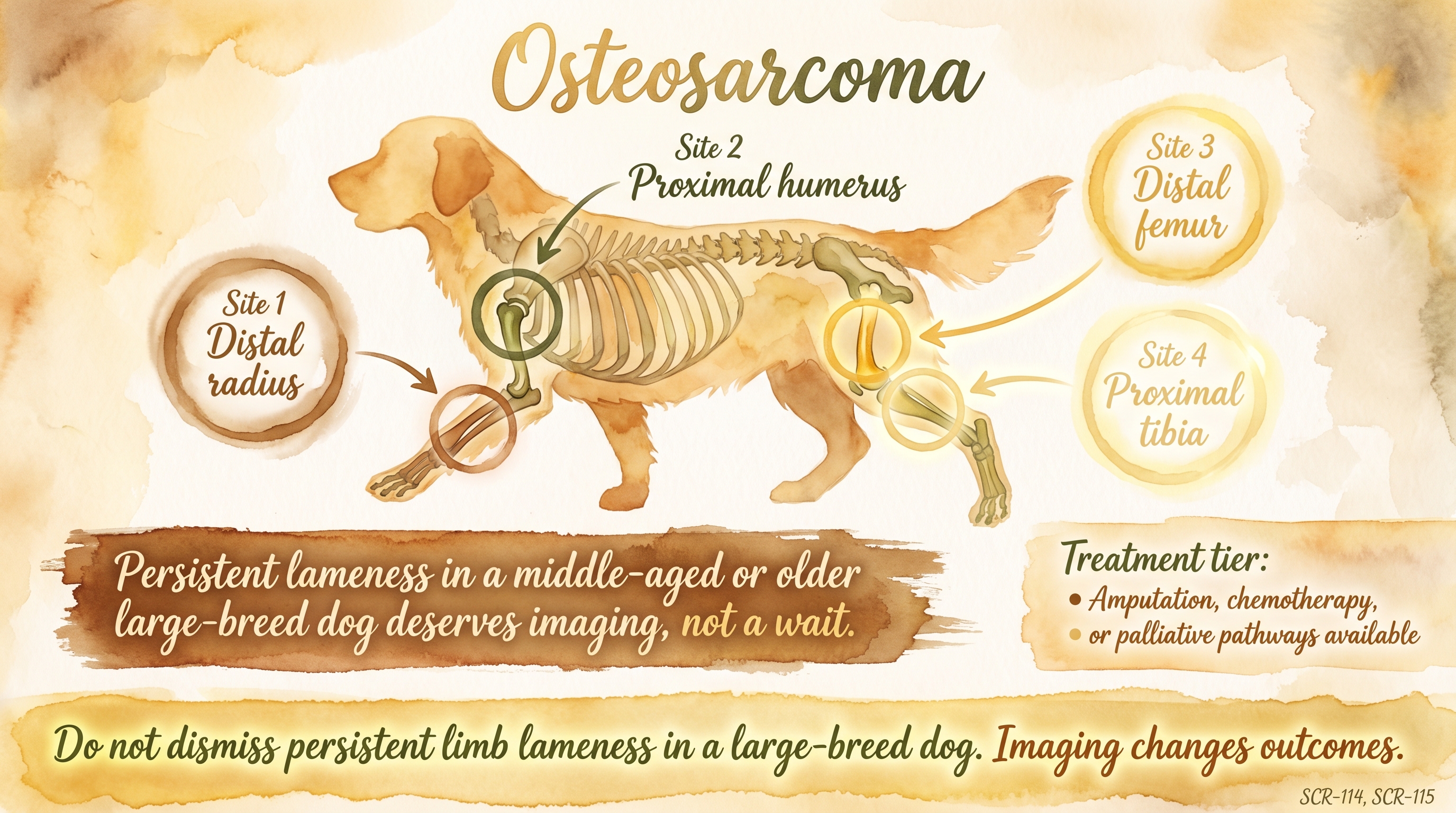
Do not dismiss persistent limb lameness in a large-breed dog - imaging changes outcomes.
Key Takeaways
- Osteosarcoma is an aggressive painful bone cancer that often first appears as persistent lameness rather than an obvious cancer syndrome.
- Radiographs are often highly suggestive, and the treatment conversation usually centers on pain relief, local control, and metastatic risk.
- Amputation plus chemotherapy is a standard pathway for many dogs, but humane palliative choices are also legitimate depending on the case.
- A Golden whose lameness pattern changes or fails to improve deserves a fresh veterinary evaluation rather than automatic assumption that it is routine orthopedic wear and tear.
The Evidence
This entry uses observed claim-level tags beyond the dedicated EvidenceBlocks below. These tags mark JB program observation or practice-derived claims that need dedicated EvidenceBlock coverage in a later content pass.
- Veterinary oncology literaturedogs
Osteosarcoma is the most common primary bone tumor in dogs and typically presents with progressive painful lameness. - Canine imaging literaturedogs
Radiographs often show aggressive bone change, but thoracic staging and case-by-case tissue confirmation remain important. - Golden cancer contextGolden Retrievers
Osteosarcoma is one of the major cancers tracked in Golden-specific cancer research and longitudinal cohort work.
- SCR placeholder noteGolden Retrievers
The register does not yet include a dedicated osteosarcoma-specific entry capturing the full diagnostic and treatment framework summarized here. - Breed-level nuanceGolden Retrievers
Osteosarcoma belongs on the Golden cancer map, but precise within-breed incidence and line-specific risk remain less formally encoded than the general clinical picture.
SCR References
Sources
- Christensen, J., Johnson, K., Ettinger, S., Garrett, L., Gordon, I., Ireifej, S., Love, A., & Wisecup, M. (2026). 2026 AAHA oncology guidelines for dogs and cats. Journal of the American Animal Hospital Association, 62(1), 1-37. https://doi.org/10.5326/JAAHA-MS-7549
- Spodnick, G. J., Berg, J., Rand, W. M., Schelling, S. H., Couto, G., Harvey, H. J., Henderson, R. A., MacEwen, E. G., Mauldin, N., McCaw, D. L., Moore, A. S., Morrison, W., Norris, A. M., O'Bradovich, J., O'Keefe, D. A., Page, R., Ruslander, D., Klausner, J., & Straw, R. C. (1992). Prognosis for dogs with appendicular osteosarcoma treated by amputation alone: 162 cases (1978-1988). Journal of the American Veterinary Medical Association, 200(7), 995-999. https://doi.org/10.2460/javma.1992.200.07.995
- Selmic, L. E., Burton, J. H., Thamm, D. H., Withrow, S. J., & Lana, S. E. (2014). Comparison of carboplatin and doxorubicin-based chemotherapy protocols in 470 dogs after amputation for treatment of appendicular osteosarcoma. Journal of Veterinary Internal Medicine, 28(2), 554-563. https://doi.org/10.1111/jvim.12313