Weight Management Across the Lifespan
Weight management is one of the least glamorous and most consequential things a family does for a Golden Retriever. It does not feel dramatic, and that is partly why it matters so much. A dog rarely becomes overweight because of one catastrophic decision. Weight usually drifts by ounces, habits, shared indulgences, and routines that made sense six months ago but no longer match the dog's body or stage of life. Documented
JB treats lean body condition as a form of stewardship, not as an aesthetic preference. The dog does not care how full it looks in photos. The dog lives inside the body the family maintains for it.
What It Means
The Strongest Longitudinal Signal
The clearest famous study here is the long-running Purina lifespan study in Labradors. Documented Dogs maintained at a leaner body condition lived a median 1.8 years longer and developed age-related disease later than their full-fed littermates. That is a powerful finding, and it is one of the most practically important lifespan signals families can act on.
The evidence boundary matters though. That study was in Labradors, not Golden Retrievers. JB can say the study is [Documented] in Labradors. Applying the principle directly to Goldens is a reasonable breed-neighbor inference, not a Golden-specific replication. The broader canine obesity and body-condition literature strengthens the direction of the claim, but the exact 1.8-year figure belongs to that Labrador cohort.
Why This Matters So Much in Goldens
Golden Retrievers are easy to overfeed.
They are often food motivated.
They are culturally expected to look broad and plush.
Observers are frequently calibrated to heavier dogs than is healthy.
That combination creates a constant low-grade pressure toward excess condition. Families of lean, well-muscled Goldens are routinely told the dog looks thin when the dog is actually close to ideal.
This is not a cosmetic misunderstanding. Excess weight changes the dog's whole experience: more joint load, more heat burden, less efficient movement, harder recovery, more metabolic strain, and fewer comfortable options in the senior years.
Adulthood Is Where Drift Usually Happens
Puppy growth gets attention.
Adolescent weight gets attention.
Then adulthood arrives, and the family relaxes because the dog is finished growing.
That is precisely when weight management often becomes harder. The dog can no longer hide excess condition inside growth. Treat routines become more casual. Exercise becomes more variable. The family stops measuring. The dog remains hungry because dogs often remain happy to eat beyond what best serves them.
JB prefers a steady practice instead of a crisis model: watch body condition regularly, adjust food when activity changes, account honestly for treats, chews, and table extras, and re-evaluate as the dog moves from settled adulthood into the senior years. Heuristic
Aging Changes the Math
One of the most common senior weight stories is simple: the family keeps feeding like the dog is still five. Activity is a little lower, recovery is slower, and muscle mass begins to shift. The food bowl does not.
Then weight climbs, and the climb is misread as normal aging rather than as a mismatch between intake and current physiology. That extra weight is especially costly in older dogs because it lands on joints already facing age-related wear and on systems already working harder than before.
The goal is not dietary austerity. The goal is staying honest as the dog's needs change.
Why Lean Gets Socially Misread
Many families need explicit permission to hold the line here. Lean adult Goldens are often described by others as deprived, small, or too slim. Those comments usually reflect cultural normalization of heavy dogs, not sound body-condition assessment.
That is why body condition scoring matters more than casual opinion. Hands on ribs, waist visibility, abdominal tuck, and overall muscle quality tell the truth more reliably than what neighbors think a Golden Retriever should resemble.
What This Is Not
JB is not arguing for chronic hunger. It is not arguing that every dog should be at the lowest safe weight. It is not turning one Labrador study into a magical universal formula. Documented
It is saying that lifelong avoidance of excess condition is one of the strongest documented health levers families actually control, even if the exact longevity gain varies by breed and individual dog.
Why It Matters for Your Dog
Weight management is quiet prevention in one of its purest forms. The family never gets applause for the orthopedic pain the dog avoided, the mobility it preserved, or the metabolic strain it never had to carry. Documented But the dog lives those absences.
Keeping a dog lean is not about making the dog look a certain way. It is about refusing to add preventable physical burden year after year to a body that already has enough to carry through life.
This matters most in the senior years, because that is where the investment pays out most visibly. The dog that arrives there lean usually has more room to move, more comfort margin, and more usable life inside the same age than the dog that has been carrying extra load for years.
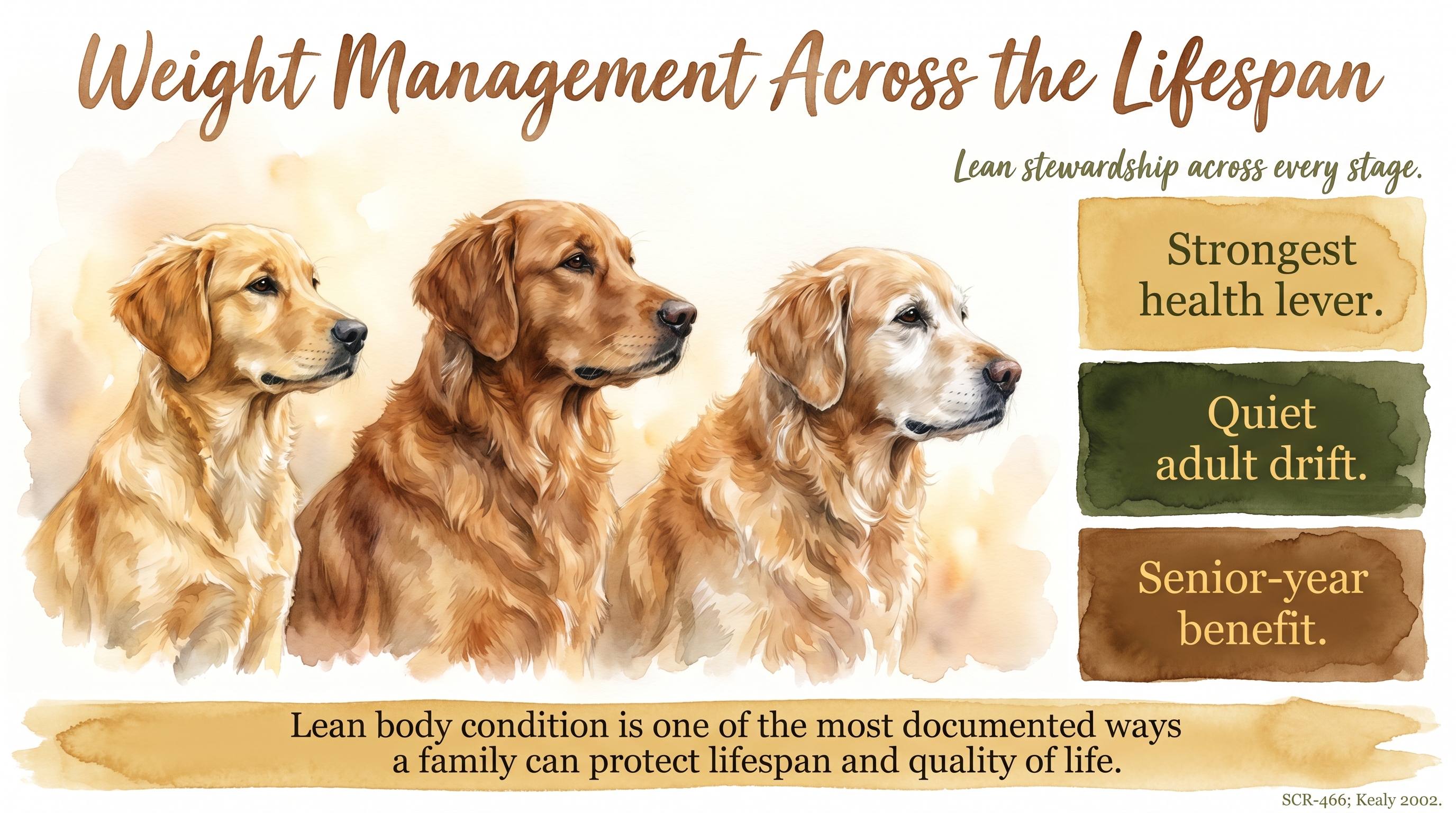
Lean body condition is one of the most documented ways a family can protect lifespan and quality of life.
Key Takeaways
- Lean body condition is one of the strongest documented health levers families can control across a dog's life.
- The best-known exact lifespan extension figure comes from a Labrador cohort, so that number should not be presented as a Golden-specific replication.
- Weight drift usually happens quietly in adulthood and again during the senior transition if families do not adjust intake honestly.
- The senior years are often where the benefits of lifelong lean stewardship become easiest to see.
The Evidence
- Kealy et al. and related Purina lifespan cohort workLabrador Retrievers
Labradors maintained at leaner body condition lived a median 1.8 years longer and showed delayed onset of age-related disease compared with full-fed littermates. - obesity and body-condition literaturedomestic dogs
Excess body condition is associated with orthopedic, metabolic, and quality-of-life burden across canine populations. - Golden longevity contextGolden Retrievers
Golden Retriever lifespan is shaped by multiple factors including cancer burden, but modifiable stewardship variables such as body condition remain clinically relevant.
- JB evidence boundaryGolden Retrievers
Applying the exact longevity gain from the Labrador restricted-feeding cohort directly to Goldens is a reasoned inference rather than a Golden-specific measured result.
No published study directly tests the practical implications of weight management across the lifespan for domestic dog raising programs. The application to household dog raising remains an interpretive synthesis rather than a directly tested intervention finding.
SCR References
Sources
- World Small Animal Veterinary Association. (n.d.). Global nutrition guidelines. https://wsava.org/global-guidelines/global-nutrition-guidelines/
- World Small Animal Veterinary Association Global Nutrition Committee. (2021). Global nutrition toolkit. https://wsava.org/wp-content/uploads/2021/04/WSAVA-Global-Nutrition-Toolkit-English.pdf
- Kealy, R. D., Lawler, D. F., Ballam, J. M., Mantz, S. L., Biery, D. N., Greeley, E. H., Lust, G., Segre, M., Smith, G. K., & Stowe, H. D. (2002). Effects of diet restriction on life span and age-related changes in dogs. Journal of the American Veterinary Medical Association, 220(9), 1315-1320. https://doi.org/10.2460/javma.2002.220.1315
- Smith, G. K., Paster, E. R., Powers, M. Y., Lawler, D. F., Biery, D. N., Shofer, F. S., McKelvie, P. J., & Kealy, R. D. (2006). Lifelong diet restriction and radiographic evidence of osteoarthritis of the hip joint in dogs. Journal of the American Veterinary Medical Association, 229(5), 690-693. https://doi.org/10.2460/javma.229.5.690
- McGreevy, P. D., Thomson, P. C., Pride, C., Fawcett, A., Grassi, T., & Jones, B. (2005). Prevalence of obesity in dogs examined by Australian veterinary practices and the risk factors involved. Veterinary Record, 156(22), 695-702. https://doi.org/10.1136/vr.156.22.695
- Marshall, W. G., Hazewinkel, H. A. W., Mullen, D., De Meyer, G., Baert, K., & Carmichael, S. (2010). The effect of weight loss on lameness in obese dogs with osteoarthritis. Veterinary Research Communications, 34(3), 241-253. https://doi.org/10.1007/s11259-010-9348-7
- Just Behaving program observation disclosure. (2026). Boundary: this internal observation is limited to JB-raised Golden Retrievers whose families continued the JB framework after placement; cohort size, time window, and counting rule are deferred in this revision. Treat as program observation supporting weight-management across the lifespan in Golden Retriever homes, not as published external evidence.