Separation Distress: The Science
Separation distress is the cluster of behavioral and physiological responses that appear when a dog cannot maintain access to an attachment figure or social group under conditions it cannot yet regulate. In practice, that cluster can include vocalization, pacing, destruction, elimination, hypersalivation, or frantic reunion behavior. The science supports the phenomenon clearly. The harder question is what kind of problem any particular case actually is, because not every dog labeled "separation anxiety" is showing the same mechanism. Mixed Evidence
What It Means
The Affective Foundation
Panksepp's affective-neuroscience framework is often used as the broad mammalian backdrop for separation distress. The key idea is that mammals possess core affective systems, including systems relevant to care, social bonding, and distress on separation. The PANIC/GRIEF system is the one most often invoked here.
That framework is strongest as mammalian comparative grounding. It helps explain why distress at caregiver loss or social isolation is not a trivial behavioral quirk. It is tied to ancient systems that organize attachment and social survival. In dogs, the safest use of the framework is supportive rather than over-specific: it gives a plausible affective substrate for why separation can be so destabilizing, but it should not be presented as if canine brain imaging has directly mapped every Panksepp construct one-for-one.
What Separation Distress Looks Like in Dogs
Clinically, separation distress is usually inferred from the behavior that appears when the caregiver leaves or when the dog anticipates that loss of access. Observed-JB Common signs include whining, barking, or howling, pacing, circling, or spinning, scratching doors or windows, destructive behavior near exit points, urination or defecation in the caregiver's absence, and hypersalivation or autonomic agitation.
Those signs are real, but they are not specific to a single diagnosis. A dog may vocalize because it is panicking, because it is frustrated, because it has never been gradually habituated to alone time, because the environment is overstimulating, or because broader anxiety is surfacing during caregiver absence. That is why careful case interpretation matters.
Attachment and Distress
Attachment science helps explain why separation problems are so emotionally loaded. Documented If the caregiver functions as secure base and safe haven, then abrupt loss of that figure under conditions of poor coping can destabilize behavior fast. The more the dog relies on the relationship for regulation, the more difficult poorly prepared separations may become.
But attachment does not mean pathology by itself. A securely attached dog can prefer its caregiver and still tolerate reasonable absences. Separation distress usually reflects some combination of attachment significance, coping limitations, developmental history, routine instability, and environmental mismatch. Observed-JB
This is an important distinction. Strong attachment is not the same thing as dysfunctional dependence. The pathology enters when the dog cannot recover organization once the attachment figure is unavailable.
Why It Matters for Your Dog
The Punishment Finding
One of the most important recent additions to this topic is SCR-036. Dale et al. (2024), using a prospective longitudinal puppy cohort, found that caregivers who used more punishment or aversive responses to puppy misbehavior had increased odds of their dogs showing separation-related behaviors by six months. Documented
That finding matters for several reasons.
First, it is prospective rather than purely retrospective, which makes it stronger than much of the older association literature.
Second, it shows that separation problems are not just about what happens when the caregiver leaves. They are also related to the early relational and management environment around the puppy.
Third, it gives a concrete boundary against simplistic narratives. If caregiver response style during ordinary puppy management predicts later separation-related problems, then the topic is partly attachment, partly arousal regulation, and partly household patterning.
The paper does not prove that punishment mechanically causes every later separation problem. It does justify saying that punitive early response styles are a documented risk factor.
Diagnostic Cautions
The phrase "separation anxiety" often gets used too broadly. Some dogs do show distress centered tightly on social separation. Others are better described as showing generalized anxiety that becomes obvious when the caregiver is absent, barrier frustration, boredom or under-stimulation, poor gradual-habituation history, or routine instability during transitions or rehoming.
That is why clinical neutrality matters. The dog chewing a door frame is not necessarily making an abstract statement about attachment theory. The behavior needs to be interpreted in context. Documented
The literature also shows that transition periods are especially sensitive. Novel environments, rehoming, and abrupt changes in alone-time routines can heighten stress and increase separation-related behaviors, which is one reason the attachment and cortisol-buffering literature overlaps so heavily with this topic.
The pillar entry argues for calm continuity in transitions. This page stays narrower: separation distress is a real mammalian phenomenon in dogs, and abrupt or punitive handling patterns are documented risk factors, but the full JB transition protocol has not itself been directly tested in breeder-to-family trials.
No published prospective trial has directly compared separation-distress outcomes in puppies experiencing JB soft-landing transitions versus standard breeder-to-family handoffs or other transition approaches.
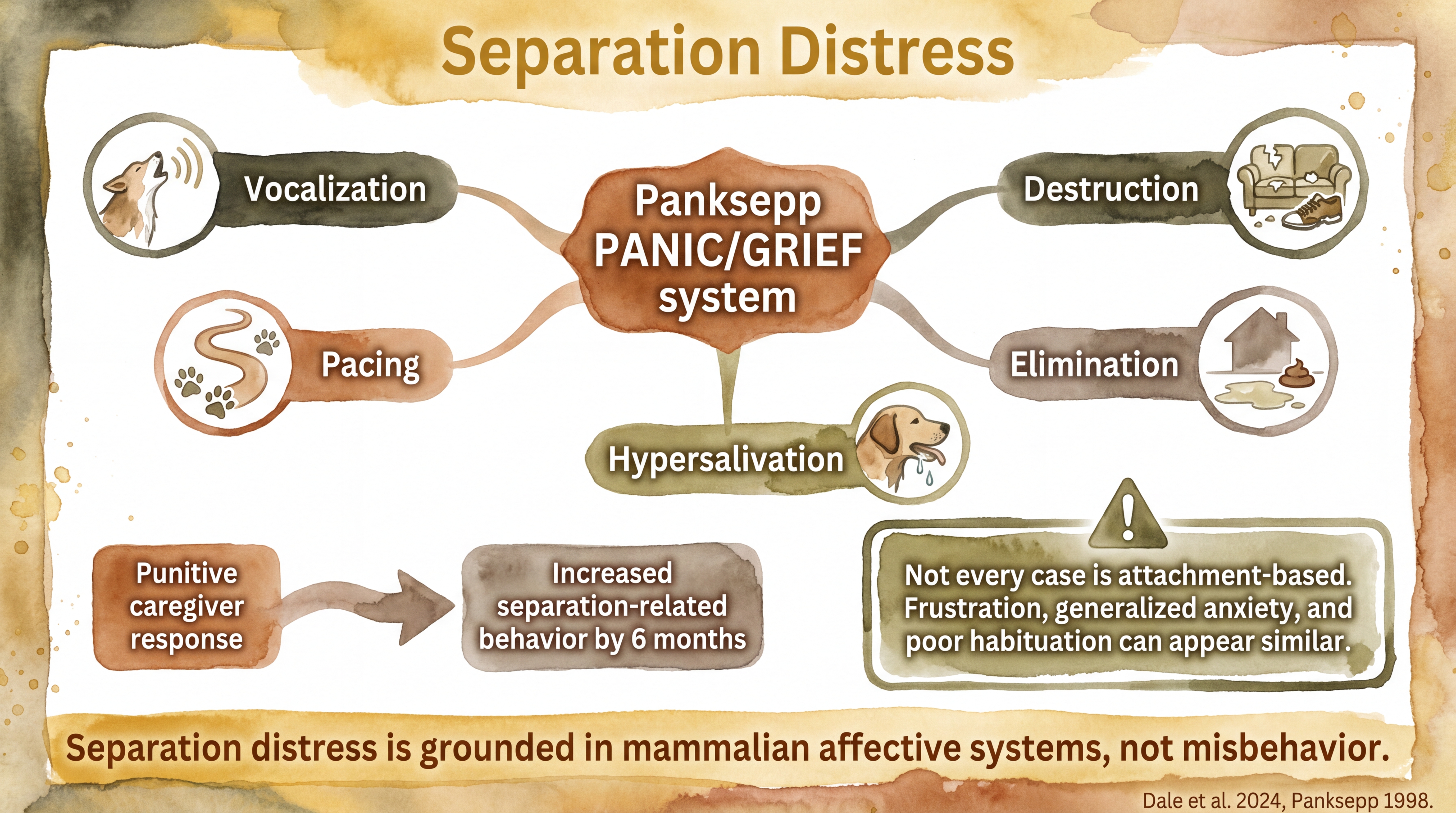
Separation distress activates Panksepp's PANIC system - a primary affective response, not a learned behavioral problem.
Key Takeaways
- Separation distress is a real attachment- and regulation-related phenomenon, not just bad behavior during caregiver absence.
- Not every case labeled separation anxiety has the same mechanism; frustration, generalized anxiety, and poor habituation can look similar.
- Prospective puppy data show that punitive caregiver responses are a documented risk factor for later separation-related behaviors.
- The affective-neuroscience framework is useful grounding, but dog-specific claims still need to stay below the SCR ceiling.
The Evidence
This entry uses observed claim-level tags beyond the dedicated EvidenceBlocks below. These tags mark JB program observation or practice-derived claims that need dedicated EvidenceBlock coverage in a later content pass.
This entry uses mixed-evidence claim-level tags beyond the dedicated EvidenceBlocks below. These tags mark claims that combine documented findings with observed practice, heuristic application, or unresolved gaps.
- Dale, F. C. et al. (2024)domestic dogs
Prospective longitudinal puppy data linked punishment or aversive owner responses to increased odds of separation-related behaviors at six months. - Topal, J. et al. (1998) and later attachment workdomestic dogs
Established that owner absence and reunion are attachment-relevant events rather than generic social changes. - Cannas, S. et al. (2010)domestic dogs
Documented change in puppy alone-home behavior during the first months after adoption, supporting transition sensitivity.
- Panksepp, J. (1998)multiple mammals
Described core affective systems including CARE and PANIC/GRIEF, which are relevant to maternal regulation and separation distress. - Panksepp, J. et al. (1978)multiple mammals
Showed that separation distress in mammals has a biologically meaningful affective basis rather than being a trivial learned nuisance.
- SCR-014 boundarydomestic dogs and multiple mammals
Panksepp's framework is a valid mammalian scaffold, but downstream documents should not present canine separation distress as though every affective subsystem has been directly mapped in dog-specific neural terms. - SCR-036 boundarydomestic dogs
The punishment finding is a documented risk association from prospective data, not proof that every separation problem is caused by punishment.
SCR References
Sources
- Cannas, S., et al. (2010). Puppy behavior when left home alone: Changes during the first few months following adoption. Journal of Veterinary Behavior.
- Dale, F. C., Burn, C. C., Murray, J., & Casey, R. (2024). Canine separation-related behaviour at six months of age: Dog, owner and early-life risk factors identified using the Generation Pup longitudinal study. Animal Welfare, 33, e60.
- Panksepp, J. (1998). Affective neuroscience: The foundations of human and animal emotions. Oxford University Press.
- Panksepp, J., Herman, B., Conner, R., Bishop, P., & Scott, J. P. (1978). The biology of social attachments: Opiates alleviate separation distress. Biological Psychiatry, 13(5), 607-618.
- Topal, J., Miklosi, A., Csanyi, V., & Doka, A. (1998). Attachment behavior in dogs (Canis familiaris): A new application of Ainsworth's Strange Situation Test. Journal of Comparative Psychology, 112(3), 219-229. https://doi.org/10.1037/0735-7036.112.3.219