Attachment and Cortisol Buffering
Attachment does not only change behavior. It also changes physiology. In stress science, this is often called social buffering: the presence of a trusted attachment figure dampens or reorganizes stress responding. In dogs, the literature supports a cautious but meaningful version of that claim. Secure attachment is associated with lower cortisol reactivity in standardized procedures, dogs detect human stress cues, and rehoming or novel intake contexts produce measurable cortisol disruption that calmer, more stable environments help reduce. Documented
What It Means
Social Buffering Means
Social buffering is the idea that another organism can alter how a stressor is processed. The stressor does not have to disappear. Its physiological impact changes because the individual is no longer confronting it alone.
In humans and other mammals, this is a large literature. Caregiver presence affects infant cortisol responses, vagal regulation, and recovery under strain. Rodent work similarly shows that social context can shape the magnitude and duration of stress responses.
The canine version of the claim is narrower. The literature does support caregiver-related buffering effects, but not every study measures them the same way, and not every form of long-term coupling is universal across breeds or households. Documented The responsible summary is not "your presence always fixes your dog's cortisol." It is that caregiver presence and caregiver state are measurable parts of the dog's stress ecology.
Attachment Quality and Cortisol
Schoberl and colleagues provide one of the clearest attachment-specific findings. In a Strange Situation context, dogs classified as securely attached showed significantly lower cortisol reactivity than less secure dogs. Caregiver relational variables and caregiver personality traits also predicted aspects of dog stress flexibility. Documented
That matters because it moves attachment science beyond behavior description. If secure attachment correlates with lower cortisol reactivity under standardized social stress, then the relationship is functioning as more than familiarity or convenience. It is changing the dog's physiological response to challenge.
This is also why the phrase secure base is not just metaphorical. A secure base has measurable downstream consequences.
Human State as an Upstream Variable
SCR-058 adds another important piece. Dogs can discriminate human baseline odor from human stress odor, and exposure to unfamiliar human stress odor alters dog cognition and learning performance. In plain language, dogs do not only notice that humans are stressed. Human stress cues can change what dogs do.
That finding does not by itself prove attachment buffering, but it explains one pathway by which caregiver state enters the dog's regulatory world. Documented If dogs detect human stress through olfaction and other channels, then calm caregiver presence and stressed caregiver presence are not the same physiological event from the dog's point of view.
The broader synchrony literature extends this further. Hair cortisol, autonomic co-modulation, and caregiver-personality findings all suggest that dogs and humans can become physiologically linked in ways that are more than shared scenery. Those findings are strongest when stated conservatively: linked, not fused; measurable, not magical; bounded, not universal.
Transition Stress and Rehoming
SCR-060 is especially important for attachment science because it captures what happens when stability is disrupted. Novel kennel, shelter, and rehoming contexts produce sharp cortisol increases, while quieter and more stable home environments reduce stress over days to weeks. Documented
This is the part of the literature that most clearly shows that transition itself is a physiological event. A move is not just a new address. It is a stressor. The dog has to process novelty, altered social access, altered routine, altered sensory input, and altered predictability.
The boundary matters just as much. The best cortisol evidence here comes from shelter, kennel, and broader rehoming contexts. It does not directly validate a breeder-to-family protocol in which one reception style is experimentally compared against another. So the science strongly supports the principle that stable environments buffer transition stress. It does not justify claiming that any specific soft-landing script has already been cortisol-proven in puppies.
Why It Matters for Your Dog
Owner References to Fix
In this entry, the following "owner" references appear in JB application prose:
- Line describing owner relational variables and owner state transmission - replace with "caregiver"
- References to owner presence and owner stress - preserve in caregiver context, change where appropriate to "caregiver" or "person"
Attachment-and-cortisol research helps explain why some relationship variables keep reappearing across different parts of the knowledge base. Documented Secure attachment predicts lower stress reactivity, caregiver stress cues alter dog processing, transition instability raises stress load, and calm and stable environments help reduce that load.
These findings belong together. They describe different points in the same system: the dog does not regulate stress in a vacuum. Relationship quality, caregiver physiology, sensory access to the caregiver, and environmental continuity all matter.
The pillar entry uses this literature to explain why calm presence matters. This page keeps the statement narrower: dog stress physiology is shaped by attachment quality, caregiver state, and environmental stability, but exact protocol-level promises still require more direct testing.
No published study has directly tested whether specific caregiver-guided transition protocols (such as soft-landing approaches) reduce puppy cortisol reactivity compared to standard breeder-to-family handoff procedures.
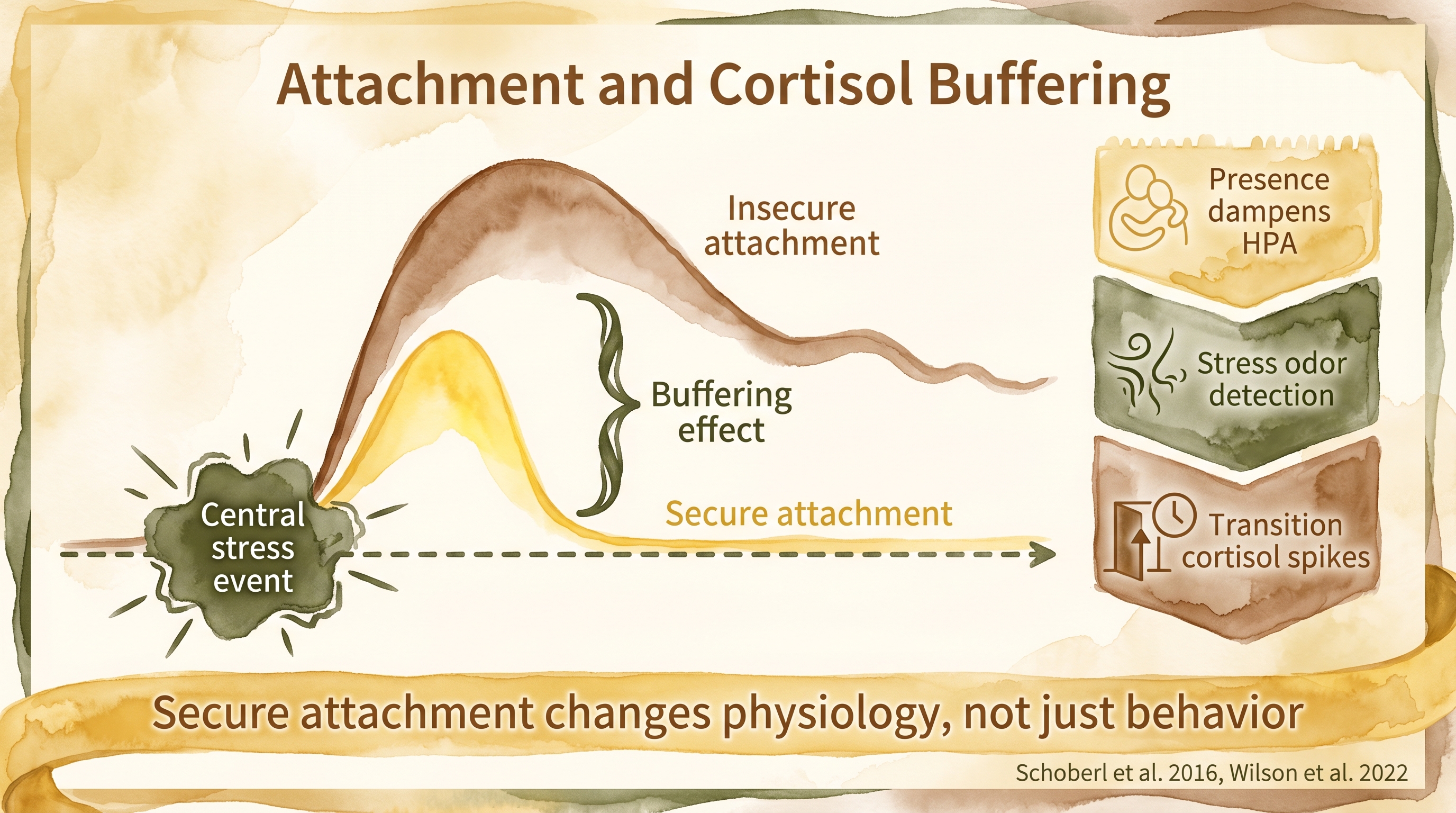
Secure attachment changes physiology directly - dampening cortisol peaks and accelerating recovery.
Key Takeaways
- Attachment affects canine physiology as well as behavior.
- Securely attached dogs show lower cortisol reactivity in standardized stress procedures.
- Dogs detect human stress cues, which makes owner state part of the dog's stress environment.
- Transition and rehoming are real physiological stressors, and stable environments help reduce that load, but protocol-level claims still need tighter direct testing.
The Evidence
- Schoberl, I. et al. (2016)domestic dogs and humans
Securely attached dogs showed lower cortisol reactivity in a Strange Situation procedure. - Schoberl, I. et al. (2017)domestic dogs and humans
Caregiver personality and relational variables predicted dog HPA-axis flexibility. - Wilson, C. et al. (2022)domestic dogs
Dogs discriminated human stress odor from baseline odor. - Parr-Cortes, Z. et al. (2024)domestic dogs
Exposure to stressed human odor impaired learning and cognitive flexibility in dogs. - van der Laan, J. E. et al. (2022)domestic dogs
Novel shelter intake and subsequent adoption showed marked cortisol disruption with reduction in more stable home environments.
- Feldman, R. (2010, 2012)humans
Caregiver-infant physiological synchrony and co-regulation affect stress and autonomic responding. - Rodent maternal-regulation literaturerodents
Maternal presence and care quality shape stress responsivity and buffering across development.
- SCR-060 boundarydomestic dogs
Stable environments reduce transition stress, but breeder-to-family soft-landing scripts have not been directly compared in puppy cortisol trials. - SCR-058 boundarydomestic dogs
Human stress detection is documented, but it should not be inflated into a claim that every owner emotional shift produces a uniform cortisol outcome in the dog.
SCR References
Sources
- Feldman, R. (2012). Parent-infant synchrony: A biobehavioral model of mutual influences in the formation of affiliative bonds. Monographs of the Society for Research in Child Development.
- Parr-Cortes, Z., et al. (2024). Human stress odor alters learning and cognitive flexibility in dogs. Scientific Reports.
- Schoberl, I., Beetz, A., Solomon, J., Gee, N., Kotrschal, K., & Wedl, M. (2016). Social factors influencing cortisol modulation in dogs during a strange situation procedure. Journal of Veterinary Behavior, 11, 77-85.
- Schoberl, I., Wedl, M., Bauer, B., Day, J., Mostl, E., & Kotrschal, K. (2017). Effects of owner-dog relationship and caregiver personality on canine cortisol modulation. PLOS ONE, 12(2), e0170707.
- van der Laan, J. E., et al. (2022). Evaluation of hair cortisol as an indicator of long-term stress responses in dogs in an animal shelter and after subsequent adoption. Scientific Reports, 12, 5117.
- Wilson, C., et al. (2022). Dogs can discriminate between human baseline and stress odours. PLOS ONE, 17(9), e0274143.