Alone Time and Quiet Independence
One of the easiest ways to misunderstand JB is to imagine that a relationship-centered household means the dog is always attached to a human body. It does not. Secure attachment should make quiet independence easier, not harder. A dog who cannot rest in another room, cannot handle ordinary departures, or cannot remain calm when a family member moves out of sight is not demonstrating a deeper bond. The dog is showing fragility in the bond system. JB therefore treats alone time as part of normal daily life, not as a dramatic exercise. In most well-held households, it develops naturally from the same calm floor that supports settling, sleep, and ordinary transitions. That is an observed JB claim built on a documented attachment baseline and a documented separation-distress literature. Observed-JB
What It Means
Quiet independence is not emotional distance. It is the dog's ability to remain regulated when the human walks to another room, work happens without constant interaction, the family leaves the house for an ordinary period, and the dog rests apart and then reconnects later.
This is the healthy counterbalance to everything else in the dispatch. If the dog truly experiences the human as secure base, then the dog should be able to borrow safety from that relationship even when not in continuous physical contact. Observed-JB
How It Starts
For many JB puppies, alone time starts almost invisibly. The puppy naps while the family moves about. The puppy rests in a quiet bedroom while the adults do something elsewhere. The puppy learns that doors closing, footsteps fading, and short absences are ordinary parts of a predictable day rather than signs of abandonment.
Because the foundation is calm, these first separations do not need to be theatrical or heavily engineered. The family is not making a big emotional event out of leaving, nor making a big emotional event out of returning.
That ordinary tone matters.
Why Some Households Accidentally Build Dependence
Dependence often develops not because the family loved too much, but because the family accidentally made constant contact the only known form of safety. Observed-JB The puppy is talked to every time it wakes, every movement brings interaction, every complaint brings immediate response, and every departure is preceded by anxious human energy and followed by an equally intense reunion.
The puppy learns that proximity is the only stable state, separation is unusual, and return is dramatic. Then the family is surprised when the dog struggles with being alone.
JB tries to make independence ordinary early enough that it never has to become a big fight later.
When the Dog Does Not Scale Easily
This page also needs honesty. Not every dog glides into alone time. Some dogs are genuinely vulnerable to separation distress or separation anxiety. Genetics, developmental history, abrupt transition errors, illness, and household pattern all matter.
When that is happening, the humane answer is not to harden the heart and hope the dog gets over it. The family may need to return to shorter absences, increase predictability, reduce departure drama even further, and seek qualified professional help.
JB does not deny that formal protocols can be useful in those cases. It simply notes that dogs with secure attachment and strong parasympathetic baselines often need much less of that formal repair. Observed-JB
Why It Matters for Your Dog
Ordinary independence matters because family life includes separation. People go to work, take showers, run errands, sleep, host visitors, and move through the house with varying degrees of access. A dog that can remain quietly intact through those shifts lives a far easier life than a dog who experiences each separation as destabilization.
Secure attachment is not clinginess. It is the confidence that the relationship still exists when the person is briefly absent. Quiet independence is one of the healthiest expressions of that confidence.
It matters for the humans too. Families should be able to leave the house, shut a bathroom door, or work in another room without feeling that the dog is unraveling behind them. When independence is part of the normal rhythm, both dog and family become freer.
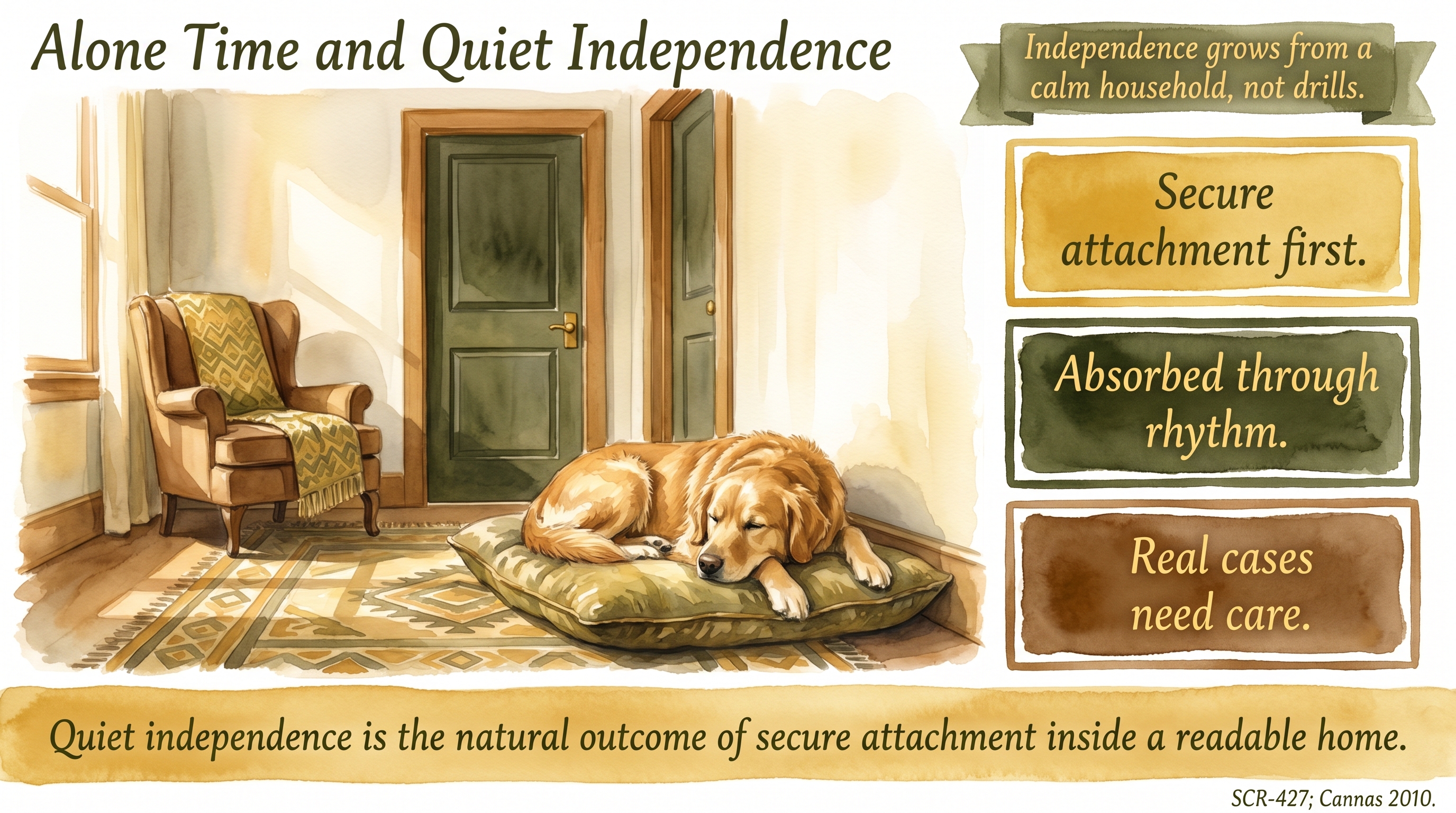
Quiet independence is the natural outcome of secure attachment inside a readable home.
Key Takeaways
- Secure attachment should make quiet independence easier, not create constant physical dependence.
- In many JB homes, alone time develops naturally through ordinary calm rhythm, quiet rest, and low-drama departures and returns.
- Some dogs still develop real separation problems, and those cases deserve slower progression and appropriate professional support.
- The JB claim is observational, resting on a documented attachment floor rather than on a direct trial of the exact household method.
The Evidence
- Canine attachment literaturedogs
Secure attachment in dogs is compatible with exploration and regulation away from the attachment figure, not only with constant contact. - Separation-distress literaturedogs
Ordinary alone-time difficulty and genuine separation pathology are real canine welfare issues that require careful differentiation and humane management.
- JB breeder and family observationGolden Retrievers and family dogs
Dogs raised in calm predictable homes often develop quiet independence gradually through normal daily rhythm rather than through formalized separation drills. - JB observationfamily homes
Making departures and returns emotionally ordinary appears to support easier alone-time adaptation than repeatedly turning those moments into dramatic events.
- JB synthesisfamily dogs
The claim that secure attachment usually reduces the need for formal independence protocols is a practical interpretation of attachment science and breeder experience rather than a direct intervention trial.
No published study directly tests the practical implications of alone time and quiet independence for domestic dog raising programs. The application to household dog raising remains an interpretive synthesis rather than a directly tested intervention finding.
SCR References
Sources
- Topal, J., Miklosi, A., Csanyi, V., & Doka, A. (1998). Attachment behavior in dogs (Canis familiaris): A new application of Ainsworth's Strange Situation Test. Journal of Comparative Psychology, 112(3), 219-229. https://doi.org/10.1037/0735-7036.112.3.219
- Payne, E., Bennett, P. C., & McGreevy, P. D. (2015). Current perspectives on attachment and bonding in the dog-human dyad. Psychology Research and Behavior Management, 8, 71-79. https://doi.org/10.2147/PRBM.S74972
- Amat, M., Camps, T., Le Brech, S., & Manteca, X. (2014). Separation anxiety in dogs: The implications of predictability and contextual fear for behavioural treatment. Animal Welfare, 23(3), 263-266. https://doi.org/10.7120/09627286.23.3.263
- Just Behaving program observation disclosure. (2026). Boundary: this internal observation is limited to JB-raised Golden Retrievers whose families continued the JB framework after placement; cohort size, time window, and counting rule are deferred in this revision. Treat as program observation supporting quiet-independence development in family homes, not as published external evidence.