Boarding and Home-Care Decisions
Sooner or later almost every family faces the same question: if we are traveling without the dog, where should the dog be? JB answers that question by starting from continuity rather than convenience. The goal is not simply finding supervision. The goal is preserving as much of the dog's calm floor as possible during the family's absence. Observed-JB
That changes the ranking of options. Many modern boarding decisions are made from the human side of the arrangement: schedule, availability, location, booking simplicity. JB asks a different question first. Where is the dog most likely to remain the same dog while we are gone?
What It Means
The Preferred Order
For most JB families, the strongest option is care in the dog's own home by a trusted person the dog already knows. Observed-JB
The second-best option is usually care in a trusted friend or family members calm home, especially if the dog has been there before and the environment is not crowded or chaotic.
The third option can be small-scale in-home boarding with a very limited number of dogs, clear rest structure, and genuinely calm management. Observed-JB
Large-volume group boarding is usually the least attractive option in the JB framework.
This is not ideology. It is pattern recognition. The more novel, crowded, loud, and socially dense the care setting is, the more likely the dog's regulation is to erode while the family is away.
Why the Home Usually Wins
The dog's home already contains almost everything it needs: familiar smells, familiar rest spaces, familiar sound patterns, and familiar routes to yard, door, food, and bed.
The family may be absent, and that absence matters, but the environment is still legible. For a dog raised on rhythm, that legibility is protective. A trusted sitter who can enter the house calmly and preserve ordinary patterns often creates the least disruption of all available options.
Why Group Boarding So Often Costs More Than People Expect
Families are often surprised by how much behavioral residue can follow a few days in a high-density boarding environment. The dog returns louder, sleep is thinner, greeting charge is higher, leash behavior is rougher, and settling takes days to recover. Observed-JB
This is not because every boarding environment is negligent. It is because many group environments are structurally arousing. Barking, turnover, corridor movement, unfamiliar handlers, strange dogs, smell density, irregular rest, and repeated social friction all create a baseline very different from the home rhythm JB has spent months or years building.
That is why JB is skeptical of environments that treat stimulation itself as enrichment. Some dogs tolerate that. Many simply absorb it.
Legitimate Exceptions
JB is not claiming every non-home arrangement is harmful.
Some smaller boarding environments are excellent.
Some individual caretakers are calm, experienced, and deeply observant.
Some dogs genuinely do well with a known caregiver in a quiet alternative home.
The standard is still the same: can the dog rest there, eat there, and remain itself there?
Families should look for low dog volume, clear separation and rest opportunities, calm handler style, minimal forced dog-to-dog interaction, and honest willingness to say a setup is not a fit.
The Breeder Option
Some JB breeders offer continuity boarding or temporary care for alumni. When that is available, it can be an especially good option because the environment is not only calm but already inside the same relational language the dog learned early in life.
Not every breeder can provide that. Not every trip allows for it. But when it exists, it is worth serious consideration because it solves the biggest problem with most alternate care: the dog does not have to translate itself into a new culture while the family is away.
What Families Should Avoid
JB is especially cautious about high-turnover group boarding, day-care style environments used as overnight care, setups that advertise nonstop social play as the main value, and care situations where the family cannot verify rest, supervision, and handling style.
A dog can come home physically unharmed and still behaviorally depleted.
That is the part families often underestimate.
What This Is Not
This page is not accusing every boarding facility of doing poor work, not claiming a dog should never spend a night away from home, and not saying a family has failed if group boarding is the only available choice on a difficult week.
It is saying that dogs raised around calmness often pay a higher price for high-arousal care than families predict, and that price deserves to be part of the decision.
Why It Matters for Your Dog
When a family comes home, the dog they greet should feel like the same dog they left. That is the cleanest practical test of whether the care arrangement supported the dog's nervous system or merely contained it.
Separation does not have to become chaos. The best care arrangement is the one that protects continuity so well that the family returns to their dog, not to a week-long recovery project.
That is why JB leans so strongly toward known people in known places. The dog is already working through the family's absence. It should not have to work through the collapse of its whole environment at the same time.
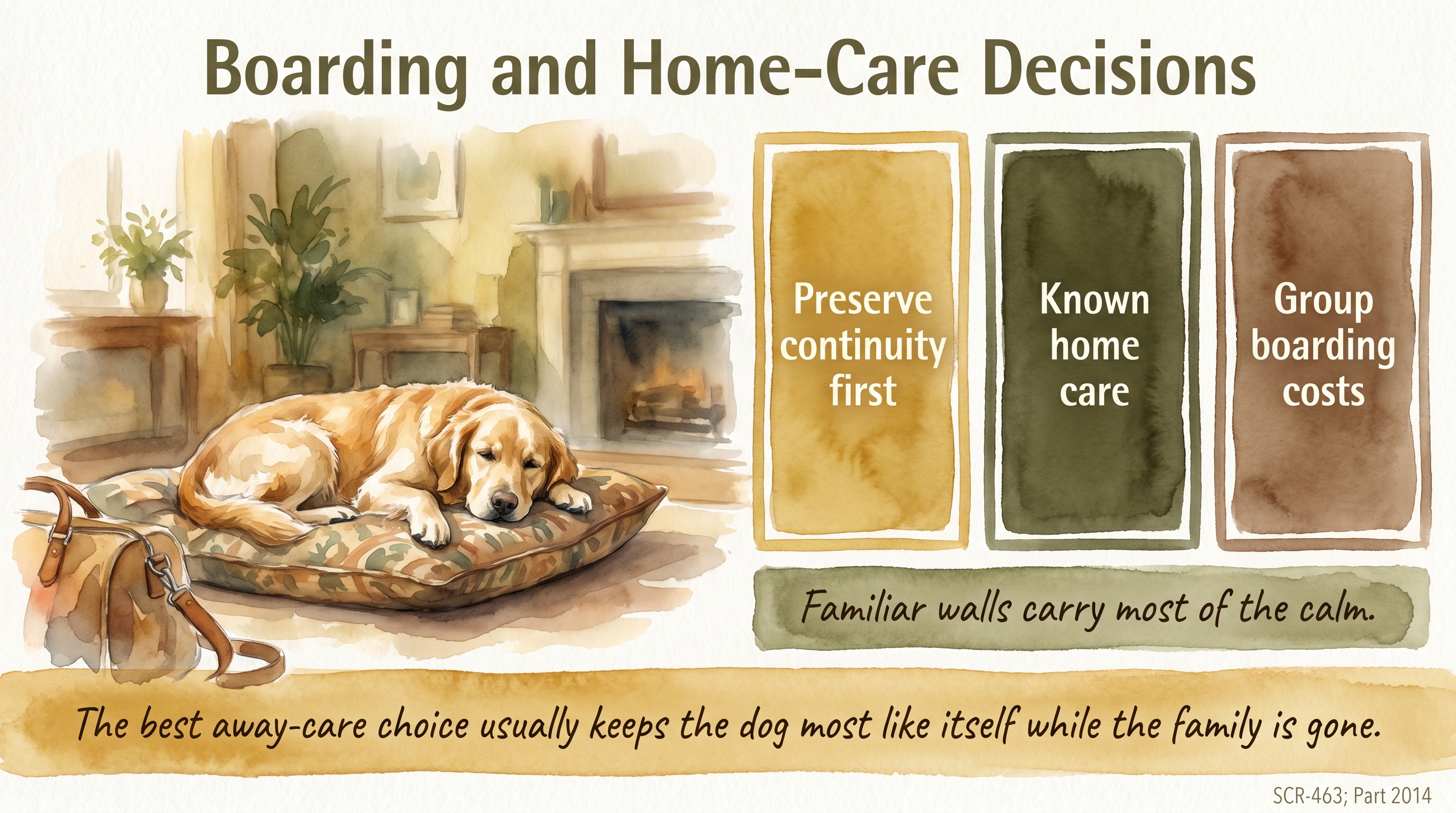
The best away-care choice usually keeps the dog most like itself while the family is gone.
Key Takeaways
- The best away-care decision is usually the one that preserves the most continuity, not the one that is easiest to book.
- Known home care with a trusted person is usually the strongest fit for JB dogs.
- Group boarding often carries more regulation cost than families expect, even when the dog comes home physically fine.
- When possible, choose care where the dog can remain recognizably itself while the family is away.
The Evidence
- owner-behavior and handler-effect literaturedomestic dogs
Dogs' behavior and coping are shaped by the people handling them and by the predictability of the social environment. - arousal-regulation literaturedomestic dogs
High-density, high-noise, low-recovery contexts can elevate baseline arousal and produce lingering spillover after the immediate exposure ends.
- JB breeder observationGolden Retrievers
Most dogs preserve their regulation best when they stay in a known home environment with a trusted caregiver rather than shifting into a crowded boarding setting. - JB family practiceadult family dogs
Dogs returning from high-arousal boarding often need a distinct recovery period before their normal household settling fully returns.
No published study directly tests the practical implications of boarding and home-care decisions for domestic dog raising programs. The application to household dog raising remains an interpretive synthesis rather than a directly tested intervention finding.
SCR References
Sources
- Sundman, A.-S., Van Poucke, E., Svensson Holm, A.-C., Faresjo, A., Theodorsson, E., Jensen, P., & Roth, L. S. V. (2019). Long-term stress levels are synchronized in dogs and their owners. Scientific Reports, 9, 7391. https://doi.org/10.1038/s41598-019-43851-x
- Schork, I. G., Manzo, I. A., De Oliveira, M. R. B., da Costa, F. V., Palme, R., Young, R. J., & de Azevedo, C. S. (2022). How environmental conditions affect sleep? An investigation in domestic dogs (Canis lupus familiaris). Behavioural Processes, 199, Article 104662. https://doi.org/10.1016/j.beproc.2022.104662
- Moyer, B. J., Zulch, H., Ventura, B. A., & Burman, O. (2025). A qualitative exploration of owner experiences following dog adoption. Animal Welfare, 34, e9. https://doi.org/10.1017/awf.2025.4
- Just Behaving program observation disclosure. (2026). Boundary: this internal observation is limited to JB-raised Golden Retrievers whose families continued the JB framework after placement; cohort size, time window, and counting rule are deferred in this revision. Treat as program observation supporting boarding versus home-care decision patterns, not as published external evidence.