Canine Attachment Styles
Canine attachment-style research tries to answer a harder question than basic attachment science. It is one thing to show that dogs form attachment bonds. It is another to classify those bonds into recognizable styles such as secure, avoidant, resistant, or disorganized. The field has made real progress here, but the strongest conclusion is still two-part: attachment behavior in dogs is documented, while the finer human-style category structure is useful but less settled. Documented
What It Means
What Researchers Mean by "Attachment Style"
In human attachment research, attachment style is a shorthand for patterned relationship organization under stress. A secure infant typically uses the caregiver as both safe haven and secure base, shows distress that is proportionate rather than chaotic, and recovers efficiently on reunion. Insecure patterns alter that balance. Avoidant patterns may mute overt proximity seeking. Resistant or ambivalent patterns may show intense contact seeking without efficient calming. Disorganized patterns reflect disrupted or contradictory behavioral organization.
When dog researchers use this language, they are trying to describe canine behavior in the same structured way. Documented The focus is not personality in the broad sense. It is the form the relationship takes when novelty, separation, and reunion test the bond.
What Secure Attachment Looks Like in Dogs
In the dog literature, secure attachment is the clearest and best-supported pattern. Documented Securely attached dogs tend to seek the caregiver under stress, recover more efficiently on reunion, explore more readily when the caregiver is present, and show better balance between contact seeking and outward engagement.
This is why secure attachment is not the same thing as dependence. A secure dog is often freer to move away, investigate, and work through mild uncertainty because the relationship is functioning as a base.
Solomon and colleagues found that secure classifications were common in companion dogs and could be distinguished from insecure patterns with substantial coding agreement. Documented Related work in foster, shelter, and commercial-breeding settings suggests the same broad idea holds across environments, even if the exact prevalence varies with population and method.
Insecure and Disorganized Patterns
The insecure side of the literature is more complex. Avoidant-like dogs may appear less likely to seek or maintain contact under strain. Resistant or ambivalent-like dogs may show higher reunion intensity without clean calming. Disorganized dogs may show contradictory, poorly organized, or conflict-like responses around the caregiver. These descriptions are useful because they capture meaningful variation in relationship behavior rather than lumping every non-secure dog into one bucket.
At the same time, this is where caution matters most. Dogs are not human toddlers, and the behavioral surface of canine insecurity may not map perfectly onto the human clinical language that inspired the categories. Some of the observed behavior can also reflect temperament, prior adversity, frustration, or context-specific fear rather than a pure attachment pattern alone.
Why It Matters for Your Dog
What the Categories Predict
Even with those limits, classification work has practical value because it predicts outcomes. Dogs classified as more secure tend to show lower stress reactivity in standardized procedures, stronger exploratory balance, better persistence in some problem-solving tasks, and more stable social performance.
In contrast, insecure patterns are more often associated with behavioral dysregulation, distress-related responses, or weaker social resilience. The connection to anxiety science matters here. SCR-049 documents that clinically anxious dogs show heightened amygdala-centered salience-network connectivity. That finding does not mean that every insecurely attached dog has the same neural profile, but it does support a broader point: anxiety-related relationship patterns are not purely interpretive language. They can covary with measurable differences in how threat and salience are processed.
Why the Field Treats the Categories Carefully
The main reason this page carries a mixed evidence label is not that the field is weak. It is that the field contains two different strength levels at once.
The strong part is clear: dogs form attachment bonds, and those bonds vary in quality. Secure-base effects, reunion differences, and stress-modulation findings are all documented.
The more tentative part is category precision. The literature does not yet support treating the full four-style human typology as a universally standardized, universally replicated gold standard for dogs. There are several reasons:
The field contains several sources of variation: methodological differences across Strange Situation variants, order effects and scoring differences, canine-specific behavior that does not always fit human coding assumptions, and increasing use of canine-specific scales such as the DHAS alongside laboratory tests. Documented
That is why the safest phrasing is not "dogs have exactly the same attachment categories as children." It is that canine research supports meaningful secure versus insecure variation, with more refined subtype work continuing to mature. Documented
JB often speaks in terms of secure versus insecure relational organization. That general distinction is well aligned with the science. The stronger claim that a specific raising system has been proven to produce higher secure-classification rates than competing systems has not yet been directly tested.
No published study has directly tested whether JB-style raising produces measurably higher secure-attachment classification rates than other breeder or raising approaches in puppies.
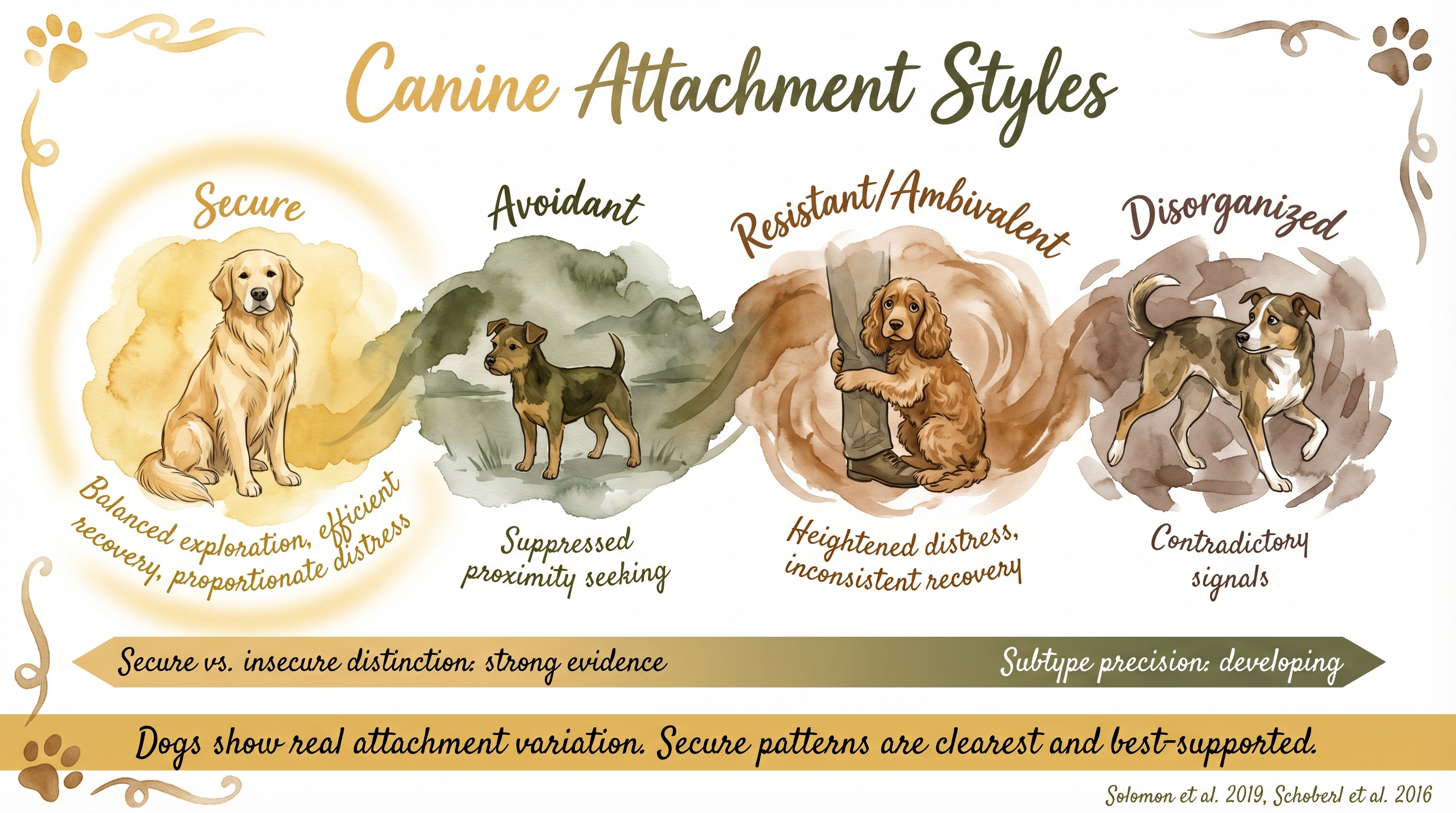
Dogs display distinct attachment styles that parallel human infant classifications and predict behavioral outcomes.
Key Takeaways
- The existence of attachment variation in dogs is documented.
- Secure attachment in dogs is associated with better exploratory balance and lower stress reactivity.
- The human-inspired category vocabulary is useful, but exact category transfer remains less settled than the broader attachment finding itself.
- Neural findings in anxious dogs support the reality of anxiety-related behavioral dysregulation, but they do not make every insecure attachment pattern a simple brain-scan story.
The Evidence
- Solomon, J. et al. (2018/2019)domestic dogs
Adapted attachment classification procedures to dogs and reported substantial inter-rater agreement with meaningful secure versus insecure distinctions. - Stahl, A. et al. (2024)domestic dogs
Commercial-breeding-kennel dogs could be classified into attachment-style groupings associated with stranger-directed social behavior and caretaker-buffer effects. - Thielke, L. E., & Udell, M. A. R. (2019, 2020)domestic dogs
Secure versus insecure attachment patterns in shelter and foster contexts were associated with personality and task outcomes. - Schoberl, I. et al. (2016)domestic dogs and humans
Secure attachment was associated with lower cortisol reactivity during standardized social stress. - Xu, G. et al. (2023)domestic dogs
Clinically anxious dogs showed heightened amygdala-salience network connectivity correlated with stranger fear and excitability.
- Ainsworth, M. D. S. et al. (1978)humans
Established the secure, avoidant, resistant, and later disorganized attachment framework in infant-caregiver research.
- Attachment source synthesisdomestic dogs
Secure versus insecure variation is strongly supported, but strict one-to-one transfer of the full human category architecture remains methodologically developing in dogs. - JB application boundarydomestic dogs
The claim that JB-style raising yields higher secure-attachment rates than standard industry practice remains observational rather than experimentally established.
SCR References
Sources
- Ainsworth, M. D. S., Blehar, M. C., Waters, E., & Wall, S. (1978). Patterns of attachment: A psychological study of the strange situation. Erlbaum.
- Schoberl, I., Beetz, A., Solomon, J., Gee, N., Kotrschal, K., & Wedl, M. (2016). Social factors influencing cortisol modulation in dogs during a strange situation procedure. Journal of Veterinary Behavior, 11, 77-85.
- Solomon, J., Beetz, A., Schoberl, I., Gee, N., & Kotrschal, K. (2018/2019). Attachment security in companion dogs: Adaptation of Ainsworth's strange situation and classification procedures to dogs and their human caregivers. Attachment & Human Development, 21(4), 389-417.
- Stahl, A., Barnard, S., Diana, A., Udell, M. A. R., & Croney, C. (2024). Attachment style and social behavior in dogs from commercial breeding kennels. Applied Animal Behaviour Science.
- Thielke, L. E., & Udell, M. A. R. (2019). Evaluating cognitive and behavioral outcomes in conjunction with the secure base effect for dogs in shelter and foster environments. Animals, 9(11), 932.
- Thielke, L. E., & Udell, M. A. R. (2020). Characterizing human-dog attachment relationships in foster and shelter environments as a potential mechanism for achieving mutual wellbeing and success. Animals, 10(1), 67.
- Xu, Y., Yam, P. S., & Mills, D. S. (2023). Network analysis reveals abnormal functional brain circuitry in anxious dogs. PLOS ONE, 18(2), e0282087.