Proximity Seeking and Contact Comfort
Proximity seeking is one of the most basic behavioral signs of attachment. When a social mammal is stressed, uncertain, tired, or overwhelmed, it moves toward the attachment figure. Contact comfort is the regulatory side of the same story: closeness itself changes how the organism feels and behaves. In dogs, both patterns are documented, but the details matter. Contact is not automatically calming. The form of contact, the relationship history, and the surrounding arousal level all shape whether closeness regulates or excites. Documented
What It Means
Why Proximity Matters
Attachment theory treats proximity seeking as functional behavior, not sentiment. A young or dependent organism moves toward the caregiver because the caregiver organizes safety. That is why attachment behavior is usually strongest under novelty, separation, fatigue, pain, or uncertainty. If everything is calm and familiar, the need for contact may be less visible. When strain rises, the bond becomes obvious.
Dogs show this same pattern in standardized attachment testing. They orient toward caregivers on reunion, use caregivers as secure bases in unfamiliar environments, and shift their behavior when the caregiver is absent or returns. Documented
This is one reason attachment science cannot be reduced to food or training history alone. A dog may seek a caregiver because the caregiver predicts safety, not merely because the caregiver dispenses rewards.
Contact Comfort Across Species
The classic cross-species foundation is Harlow's rhesus macaque work. Infant monkeys preferred soft surrogate contact figures over wire surrogates even when the wire figure provided food. That research is not dog research, but it established an enduring principle: comfort, regulation, and attachment cannot be explained by feeding alone. Documented
Human attachment research extended the same idea. Documented Infants use touch, holding, and caregiver contact not only as affection but as regulation. The relevant cross-species lesson for dogs is modest and important: the body of the attachment figure can function as a stabilizing resource.
The canine literature supports that principle behaviorally. Dogs seek caregiver proximity under stress, greet in caregiver-specific ways, and regulate exploration around the caregiver's presence. What the dog research adds is an important refinement: not every form of human touch is equivalent.
What Dogs Show
In the dog literature, proximity seeking is documented in both experimental and naturalistic contexts. Topal's Strange Situation work, Horn's secure-base experiments, and later attachment studies all point to the same architecture. Under uncertainty, the caregiver becomes behaviorally special.
But the comfort side of the story becomes more precise when physiology enters the picture. SCR-044 documents that touch type differentially affects canine endocrine arousal. Slow stroking and calm affiliative contact are associated with quieter, more settling outcomes, while activating touch such as vigorous patting or arousing handling can be associated with cortisol increases.
That means "contact comfort" in dogs should not be translated as "touch the dog more." The better translation is that regulated, relationship-consistent contact can support settling, while rough, stimulating, or poorly timed contact can do the opposite.
Why It Matters for Your Dog
Comfort Is Not the Same as Excitement
This distinction matters for both science and everyday handling.
A dog can rush into contact in an excited way without actually becoming more regulated. Likewise, a caregiver can offer physical contact that increases arousal rather than reducing it. The behavioral picture therefore has to be read alongside the tone of the interaction.
The safest evidence-based summary is: dogs seek caregiver proximity under stress, caregiver contact can be regulating, the quality of touch matters, and affiliative calm contact and activating contact are not interchangeable.
That last point is especially important because it prevents a common slippage. Contact comfort is a regulatory concept, not a blanket endorsement of constant petting, roughhousing, or exuberant reassurance.
Why This Matters for Attachment Science
Attachment theory predicts that the attachment figure should become especially valuable when the environment is uncertain. Ambiguous Proximity seeking and contact comfort are two of the clearest outputs of that system. In dogs, they help explain why caregiver presence changes behavior so strongly in some settings and why reunion is not just social enthusiasm.
These findings also connect directly to the cortisol-buffering literature. Documented Contact comfort is one of the most plausible behavioral routes by which an attachment figure dampens stress responses. The attachment science page shows the bond. This page shows the closeness behavior inside the bond. The cortisol-buffering page then asks what that closeness does physiologically.
This science does not say that every anxious moment should be met with bigger, louder, or more emotional contact. It says that calm, usable caregiver proximity is part of how attachment figures regulate strain and that the person should remain regulated as well.
No published study has directly tested whether JB-style proximity and calm contact produces measurably better attachment security or stress buffering compared to other contact or caregiver-proximity approaches in puppies.
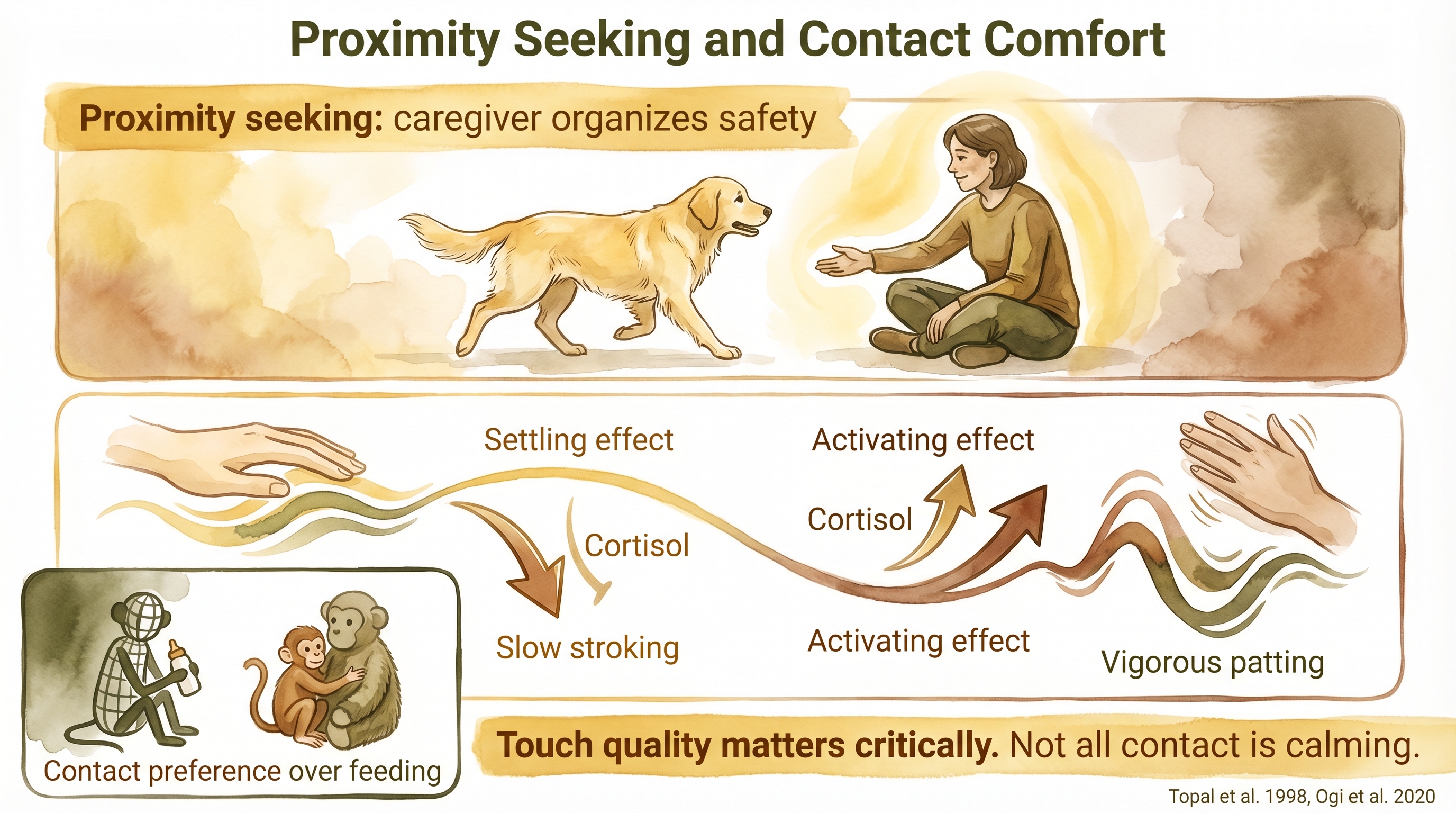
Proximity seeking and contact comfort are primary attachment behaviors - not byproducts of feeding but needs in their own right.
Key Takeaways
- Proximity seeking is one of the clearest behavioral outputs of attachment.
- Contact comfort is about regulation, not just closeness or affection.
- In dogs, touch quality matters: calm affiliative contact and activating contact do not have the same physiological profile.
- These findings help explain why caregiver presence can organize exploration and stress recovery in attachment research.
The Evidence
This entry uses ambiguous claim-level tags beyond the dedicated EvidenceBlocks below. These tags mark claims where the literature remains unsettled or multiple interpretations coexist.
- Topal, J. et al. (1998)domestic dogs
Dogs showed attachment-relevant proximity seeking and reunion organization toward owners in Strange Situation testing. - Horn, L., Huber, L., & Range, F. (2013)domestic dogs
Owner presence altered exploration and task engagement, supporting secure-base use rather than mere companionship. - Ogi, A. et al. (2020)domestic dogs
Stroking studies in guide dogs showed that contact style is physiologically consequential rather than uniformly calming. - SCR-044 synthesisdomestic dogs
Slow stroking is associated with calming effects, while activating touch is associated with cortisol increases.
- Harlow, H. F. (1958)rhesus macaques
Contact comfort, not feeding alone, organized infant attachment preference in surrogate-mother studies. - Ainsworth, M. D. S. et al. (1978)humans
Caregiver contact and proximity are central outputs of secure attachment under separation and reunion conditions.
- SCR-044 boundarydomestic dogs
Touch should not be treated as uniformly calming. The regulatory effect depends on contact style, timing, and context.
SCR References
Sources
- Ainsworth, M. D. S., Blehar, M. C., Waters, E., & Wall, S. (1978). Patterns of attachment: A psychological study of the strange situation. Erlbaum.
- Harlow, H. F. (1958). The nature of love. American Psychologist, 13(12), 673-685.
- Horn, L., Huber, L., & Range, F. (2013). The importance of the secure base effect for domestic dogs. PLoS ONE, 8(1), e65296.
- Ogi, A. et al. (2020). Effects of stroking on salivary oxytocin and cortisol in guide dogs. Animals.
- Topal, J., Miklosi, A., Csanyi, V., & Doka, A. (1998). Attachment behavior in dogs: A new application of Ainsworth's Strange Situation Test. Journal of Comparative Psychology, 112