The Second Week Regression
The second-week regression is the moment many families find themselves whispering some version of, "What happened to my puppy?" Around day ten to fourteen, the puppy who seemed surprisingly easy in week one can become mouthier, louder, more restless, and more willing to test the edges of the home. In JB, this moment is normalized rather than dramatized. The pattern is strongly observed across families, while the exact mechanism remains a plausible but not directly measured canine explanation. Observed-JB
What It Means
The word regression is useful only if families hear it correctly.
It does not mean: the puppy has turned bad, week one was fake, and the family ruined everything. Observed-JB
It means the adjustment period is changing shape.
During week one, many puppies are still somewhat inhibited by transition. By the second week, they often begin acting more like themselves in the new home. That means the family finally sees more of: normal puppy persistence, stronger exploratory behavior, sharper protest when boundaries appear, and more obvious fatigue spillover when rest has not been protected well. Observed-JB
What Families Usually Notice
The second-week regression often shows up in clusters, not as one single problem. Observed-JB
The family may notice: more nipping, faster escalation in the evening, less clean settling after meals or outings, resistance to handling that seemed easy last week, more vocal protest around brief separations, and small setbacks in house training. Observed-JB
The common emotional mistake is to read all of this as character.
The better reading is state plus structure.
The puppy is carrying less novelty-muted behavior now, and the household is being tested more honestly.
Why the Timing Makes Sense
JB has to be careful here. There is no clinical paper naming a canine "second-week regression" and timing it neatly to day twelve.
What the science does support is the larger pattern: acute cortisol is not a multi-week circulating event, transition and social disruption do alter stress physiology, caregiver change and environmental novelty matter, and the early home period is developmentally sensitive.
That makes it reasonable to interpret the second week as the point when the puppy is no longer simply arriving. The nervous system is starting to show a truer working baseline, and the puppy is beginning to test how real the household's structure actually is.
The Industry Default Mistake
This is where many families get pulled off course.
The puppy becomes harder, so the adults escalate: more formal training sessions, more verbal correction, more excitement-based "exercise", more attempts to tire the puppy out, and more emotion in the humans' voices.
All of that can make the week worse.
The puppy is not usually asking for a bigger program. It is asking whether the adults will remain readable when the first easy days are over.
The JB Alternative
JB's response to second-week turbulence is usually quieter, not bigger.
The adults tighten the parts of life that often got a little sloppy after a decent first week: nap windows become more protected, greeting excitement is answered less, not more, meal rhythm gets cleaner, novelty is reduced instead of increased, handling returns to shorter, calmer intervals, and the adults stop chasing the puppy's state upward.
This is one of the deepest practical points in the whole category. The family holding steady is the intervention.
Regression Often Means the Puppy Feels Safer, Not Less Safe
This is counterintuitive, but important.
A puppy that is safer in the household often becomes bolder in the household. That boldness can be inconvenient. It can involve more experimentation, more push, and less of the shut-down or overly careful behavior families saw at first.
That can feel like worsening when it is actually movement.
The question is not, "Did the puppy stop being easy?"
The better question is, "Can the puppy become more awake, more present, and still be guided back to calm?"
That is the developmental task of week two.
What a Crash Landing Looks Like
Second-week crash landings usually happen because the family loses confidence just when confidence matters most.
The adults think: we need to do more, we need to clamp down, she is getting away with things, and we must be too soft.
Then the household becomes louder and more reactive than the puppy is.
That teaches exactly the wrong lesson. The puppy rises, the people rise higher, and every evening becomes a contest of momentum.
A soft landing in week two does not mean permissiveness.
It means the adults stay calmer than the puppy, keep the structure clean, and refuse to turn the middle of the month into a household panic.
Why It Matters for Your Dog
The second-week regression matters because it is the first honest stress test of the family's month-one philosophy.
When week two gets harder, the answer is usually tighter prevention and better rest protection, not more stimulation and not bigger emotional correction. The family staying steady is what teaches the puppy that the calm floor is real.
If the adults answer regression with steadier structure, the puppy often comes through the period with a stronger baseline than before. If the adults answer regression with frantic over-management, they can teach the puppy that household instability begins the moment the puppy itself becomes harder.
That is why this page should feel reassuring.
Many families hit this moment.
It is not a secret sign that the puppy is wrong for them. It is the point where the relationship stops being a welcome event and starts becoming a real household.
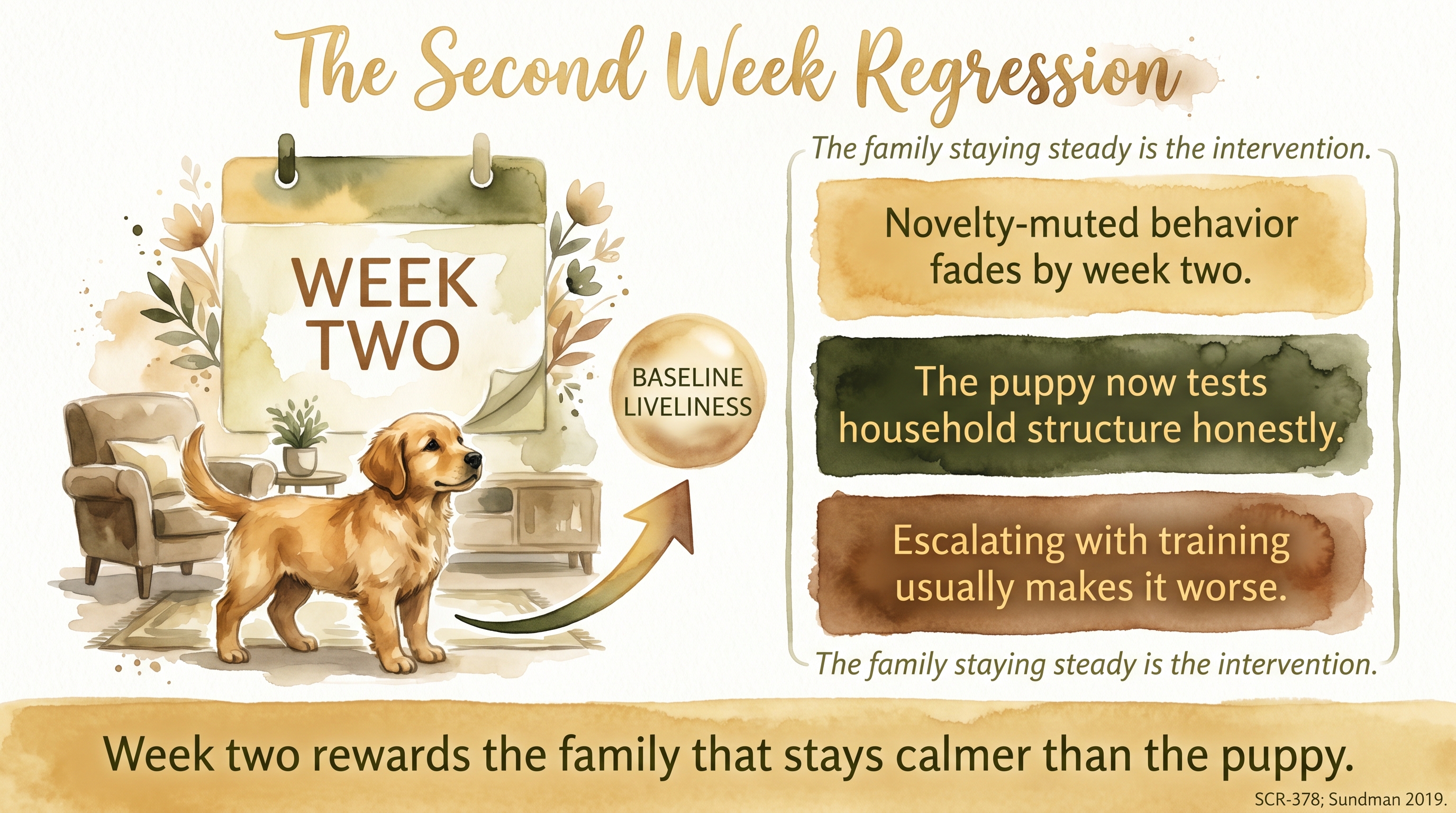
Week two rewards the family that stays calmer than the puppy.
Key Takeaways
- The second-week regression is a common pattern in which the puppy becomes more mouthy, more restless, and more willing to test the household after the easier opening days.
- This period should not be read as the puppy showing bad character or the family failing; it often reflects a more honest baseline emerging.
- Escalating into bigger training, louder correction, or more stimulation usually worsens the problem by raising household arousal further.
- The most reliable JB response is tighter prevention, stronger nap protection, cleaner routine, and adults who stay calmer than the puppy.
The Evidence
- JB breeder-network observationfamily-raised puppies
Many puppies show a recognizable harder period around days ten to fourteen, with more edge testing, nipping, and difficulty settling than in the arrival week.
- Sundman et al. (2019); Hoglin et al. (2021); Beerda et al. (1999); Hennessy et al. (2009)domestic dogs
Acute cortisol dynamics operate on a minutes-to-hours timescale, while multi-day or multi-week stress patterns are better understood as broader adaptation states rather than a single hormone pulse remaining high for weeks. - Mariti et al. (2020); Fallani et al. (2006); Topal et al. (2005); Cannas et al. (2010)domestic dogs
Caregiver change and early transition meaningfully affect canine adjustment, even though the exact week-two pattern has not been isolated as its own clinical syndrome.
- JB synthesisbreeder-to-family transition practice
The second-week regression is plausibly explained as the end of novelty-muted behavior plus the beginning of more honest social testing inside a home the puppy now reads as real.
No published study directly tests the specific Just Behaving guidance on second week regression within a breeder-to-family transition, so this entry relies on broader canine evidence, breeder observation, and practical synthesis rather than a direct trial of the full protocol.
SCR References
Sources
- Sundman, A.-S., Van Poucke, E., Svensson Holm, A.-C., Faresjo, A., Theodorsson, E., Jensen, P., & Roth, L. S. V. (2019). Long-term stress levels are synchronized in dogs and their owners. Scientific Reports, 9, 7391. https://doi.org/10.1038/s41598-019-43851-x
- Hoglin, A., Van Poucke, E., Katajamaa, R., Jensen, P., Theodorsson, E., & Roth, L. S. V. (2021). Long-term stress in dogs is related to the human-dog relationship and personality traits. Scientific Reports, 11, 8612. https://doi.org/10.1038/s41598-021-88201-y
- Beerda, B., Schilder, M. B. H., van Hooff, J. A. R. A. M., de Vries, H. W., & Mol, J. A. (1999). Chronic stress in dogs subjected to social and spatial restriction. I. Behavioral responses. Physiology & Behavior, 66(2), 233-242. https://doi.org/10.1016/S0031-9384(98)00289-3
- Hennessy, M. B., Voith, V. L., Mazzei, S. J., Buttram, J., Miller, D. D., & Linden, F. (2009). Behavior and cortisol levels of dogs in a public animal shelter, and an exploration of the ability of these measures to predict problem behavior after adoption. Applied Animal Behaviour Science, 113(4), 798-810. https://doi.org/10.1016/j.applanim.2008.06.004
- Mariti, C., Lenzini, L., Carlone, B., Zilocchi, M., Ogi, A., & Gazzano, A. (2020). Does attachment to man already exist in 2 months old normally raised dog puppies? A pilot study. Dog Behavior, 6(1), 1-11. https://doi.org/10.4454/db.v6i1.96
- Fallani, G., Previde, E. P., & Valsecchi, P. (2006). Do disrupted early attachments affect the relationship between guide dogs and blind owners? Applied Animal Behaviour Science, 100(3-4), 241-257. https://doi.org/10.1016/j.applanim.2005.12.005
- Topal, J., Gacsi, M., Miklosi, A., Viranyi, Z., Kubinyi, E., & Csanyi, V. (2005). Attachment to humans: A comparative study on hand-reared wolves and differently socialized dog puppies. Animal Behaviour, 70, 1367-1375. https://doi.org/10.1016/j.anbehav.2005.03.025
- Cannas, S., Frank, D., Minero, M., Godbout, M., & Palestrini, C. (2010). Puppy behavior when left home alone: Changes during the first few months after adoption. Journal of Veterinary Behavior, 5(2), 94-100. https://doi.org/10.1016/j.jveb.2009.08.009