Cortisol Physiology and Measurement in Dogs
Cortisol is the primary glucocorticoid measured in canine stress research. It is one of the most useful biomarkers in the field and one of the most misunderstood. A cortisol result can tell us something real about endocrine response, but only if we know what matrix was measured, when it was collected, what kind of challenge is being discussed, and whether we are looking at a single number or a trajectory over time. Documented
What It Means
What Cortisol Is Measuring
Cortisol is part of the HPA stress-response system. It rises with many forms of biologically meaningful challenge, including novelty, restraint, transport, training pressure, social instability, and anticipation. Documented That is why it is useful. It is also why it cannot be read as a simple suffering meter.
A single cortisol value does not tell us whether the dog is distressed or excited, whether the dog is recovering well, whether the dog is normally low or high relative to itself, or whether the event is acute or part of a chronic pattern. Documented That is why modern stress interpretation usually prefers within-subject change, repeated sampling, or multimodal context rather than one isolated result.
The Main Measurement Matrices
Different cortisol matrices answer different questions. Blood measures (serum or plasma) are useful for acute physiology and clinical endocrinology, but sampling is invasive and can itself affect stress output. Documented They are strongest when timing is tightly controlled. Salivary cortisol is one of the most common non-invasive acute measures in dogs. It is practical for challenge studies and training or handling contexts, and it avoids venipuncture-related stress better than blood. Urinary cortisol or cortisol:creatinine ratio integrates over a longer window than saliva and can be useful for shelter, housing, and other short-term cumulative contexts. Hair cortisol concentration (HCC) is a retrospective marker of longer-term systemic exposure. It is useful for chronic-stress and synchrony questions, but it does not timestamp acute events cleanly. It is best understood as a long-range record rather than a moment-to-moment stress readout.
Why Timing Matters
The retired "40-day cortisol" folklore is a good example of why measurement language needs precision. The source review is explicit that circulating cortisol does not stay elevated for 40 days after an ordinary stress event. Cortisol responds on the scale of minutes to hours, not weeks. Multi-week claims usually belong to chronic matrices such as hair or to repeated-cumulative welfare contexts, not to one unresolved bloodstream spike. Documented
SCR-098 adds a narrower timing point. The estimated half-life of cortisol in dogs is about 66 minutes. That is useful because it explains why closely spaced arousing events can layer on top of one another. It should not be confused with full-system recovery time. The circulating hormone can halve on that timescale while broader HPA recovery, autonomic settling, sleep disruption, or behavioral carryover take longer.
Why It Matters for Your Dog
Interpretation Cautions
Several cautions belong on almost every cortisol assessment. Cortisol rises with many states besides fear, matrix choice changes what question can be answered, individual baselines vary, repeated measures are more informative than one-off values, and context matters as much as concentration.
This is also why stable-environment findings matter. SCR-060 documents that novel intake and rehoming environments elevate canine cortisol and that calmer, more stable home conditions reduce those measures over time. Documented The pattern is not "one number proves welfare." The pattern is that context changes endocrine trajectories.
Cortisol Is Better as a Pattern Than a Verdict
The best scientific use of cortisol in dogs is usually patterned rather than moralistic. If cortisol spikes after a known challenge and then resolves, that may be expected. If it remains elevated across unstable housing or transition, that becomes more concerning. If it falls over time as environment stabilizes, that suggests adaptation or relief. If it covaries with rest, activity, immune markers, or behavior, interpretation improves further.
That is one reason cortisol is often paired with HRV, immune markers, behavioral scoring, or longitudinal follow-up. No single biomarker carries the whole interpretive burden.
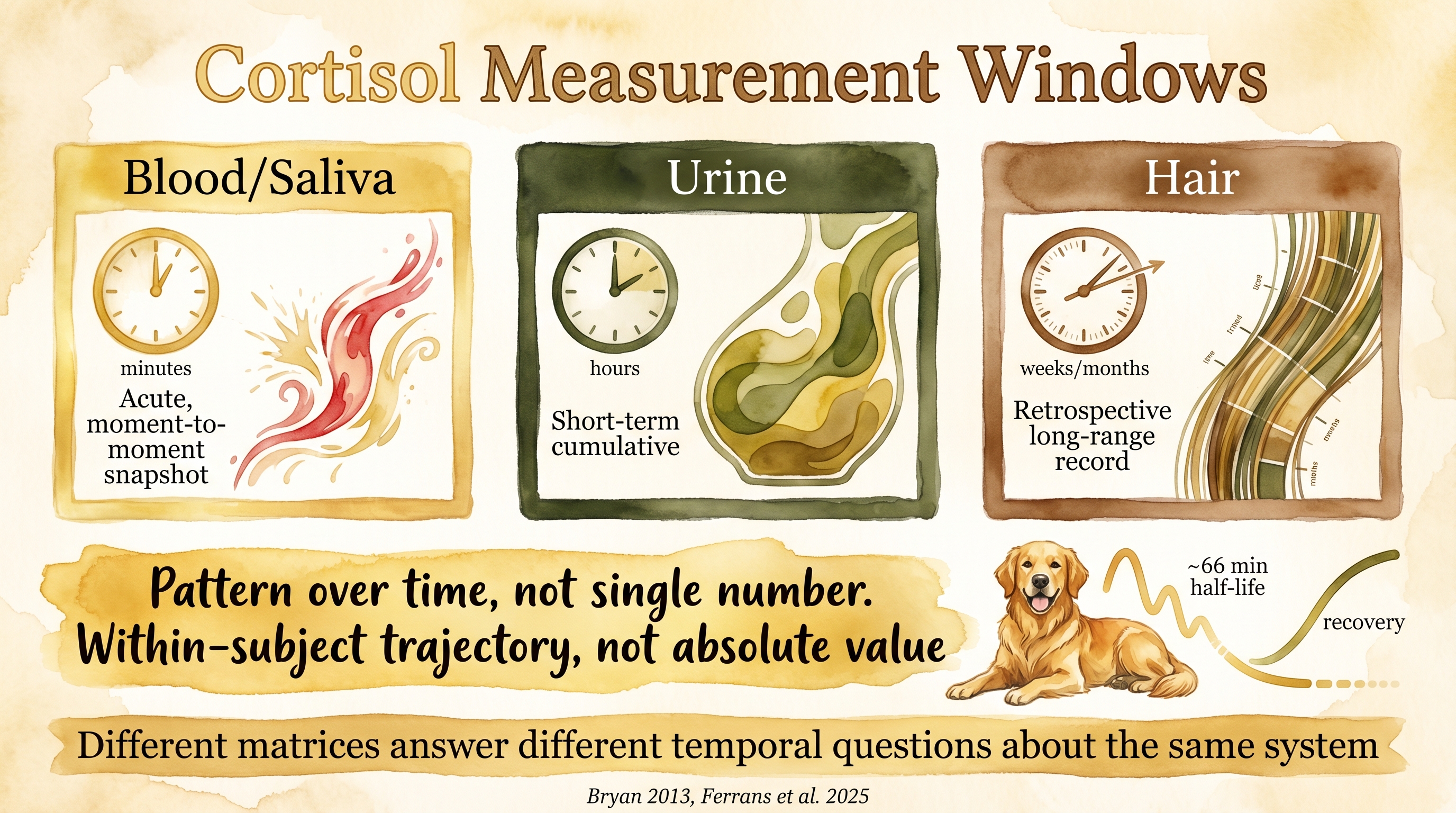
Cortisol measurement requires understanding diurnal rhythms, lag times, and the distinction between acute and chronic markers.
Key Takeaways
- Cortisol is a valuable canine stress biomarker, but its meaning depends on matrix, timing, and context.
- Saliva, urine, blood, and hair measure different timescales of HPA activity.
- The estimated 66-minute half-life is about circulating hormone decay, not full recovery of the whole stress system.
- Cortisol is most informative when interpreted as a pattern over time rather than as a single verdict number.
The Evidence
- Bryan, H. M. (2013)domestic dogs
Validated hair cortisol as a meaningful longer-range index of systemic cortisol exposure over time in dogs. - Heimburge, S. et al. (2019)multiple animal species including dogs
Reviewed methodological strengths and limits of hair cortisol as a stress-assessment tool. - Ferrans, M. et al. (2025)domestic dogs
Highlighted matrix-comparison caveats by showing salivary cortisol is not a perfect serum correlate in adult pet dogs and assistance-dog puppies. - Hennessy, M. B. et al. (1997) and van der Laan, J. E. et al. (2022)domestic dogs
Showed cortisol disruption in shelter and rehoming contexts with partial normalization in more stable environments. - Sleep-recovery source synthesisdomestic dogs
Estimated cortisol half-life in dogs at roughly 66 minutes while warning against confusing hormone decay with full-system recovery.
- SCR-098 boundarydomestic dogs
The 66-minute figure is useful for understanding hormone decay, but it must not be presented as the exact full physiological recovery time after a stress event. - Measurement source synthesisdomestic dogs
A single cortisol value usually tells less than repeated sampling, trajectory, or multi-marker interpretation.
No published study has directly compared cortisol trajectories across all major canine measurement matrices (saliva, blood, urine, hair) on the same dog samples under identical stressor conditions.
No study has validated a standardized within-subject cortisol change threshold in dogs that reliably distinguishes normal recovery from dysregulation or concerning delayed response.
SCR References
Sources
- Bryan, H. M. (2013). Hair as a meaningful measure of baseline cortisol levels over time in dogs. JAALAS.
- Ferrans, M., et al. (2025). Salivary cortisol is an unreliable correlate of serum cortisol in adult pet dogs and assistance dog puppies. Scientific Reports, 15, 15986.
- Heimburge, S., et al. (2019). The use of hair cortisol for the assessment of stress in animals. General and Comparative Endocrinology, 270, 10-17.
- Hennessy, M. B., et al. (1997). Cortisol and behavior in dogs in a public animal shelter. Applied Animal Behaviour Science.
- van der Laan, J. E., Vinke, C. M., van der Borg, J. A. M., Arndt, S. S., and Beerda, B. (2022). Evaluation of hair cortisol as an indicator of long-term stress responses in dogs in an animal shelter and after subsequent adoption. Scientific Reports, 12, 5117. https://doi.org/10.1038/s41598-022-09140-w