Not Greeting Excitement
The most practically important signal in the first week may be the one families almost never think of as a signal at all: what they do when the puppy gets excited. If the human answer to jumping, spinning, barking, mouthing, and zooming is bigger energy, louder voice, more touch, and emotional engagement, the puppy learns something very clear: excitement works. JB's rule is the opposite. Do not greet excitement. Meet it with stillness, quiet, a small step back, and the calm refusal to turn arousal into connection. Observed-JB
What It Means
This page matters because excitement is one of the easiest things for a family to reinforce unintentionally.
The puppy escalates.
The humans interpret that escalation as: love, joy, personality, and enthusiasm.
So they respond with: laughter, talk, petting, getting on the floor, and physical engagement.
In operant language, that is often reinforcement. In JB language, it is the accidental initiation of a circuit the family will later wish had never started.
Excitement Feels Like Bonding to Humans
This is what makes the page emotionally hard.
Families are not usually rewarding excitement because they want a chronically dysregulated dog. They are rewarding it because excitement feels relational. A puppy who rushes toward you, mouths your hands, spins in circles, barks, and jumps seems full of feeling.
Humans then make a natural but costly mistake: they treat visible intensity as proof of love. Observed-JB
JB does not deny that excitement contains real feeling. It denies that excitement should become the relationship's central vocabulary.
The dog does not lose connection when the human stops greeting excitement. Observed-JB The dog learns that connection opens through calm instead.
What Greeting Excitement Teaches
If the family repeatedly greets arousal with arousal, the puppy learns a full sequence: go higher, people get bigger, bodies move toward me, voices get louder, and this is how I get social access. Observed-JB
That lesson is powerful because it is not taught once. It is taught: at wake-up, at the door, after naps, at evening time, and whenever the puppy gets wild and the humans get socially pulled into it.
This is exactly why JB frames the first week as a calibration window. The family is building a rule the puppy will later apply in a thousand different contexts.
What Not Greeting Excitement Actually Looks Like
Many people mishear this principle as emotional coldness. It is not.
Not greeting excitement does not mean: scaring the puppy, punishing the puppy, glaring, shoving, and rejecting affection. Observed-JB
It means: becoming still, lowering the voice, removing the extra energy from the moment, and waiting for a small drop in arousal before re-engaging.
Sometimes that means a literal half-step back and silence.
Sometimes it means calmly redirecting the puppy into a quieter state without fanfare.
The point is always the same. The human should not become the second engine in the arousal loop.
Prevention and Learning Theory Meet Here
This is one of the cleanest places where JB and learning theory can be described in the same sentence without confusion.
Learning theory says: behavior followed by rewarding consequences becomes more likely.
JB adds: families often do not realize which moments contain the reward.
Excited attention is still attention.
Excited physical engagement is often an even stronger reward.
That means the family may be running a training session every time it thinks it is "just responding naturally."
This is why not greeting excitement is not a vibe preference. It is one of the most important first-week prevention tools in the whole philosophy.
What a Crash Landing Looks Like Here
The crash landing is almost invisible because it feels affectionate and alive.
The puppy wakes up and the humans squeal.
The puppy barks and everyone laughs.
The puppy mouths and people wiggle their hands.
The puppy spins and the family gets on the floor.
The puppy zooms through the room and the adults talk faster, move faster, and bring even more social charge.
Then one or two months later the family says: we never meant to teach this.
Usually they did not. But they taught it anyway.
That is the whole reason JB exists in the first place. Much of puppy raising is made of lessons people are teaching without knowing they are teaching them.
Quiet Is Not Rejection
This point must be made explicitly because families often fear it deeply.
When you do not greet excitement, you are not withdrawing love.
You are protecting the form love will take in this relationship.
The puppy still gets: touch, proximity, affection, and warmth.
It simply gets them through calm access rather than through frenzy.
That is actually more generous over the long arc. A dog built around calm access can still be affectionate, joyful, and deeply bonded. A dog built around frantic access often spends years trying to regain composure in order to live comfortably with the same people it loves.
Why the First Week Is the Best Time to Do This
The earlier the family teaches this rule, the less conflict it creates later.
In the first week: behaviors are not yet heavily rehearsed, the puppy is still reading the household's grammar, and adults can decide which door social connection comes through.
If they wait, the rule becomes harder because the puppy already has a reinforcement history for escalating.
That is what prevention is always trying to avoid.
Why It Matters for Your Dog
This page matters because greeting style is destiny more often than people realize.
The family should not teach the puppy that rising in arousal is the price of social access. Calm should be the door to contact from the very first week.
If the puppy learns that calm opens the relationship, many future problems get weaker before they even begin: door excitement, post-nap frenzy, evening spirals, visitor jumping, and mouthy greetings.
If the puppy learns that excitement gets the people bigger, the opposite tends to happen.
This is why JB speaks so plainly here. Families often want a gentler sentence. But gentleness without clarity is how these patterns keep getting built.
You are not rejecting your puppy by refusing to socially amplify its excitement.
You are teaching the puppy the vocabulary of a relationship that will still be livable when it weighs seventy pounds.
That is one of the most loving first-week decisions a family can make.
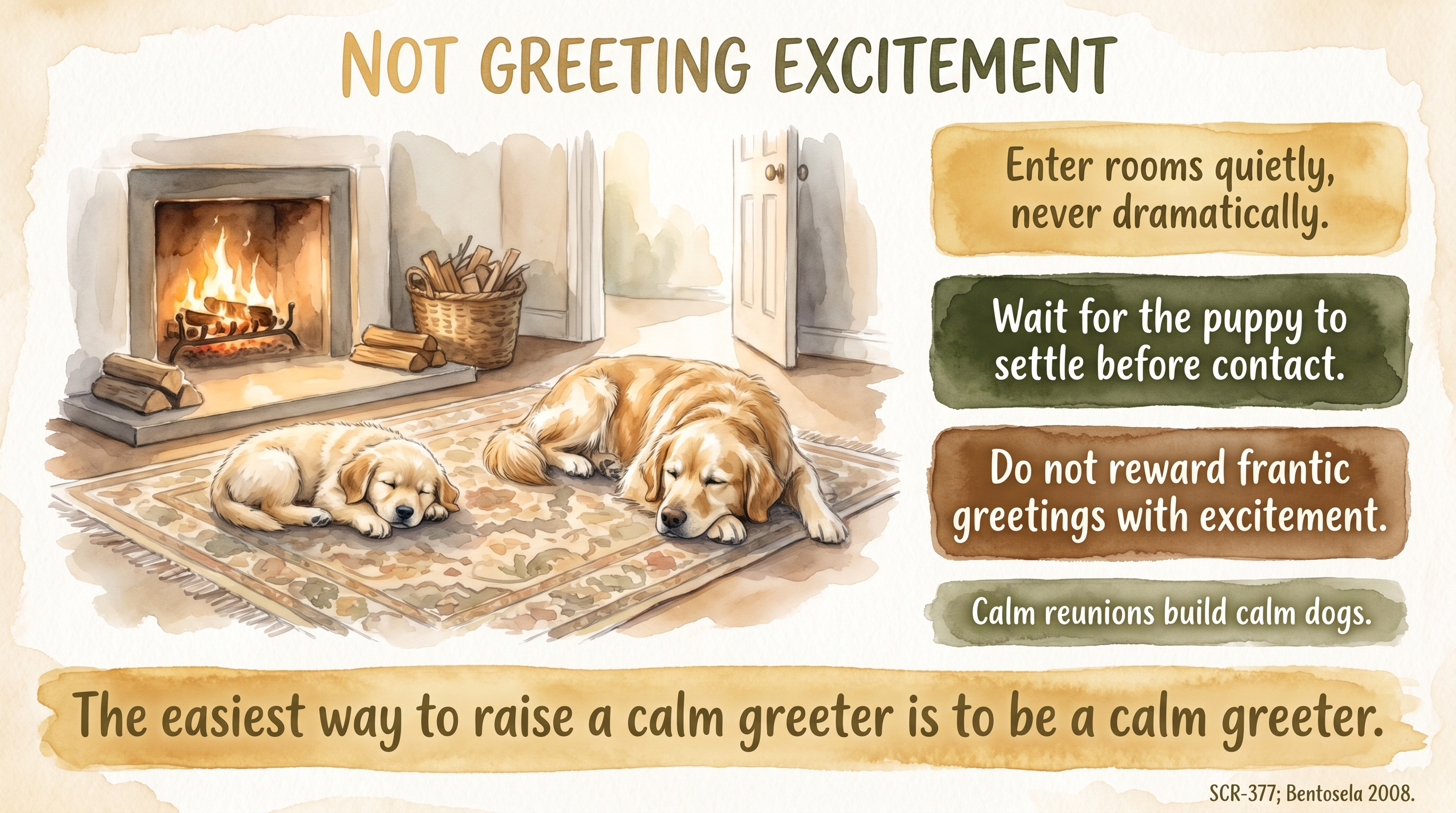
The easiest way to raise a calm greeter is to be a calm greeter.
Key Takeaways
- Excited human attention often reinforces excited puppy behavior, even when the family thinks it is only showing love.
- Not greeting excitement means removing extra energy from the moment, not withholding affection or frightening the puppy.
- A crash landing happens when the family repeatedly teaches the puppy that arousal is how social access is won.
- The first week is the best time to make calm the door to connection because the reinforcement history is still being built.
The Evidence
- Skinner (1953); Bentosela et al. (2008); Smith & Davis (2008); Hall & Wynne (2016)animals including domestic dogs
Behavior followed by reinforcing social consequences becomes more likely, even when the humans delivering those consequences do not realize they are reinforcing the behavior.
- JB first-week practicefamily-raised puppies
Meeting puppy excitement with stillness and quiet prevents arousal from becoming the route to social connection, while excited human engagement reliably strengthens the behavior families later dislike.
No published study directly tests the specific Just Behaving guidance on not greeting excitement. This entry relies on broader canine evidence, breeder observation, and practical synthesis.
SCR References
Sources
- Skinner, B. F. (1953). Science and human behavior. Macmillan.
- Bentosela, M., Barrera, G., Jakovcevic, A., Elgier, A. M., & Mustaca, A. E. (2008). Effect of reinforcement, reinforcer omission and extinction on a communicative response in domestic dogs (Canis familiaris). Behavioural Processes, 78(3), 464-469. https://doi.org/10.1016/j.beproc.2008.01.006
- Smith, S. M., & Davis, D. L. (2008). Clicker increases resistance to extinction but does not decrease training time of a simple operant task in domestic dogs. Applied Animal Behaviour Science, 110(3-4), 318-329.
- Hall, N. J. (2017). Persistence and resistance to extinction in the domestic dog: Basic research and applications to canine training. Behavioural Processes, 141(Part 3), 67-74. https://doi.org/10.1016/j.beproc.2017.04.001