The First Month: From Arrival to Integration
The first month is where the family's welcome either settles into a true soft landing or slowly drifts back toward the ordinary modern pattern of overstimulation, improvisation, and accidental rehearsal of the wrong things. Week one introduced the house. The rest of the month teaches the puppy what kind of life that house actually runs. JB therefore treats the first month as a rough integration window, not as a training window. That framing is a synthesis built from developmental timing, attachment research, and breeder observation rather than a directly trialed month-one protocol, which is why it stays at the heuristic level. Heuristic
What It Means
Families often assume the hardest part of bringing a puppy home is the first night. Observed-JB
In JB, the harder truth is this: the first night is intense and the middle of the month is decisive. Heuristic
The reason is simple. In the opening days, the puppy is still calibrating. It is learning the smell map, the sleep map, the voice map, and the emotional temperature of the new household. Many puppies look easier than expected during this period. They sleep more, explore less boldly, and do not yet show the full range of behaviors the family will later need to guide.
That ease is real, but it is not the finished picture.
In breeder observation and in many family transitions, the first month often unfolds in three recognizable phases.
The Honeymoon Period
Roughly days three through ten often feel surprisingly manageable. The puppy is still muted by novelty, social loss, and the sheer amount of new information being processed. Families sometimes read this as proof that they have already "done it right."
Sometimes they have.
But more often, they are seeing a puppy that has not yet begun moving through the home with full confidence. Observed-JB
That distinction matters because the honeymoon period is not a reward for being done. It is the quiet window in which the family builds the routine that will have to carry more honest puppy behavior later.
The Second-Week Regression
Around day ten to sixteen, many families hit the moment they were not warned about often enough. The puppy who seemed soft and easy begins to bite harder, settle less cleanly, resist handling it had accepted last week, get louder at the wrong moments, and test the edges of the household more directly.
JB does not treat that shift as failure.
It treats it as the point where the transition becomes real.
The puppy is no longer only trying to survive the new home. It is beginning to live in it. That means the family finally gets to see whether the calm floor, prevention habits, rest rhythm, and low-arousal structure of week one were actually built deeply enough to hold.
The Settled Baseline
By the latter half of the month, a different pattern often begins to emerge when the family has held well: naps become more predictable, mealtimes get calmer, body language softens, recovery after small upsets gets faster, and the house begins to feel readable to the puppy.
This is the beginning of integration. Not perfection. Not a finished dog. But a puppy whose daily life is starting to make coherent sense.
The Mnemonic Families Hear Everywhere
The popular transition mnemonic is popular for a reason. It gestures toward a real rhythm people notice in transitioned dogs: a first handful of days that feel acute, a later multi-week period where the dog's real baseline becomes clearer, and a longer arc of settling after that. JB's audit position is narrower. It is a useful mnemonic, but it is not a measured clinical protocol, and the named checkpoints are better understood as rough phases rather than literal calendar deadlines.
That distinction matters because families can become anxious when their puppy does not hit the popular internet milestones on schedule.
A puppy is not late to its own adjustment because a graphic online said week three should look a certain way.
Integration Is Not Training-by-Another-Name
This page carries one of the main philosophical guardrails of the dispatch. The first month should not be read as "the month to start working the puppy hard." It is the month to make the home biologically legible.
The family is still teaching constantly, but the primary lessons are: what rest feels like here, how greetings happen here, whether adults remain calm under pressure, whether novelty arrives in doses the puppy can absorb, and whether separation, car rides, vet visits, and first walks are events or just parts of life.
If those lessons land, later skill work happens on a much better nervous-system floor.
What a Crash Landing Looks Like
Crash landings often do not look dramatic after week one.
They look ordinary.
The house gets busier again. The puppy starts sleeping in noisier rooms. Visitors increase. Children get looser. Excited greetings become normal because "she seems settled now." The adults relax the routines they only thought were for the first few days. When the puppy escalates, they answer with more engagement rather than with steadier structure.
The result is not always chaos all at once.
It is drift.
The household slowly teaches: rest is optional, novelty should be frequent, strangers are exciting, arousal opens social doors, and routines are flexible when humans feel like changing them.
That is why JB insists the soft landing is not a first-night performance. It is a sustained way of operating.
Why It Matters for Your Dog
The first month matters because baselines become habits quickly.
A puppy that spends these weeks learning that the home runs on calm, predictability, and low-drama adult leadership begins to carry those assumptions into later puppyhood. Heuristic A puppy that spends these weeks learning that every doorway, visitor, outing, and wake window is socially charged begins carrying a different baseline forward.
The first month is where the family decides whether calm is truly the operating state of the house or only a short-term welcome strategy. What becomes ordinary now becomes much easier to keep later.
That is why families should feel reassured, not defeated, when the middle of the month feels harder than the beginning. Harder does not mean the soft landing failed. It often means the puppy is moving from inhibited adjustment into honest participation.
If the adults keep holding the house steady, that is exactly when the deeper work begins paying off.
The puppy is not supposed to stay in the arrival fog forever.
The goal is something better: a puppy who is awake and engaged, a puppy who is curious, and a puppy who still knows how to return to calm.
That is integration.
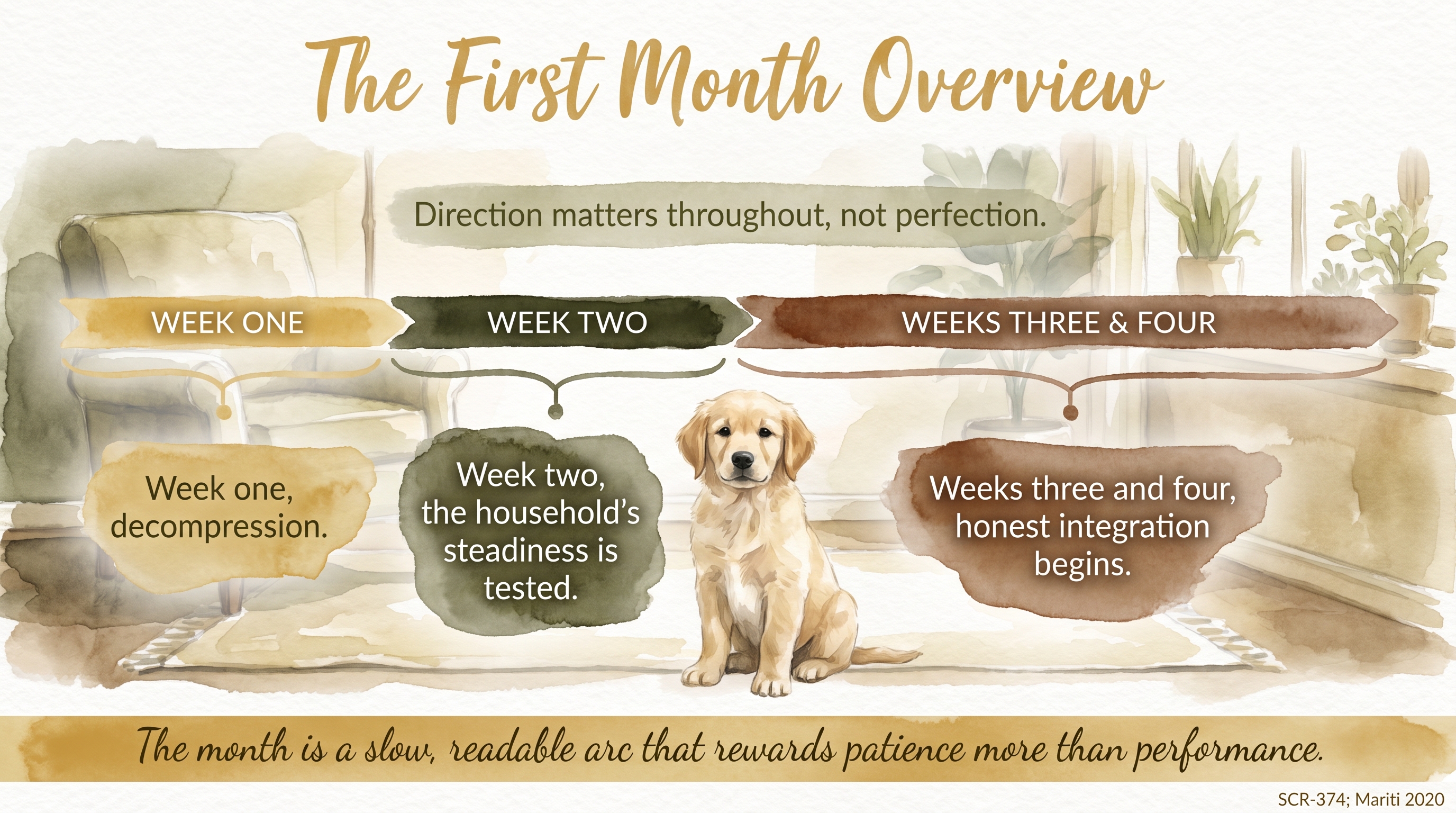
The month is a slow, readable arc that rewards patience more than performance.
Key Takeaways
- The first month is best understood as an integration window in which the puppy learns what kind of nervous system the household actually runs.
- Many puppies show an easier honeymoon period first, a harder second-week regression next, and a steadier baseline later if the adults hold calm structure.
- A soft landing is not a day-one performance but a sustained month-one operating style built around rest, prevention, and low-arousal routine.
- Popular transition mnemonics can be useful reminders, but they should be read as rough phases rather than as exact clinical deadlines.
The Evidence
- Freedman et al. (1961); Scott & Fuller (1965); Morrow et al. (2015); Howell et al. (2015)domestic dogs
The early sensitive period is a uniquely efficient phase for building broadly generalized safe associations with novelty, even though learning remains possible after it closes. - Mariti et al. (2020); Fallani et al. (2006); Topal et al. (2005); Cannas et al. (2010)domestic dogs
Caregiver change and environmental transition are meaningful developmental events, and the quality of social and environmental handling during these windows matters.
- JB breeder-network observationfamily-raised Golden Retriever puppies
The first month reliably shows an easier early phase, a harder middle phase, and a steadier later baseline when calm routines and prevention are held consistently.
- JB synthesisbreeder-to-family transition practice
Treating the first month as an integration window rather than a training window is an interpretive framework built from developmental, attachment, and transition science rather than a directly tested month-long intervention model. - JB audit positionpopular dog-adjustment guidance
The broad developmental rhythm captured by popular mnemonics is useful, but fixed calendar checkpoints are not clinically validated transition markers.
No published study directly tests the specific Just Behaving guidance on first month within a breeder-to-family transition, so this entry relies on broader canine evidence, breeder observation, and practical synthesis rather than a direct trial of the full protocol.
SCR References
Sources
- Freedman, D. G., King, J. A., & Elliot, O. (1961). Critical period in the social development of dogs. Science, 133(3457), 1016-1017.
- Scott, J. P., & Fuller, J. L. (1965). Genetics and the Social Behavior of the Dog. University of Chicago Press.
- Morrow, M., Ottobre, J. S., Ottobre, A. C., Neville, P., St-Pierre, N., Dreschel, N. A., & Pate, J. L. (2015). Breed-dependent differences in the onset of fear-related avoidance behavior in puppies. Journal of Veterinary Behavior, 10(4), 286-294. https://doi.org/10.1016/j.jveb.2015.03.002
- Howell, T. J., King, T., & Bennett, P. C. (2015). Puppy parties and beyond: The role of early age socialization practices on adult dog behavior. Veterinary Medicine: Research and Reports, 6, 143-153. https://doi.org/10.2147/VMRR.S62081
- Mariti, C., Lenzini, L., Carlone, B., Zilocchi, M., Ogi, A., & Gazzano, A. (2020). Does attachment to man already exist in 2 months old normally raised dog puppies? A pilot study. Dog Behavior, 6(1), 1-11. https://doi.org/10.4454/db.v6i1.96
- Fallani, G., Previde, E. P., & Valsecchi, P. (2006). Do disrupted early attachments affect the relationship between guide dogs and blind owners? Applied Animal Behaviour Science, 100(3-4), 241-257. https://doi.org/10.1016/j.applanim.2005.12.005
- Topal, J., Gacsi, M., Miklosi, A., Viranyi, Z., Kubinyi, E., & Csanyi, V. (2005). Attachment to humans: A comparative study on hand-reared wolves and differently socialized dog puppies. Animal Behaviour, 70, 1367-1375. https://doi.org/10.1016/j.anbehav.2005.03.025
- Cannas, S., Frank, D., Minero, M., Godbout, M., & Palestrini, C. (2010). Puppy behavior when left home alone: Changes during the first few months after adoption. Journal of Veterinary Behavior, 5(2), 94-100. https://doi.org/10.1016/j.jveb.2009.08.009