Establishing the Nap Rhythm
Most first-month behavior problems are not really behavior problems. They are sleep problems wearing behavior's clothing. A puppy who is biting harder, settling worse, zooming at the wrong time, whining more, or suddenly forgetting what the house feels like is very often a puppy who has not napped deeply enough. JB treats the nap rhythm as one of the central operating systems of the first month because rest is not empty time. Rest is where regulation is rebuilt. Observed-JB
What It Means
Young puppies need a great deal of sleep and protected downtime. Observed-JB
The exact number gets overstated online more confidently than the literature justifies. Documented Families often hear "sixteen to eighteen hours" stated as if it were a precisely measured universal norm. The safer scientific position is narrower: young puppies often need substantially more sleep and quiet than adults do, much of it in short bouts, and many families underestimate how much rest the puppy actually requires.
That still leads to the same practical conclusion.
The nap rhythm must be protected.
Sleep Happens in Bouts
Puppies do not usually sleep in one long clean block.
They cycle through: waking, eating, brief activity, and falling asleep again.
If the household treats every waking moment as an invitation for more engagement, the puppy stops getting enough true recovery. Observed-JB
Overtired Puppies Look Busy, Not Sleepy
This is one of the biggest month-one misunderstandings.
Humans expect tired puppies to behave like tired babies.
Often they do not.
They behave like this instead: biting harder, moving faster, barking or whining more, getting mouthier during handling, and losing the ability to settle after stimulation. Observed-JB
That is why JB families learn to ask one question early and often:
has this puppy actually napped enough today
Protected Nap Windows Matter
Good naps do not happen only because the puppy is tired.
They happen because the environment allows them.
That usually means: a quiet bedroom or protected pen, low human traffic, low noise, no photo opportunity interruptions, and no children's invitations to wake the puppy back up.
Many families think they are being kind when they keep checking on the puppy or waking it for interaction.
In month one, that kindness often becomes interference.
Why the Household Must Cooperate
Nap rhythm is not only a puppy-management issue. It is a family-discipline issue.
Everyone in the house has to understand: rest is part of the plan, resting puppies are not to be recruited into play, and a late nap lost to household chaos has consequences later.
The most common evening disorder in the first month is not mystery energy.
It is daytime sleep debt.
Why It Matters for Your Dog
Sleep matters because a puppy cannot regulate well without enough of it. Rest affects mood, learning, stress recovery, and the ability to re-enter calm after excitement. When the nap rhythm stabilizes, many problems soften at once. When the nap rhythm fragments, many unrelated-looking problems appear together.
The calm floor is not only built while the puppy is awake. It is also built every time the household protects a nap instead of interrupting it. Rest is one of the main ways a calm dog gets made.
This page also helps families stop personalizing the puppy's harder moments. The puppy is not being difficult on purpose because it suddenly got "wild." More often, the nervous system is simply running on too little recovery.
That is why the nap rhythm deserves to be treated almost as seriously as meals and bathroom trips.
It is not an extra.
It is infrastructure.
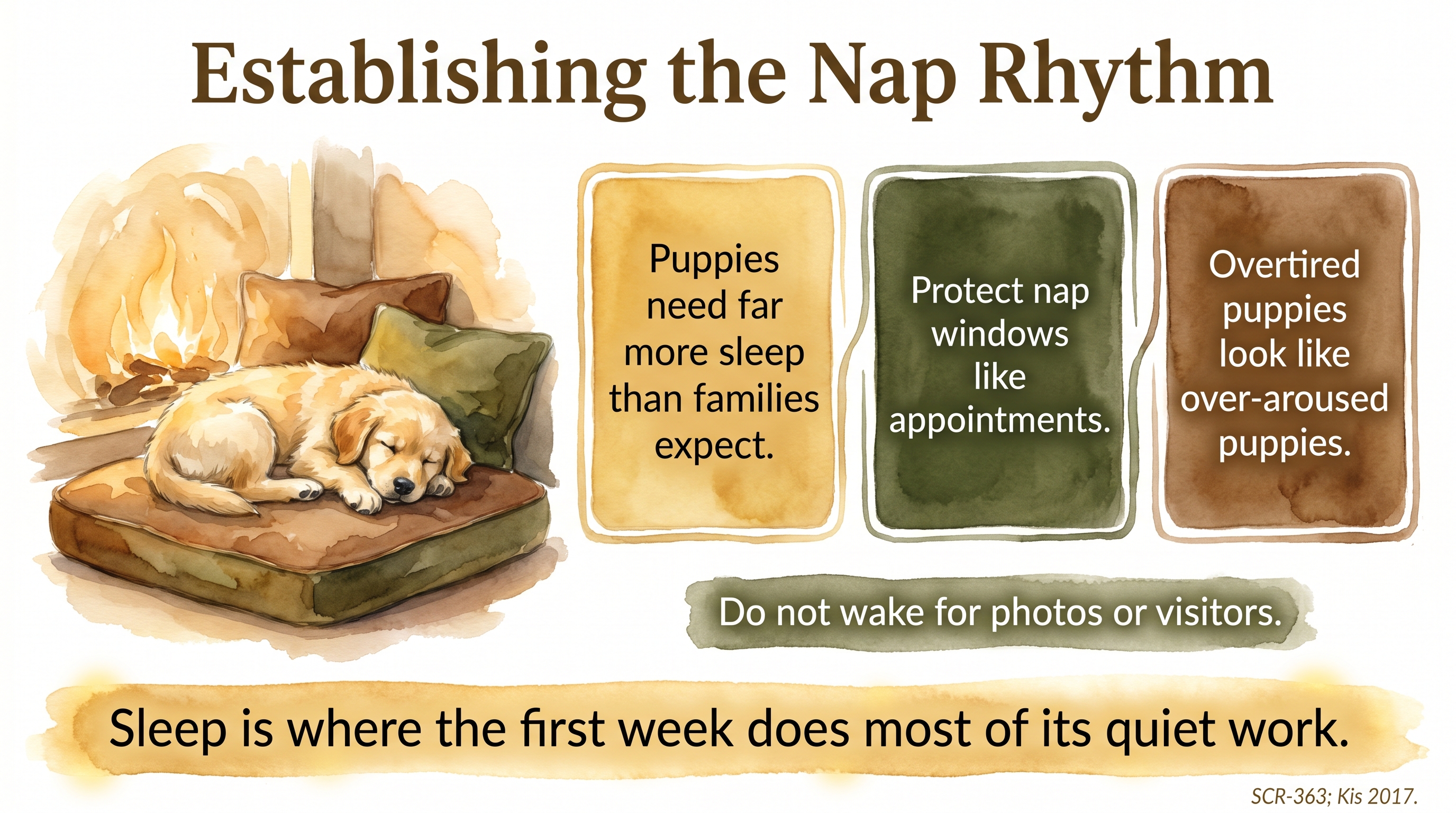
Sleep is where the first week does most of its quiet work.
Key Takeaways
- Young puppies need a great deal of sleep and downtime, even if exact hourly internet claims are often overstated as hard science.
- An overtired puppy often looks wilder rather than sleepier, which is why many first-month problems are actually rest problems.
- Protected nap windows in a quiet space are part of the soft landing, not a luxury added after the fun parts of the day.
- If behavior is deteriorating in the first month, checking sleep debt is one of the smartest first questions a family can ask.
The Evidence
- Adams & Johnson (1993); Kis et al. (2014, 2017); Reicher et al. (2021)domestic dogs
Dogs are polyphasic sleepers, and sleep quality, fragmentation, and context all influence how restorative rest actually is. - Adams & Johnson (1993); Kis et al. (2014, 2017); Reicher et al. (2021)domestic dogs
Sleep supports post-learning consolidation, and disturbed sleep alters behavioral and physiological outcomes in meaningful ways.
- Adams & Johnson (1993); Kis et al. (2014, 2017); Reicher et al. (2021)domestic dogs
The canine sleep literature supports polyphasic sleep and state-dependent recovery, but it does not establish a single home-setting puppy sleep-hour norm such as a universal sixteen-to-eighteen-hour rule.
- JB transition observationfamily-raised puppies
When naps are actively protected in the first month, biting, frantic evening behavior, and failed settling episodes commonly improve without any additional training project.
No published study directly tests the specific Just Behaving guidance on establishing the nap rhythm within a breeder-to-family transition, so this entry relies on broader canine evidence, breeder observation, and practical synthesis rather than a direct trial of the full protocol.
SCR References
Sources
- Adams, G. J., & Johnson, K. G. (1993). Sleep-wake cycles and other night-time behaviours of the domestic dog (Canis familiaris). Applied Animal Behaviour Science, 36(2-3), 233-248.
- Kis, A., Szakadat, S., Kovacs, E., Gacsi, M., Simor, P., Gombos, F., Topal, J., Miklosi, A., & Bodizs, R. (2014). Development of a non-invasive polysomnography technique for dogs (Canis familiaris). Physiology & Behavior, 130, 149-156.
- Kis, A., Szakadat, S., Gacsi, M., Kovacs, E., Simor, P., Torok, C., Gombos, F., Bodizs, R., & Topal, J. (2017). The interrelated effect of sleep and learning in dogs (Canis familiaris); an EEG and behavioural study. Scientific Reports, 7, 41873.
- Reicher, V., Bunford, N., Kis, A., Carreiro, C., Csibra, B., Kratz, L., et al. (2021). Developmental features of sleep electrophysiology in family dogs. Scientific Reports, 11, 22760. https://doi.org/10.1038/s41598-021-02117-1