Week One Review: What to Watch For
By the end of week one, most families want to know one thing: is this going well? That is a fair question, and it deserves a calmer answer than either blind reassurance or needless panic. The first week is not a final verdict on the puppy or the home. It is a calibration period. What the family should be looking for by the end of it is not perfection. It is direction. Is the puppy moving toward steadier sleep, steadier appetite, softer body language, clearer bathroom rhythm, and easier return to calm? Or does the household still feel like a crash landing that never truly settled? Observed-JB
What It Means
A good week-one review is not a scorecard for pride.
It is a reading of trajectory.
This matters because some families become discouraged too quickly: she still cries a little at night, he had two accidents yesterday, and she gets wild in the evening.
Other families dismiss too much: he still won't eat much, but maybe he's just picky, she is still hiding, but maybe she needs time, and the diarrhea is probably just stress. Observed-JB
Neither extreme helps. The family needs a steadier framework for reading what is normal transition noise and what signals a rougher-than-average first week.
What Improvement Usually Looks Like
By the end of a decent first week, many puppies begin to show at least some of the following: nighttime sleep stretching a little longer, faster settling after potty trips, more appetite consistency, clearer elimination rhythm, more time in soft body states, less frantic scanning of every room, and easier recovery after small new experiences. Observed-JB
The important phrase there is some of the following.
Not all puppies will show every sign at the same speed.
The family is not looking for a finished dog. It is looking for evidence that the puppy is beginning to find the house readable.
Behavioral Markers That the Soft Landing Is Working
Some useful week-one markers include: the puppy begins to orient to the caregiver's calm voice, the puppy chooses to settle near the household without constant prompting, naps happen more cleanly, mealtimes look less uncertain, body language spends more of the day loose than tight, and little bursts of arousal end in actual recovery rather than in repeated re-launches. Observed-JB
These are not glamorous milestones, but they are meaningful. They tell you the house is becoming biologically legible.
Signs the Week Has Been Rougher Than Average
There are also signs that the transition may need extra support: persistent nighttime distress without improvement, food refusal beyond the first day or so, diarrhea lasting beyond a short transition upset, repeated stiffness, soreness, or lameness, persistent hiding, flinching from calm touch, and no real return to calm after ordinary stimulation.
These do not automatically mean something serious is wrong. They do mean the family should stop assuming time alone will solve everything.
What a Crash Landing Looks Like at Week's End
This page needs the contrast because the dispatch requires it and because families benefit from seeing it clearly.
A week-one crash landing often does not look like one giant disaster. It looks like a string of small disorganizations: too many visitors, inconsistent sleep setup, overexcited greetings, chaotic child interactions, poor meal rhythm, no real nap protection, and repeated low-level chase or jumping that everyone laughed at.
Then by day seven the puppy is: tired but not settled, present but not regulated, and attached but highly activated.
The family may feel that they and the puppy are "getting through it," but the house still has not found a shared calm floor.
The good news is that week one is not too late to notice this. The point of the review page is precisely to create that moment of honest noticing.
Health Markers Need to Be Read Alongside Behavior
Week one is not only a behavior review. It is also a health review.
The family should be watching: appetite, stool quality, vomiting, hydration, energy, gait and comfort, and urinary pattern.
Some transition-related looseness in stool can happen, especially with stress or schedule disruption. Observed-JB But "some transition-related looseness" is not the same thing as: diarrhea that persists, repeated vomiting, lethargy, and obvious pain.
That distinction matters because families sometimes hide behind the idea that week one is "just a lot for the puppy" when in fact the puppy needs veterinary input.
The Breeder Still Matters
JB is explicit that week one is not the handoff from one relationship to another with no overlap. It is the beginning of a longer triangle: puppy, family, and breeder.
That means the breeder should still be part of the support system at week's end. A thoughtful week-one check-in is normal and useful. It allows the breeder to see: sleep pattern, appetite, stool quality, handling comfort, household rhythm, and areas where the family may be accidentally creating a crash landing.
Families should not read contact with the breeder as failure. It is exactly what a real transition partnership is for.
The First Veterinary Visit
Many families will also be moving toward the first veterinary visit around this point if it has not already happened. The details vary by breeder protocol and veterinary timing, but week one is often when families are: establishing the puppy in a local clinic, reviewing vaccination timing, checking weight, and confirming the puppy's general status after the move.
That visit should be treated as part of stewardship, not as a sign of alarm. The puppy is settling into a new home and a new care system at the same time.
Why It Matters for Your Dog
The week-one review matters because without a review, families drift.
They either: assume everything will sort itself out.
or: panic over every imperfect day.
Neither is helpful.
Week one should be read for direction, not for perfection. The family is asking whether the puppy is increasingly able to find calm, rhythm, and trust inside the new household.
This page also matters because it keeps the household from telling the wrong story too early. A puppy who had a messy first week is not a bad puppy. A family who accidentally created a crash landing is not a bad family. What matters is whether the adults can now read the pattern honestly enough to improve it.
That is why the end of week one is such a useful threshold. It is far enough in for the household rhythm to be visible, but early enough that major changes in pacing, sleep protection, greeting style, and stimulation management can still have powerful effects quickly.
The first week was calibration.
The next weeks are integration.
But integration goes much better when the adults stop at day seven and look clearly at what the first week has actually built.
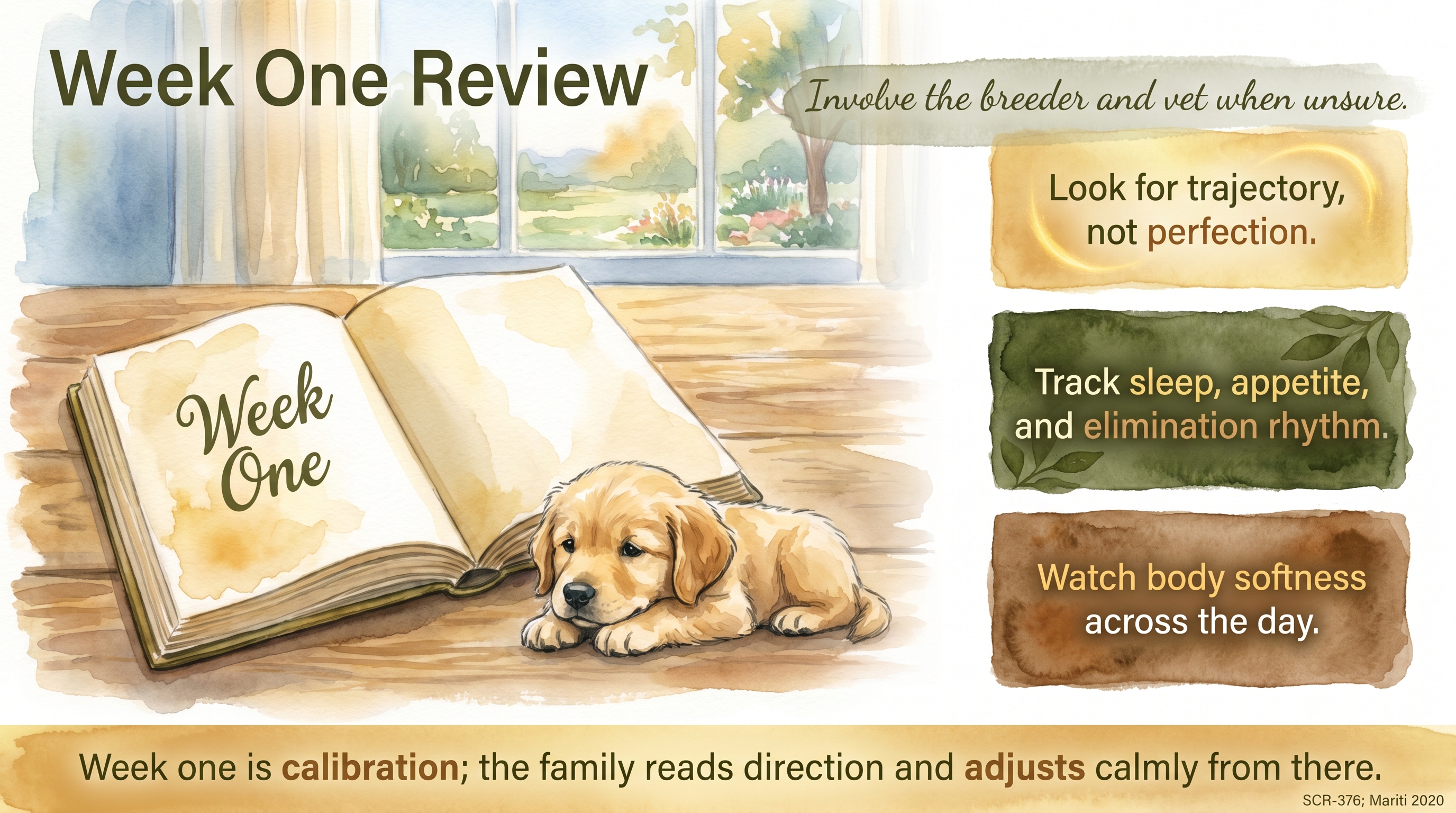
Week one is calibration; the family reads direction and adjusts calmly from there.
Key Takeaways
- A useful week-one review asks whether the puppy is moving in the right direction, not whether every problem has vanished already.
- Better sleep, steadier appetite, clearer bathroom rhythm, and softer body language are all meaningful signs that the transition is settling.
- Persistent distress, food refusal, ongoing diarrhea, pain, hiding, or flinching from calm contact are signs that the week may need more support.
- The breeder and veterinarian remain part of the week-one support system, and checking in with them is normal stewardship rather than failure.
The Evidence
- WSAVA (2024); AAHA (2022); Schultz (2006); Stepita et al. (2013)domestic dogs
Early gastrointestinal upset, appetite change, pain, or lethargy should be tracked carefully in the first days after transition because not every week-one issue is merely a behavioral adjustment problem.
- JB first-week practicefamily-raised puppies
The end of week one should be read as a checkpoint for direction, with sleep, appetite, elimination rhythm, body softness, and return to calm serving as the clearest signs that the soft landing is taking hold.
No published study directly tests the specific Just Behaving guidance on week one review what to watch for. This entry relies on broader canine evidence, breeder observation, and practical synthesis.
SCR References
Sources
- Squires, R. A., Crawford, C., Marcondes, M., & Whitley, N. (2024). 2024 guidelines for the vaccination of dogs and cats - compiled by the Vaccination Guidelines Group (VGG) of the World Small Animal Veterinary Association (WSAVA). Journal of Small Animal Practice, 65(5), 277-316. https://doi.org/10.1111/jsap.13718
- Ellis, J., Marziani, E., Aziz, C., Brown, C. M., Cohn, L. A., Lea, C., Moore, G. E., & Taneja, N. (2022). 2022 AAHA Canine Vaccination Guidelines. Journal of the American Animal Hospital Association, 58(5), 213-230. https://doi.org/10.5326/JAAHA-MS-Canine-Vaccination-Guidelines
- Schultz, R. D. (2006). Duration of immunity for canine and feline vaccines: a review. Veterinary Microbiology, 117(1), 75-79. https://doi.org/10.1016/j.vetmic.2006.04.013
- Stepita, M. E., Bain, M. J., & Kass, P. H. (2013). Frequency of CPV infection in vaccinated puppies that attended puppy socialization classes. Journal of the American Animal Hospital Association, 49(2), 95-100. https://doi.org/10.5326/JAAHA-MS-5825