The Soft Landing Principle
The Soft Landing Principle is JB's name for the kind of transition a puppy needs when it leaves the breeder and enters the family home. The core idea is simple to say and difficult for modern families to imagine because the culture has taught the opposite: the puppy should not arrive into a celebration event. It should arrive into continuity. The adult dogs, the human emotional tone, the pace of the household, the style of handling, the rules around rest, and the meaning of calm all need to feel as close as possible to the developmental language the puppy already knew. That exact breeder-to-family protocol has not been tested as a clinical intervention, which is why the principle itself is a JB heuristic rather than a documented canine treatment effect. Dog attachment and transition research supports the canine side of the logic, while caregiving and social-buffering research from humans and other mammals supports the broader developmental bridge. The combined direction is serious, but the full soft-landing protocol remains heuristic. Heuristic
What It Means
The phrase soft landing matters because the ordinary way puppies come home is usually a crash landing.
From the human point of view, the day feels beautiful. The family is excited. The children are waiting by the door. There are toys on the floor, a camera roll ready, relatives texting for pictures, and a house vibrating with anticipation. The puppy arrives and instantly becomes the emotional center of the room. Everyone talks at once. The puppy is passed from person to person. The house rules are briefly suspended because "it is the first day." The puppy is encouraged to explore everything and meet everyone, then later corrected for being too excited, too mouthy, too clingy, too noisy, or too unable to settle.
That sequence feels loving to people because it expresses human joy.
To the puppy, it often feels like social and sensory collapse.
The puppy has just lost: the mother, the litter, the breeder's home rhythm, the existing sleep pattern, the familiar smell map, and the social signals it had already begun learning to read. Heuristic
In JB, that makes the first week better understood as a calibration window than as a training event.
This is one of the load-bearing distinctions in the whole category. The puppy is not yet asking, "What cue means sit?" It is asking much deeper questions: What kind of nervous system runs this new household? What happens when people enter and leave rooms? Does novelty come with calm leadership or with emotional chaos? Do adults here make the world feel legible? When I am uncertain, is there a stable place to orient?
Those questions are being answered before the family realizes it is answering them.
That is why JB does not define the first week as a performance week. It is not the week to show the puppy off, to prove how social it is, or to start a stack of compliance rituals out of fear that structure will otherwise be "missed." The first week is the week to preserve the puppy's ability to regulate inside a brand-new world.
Continuity Is the Intervention
The soft landing is easiest to understand when stripped of rhetoric. It means the family continues the same social grammar the puppy experienced at the breeder: calm voices, low-arousal handling, predictable sleep rhythm, limited environmental scope, adult-led routines, prevention rather than reaction, and quiet correction rather than emotional flooding.
The point is not to replicate the breeder's house in every literal detail. That would be impossible. The point is to preserve the meaning of the breeder environment. If the puppy came from a home where calm mattered, rest was protected, greetings were low-key, and boundaries were already part of life, then the family should not replace that entire language with a new one on day one.
This is where attachment science becomes relevant without being overstated. Bowlby and Ainsworth gave developmental language to the caregiver's role as both secure base and safe haven. That framework was built in humans, not puppies leaving a breeder at eight or ten weeks, so it must be handled with the correct tag. But the broad principle is durable across humans and other social mammals: young organisms regulate more successfully when the caregiver is predictable, available, and emotionally legible. Documented-Cross-Species
Dog research supports the canine side of that bridge, even if it does not test JB's exact arrival-day script. Dogs show attachment-relevant proximity seeking and secure-base effects with familiar people. Transition and rehoming studies show that abrupt environmental change is physiologically real rather than emotionally imaginary. Guide-dog transition research suggests that caregiver change matters developmentally. What is missing is a direct trial comparing "soft landing" and "crash landing" breeder-to-family protocols. That is why the operational principle stays heuristic even while its scientific floor is serious. Heuristic
The First Week Is About State More Than Task
Modern dog culture tends to frame everything as a skill acquisition question. The family asks: Should we start training immediately? Should we practice independence right away? Should we get the puppy used to visitors? Should we begin crate routines on night one?
Those are not stupid questions. They are simply downstream questions.
The upstream question is: what state is this puppy being asked to live in?
A puppy living in sustained sympathetic activation can still do things. It can eat, cry, run, freeze, cling, mouth, spin, bark, and collapse from exhaustion. But none of those tell you the transition is going well. A crash-landed puppy can look "fine" because shutdown, stillness, and fatigue are often misread by humans as adjustment.
The soft landing reframes success. Success in the first week looks like: sleep that becomes more consolidated, appetite that stabilizes, body language that softens, curiosity without franticness, quick recovery after brief novelty, and the emergence of calm as a recognizable home baseline.
That is what a calibration window is for. The family is not trying to make the puppy impressive. The family is trying to make the puppy feel that this new home runs on a nervous system it can trust.
Soft Landing Is Not Sentimentality
It is important to say what the principle is not.
It is not permissiveness.
It is not "take it easy for a week and then get serious later."
It is not a week with no rules, followed by a week when the family abruptly decides the couch, the biting, the frantic door greetings, and the nighttime chaos can no longer continue.
That pattern is one of the reasons crash landings become self-reinforcing. The puppy is welcomed through excitement and inconsistency, then corrected for reproducing the exact energy it was taught to bring.
Soft landing is actually stricter than that, but in a quieter way. The rules are present immediately. The tone is present immediately. The rest rhythm is present immediately. What is absent is emotional drama.
The puppy is not left to invent the house.
The house is already there.
Why the Mammalian Parenting Literature Matters
The mammalian parenting literature matters because JB is making a claim about more than manners. Heuristic It is making a claim about developmental scaffolding.
Young mammals do not regulate themselves in isolation from their caregivers. Maternal proximity, postnatal handling, and predictable caregiving alter stress expression, exploratory confidence, and social organization across species. Again, the tag discipline matters. That literature does not prove a specific Golden Retriever homecoming protocol. What it does is make the direction of the soft-landing idea intellectually serious. Social mammals do better when early transitions remain anchored to regulated caregiving rather than to abrupt unpredictability. It establishes why the direction is serious, not that the full breeder-to-family soft-landing protocol has been directly validated.
This is also why the principle is warm rather than cold. Many people hear "do not turn the puppy's arrival into an event" and imagine emotional withholding. JB means the opposite. The family is being asked to welcome the puppy in the deepest possible way: by acting as though the bond is already real and the puppy already belongs. The house does not need to perform love. It needs to embody steadiness.
What a Crash Landing Looks Like
Because the contrast is load-bearing in this category, it is worth naming plainly.
A crash landing does not mean a bad family.
It usually means a loving family operating on the only script the culture gave them.
That script usually includes some combination of the following: excited greetings at the car and front door, multiple people crowding the puppy immediately, children encouraged to celebrate rather than to settle, the entire house opened to the puppy at once, a stream of visitors in the first days, meals, sleep, and potty opportunities happening on an improvised schedule, emotional reassurance that unintentionally rewards distress, and indulgence first, followed by correction once the indulgence becomes inconvenient.
What makes this a crash landing is not the intention. It is the collapse of signal continuity.
At the breeder, the puppy may have learned that: comings and goings are ordinary, rest is protected, adults are calm, greetings are brief, the environment has shape, and the young do not run the group.
Then the puppy enters a new home where: every doorway is a social event, every sound brings a human reaction, every behavior gets verbal narration, every wake window becomes an interaction window, and every uncertainty gets answered with performance rather than with structure. Heuristic
The puppy does not experience that as "fun." The puppy experiences that as a new language.
And because the first week is a calibration window, the new language gets learned fast.
Why It Matters for Your Dog
The first week matters because household baselines are sticky. A puppy that learns homecomings are arousing, evenings are chaotic, sleep is interruptible, distress gets dramatic human theater, and greetings are big will carry those assumptions forward into later puppyhood and often into adolescence. A puppy that learns the home is quiet, routines are unsurprising, adults stay readable, and calm opens the door to connection will carry a different baseline forward.
That is why the soft landing is upstream. It is not about controlling one behavior. It is about deciding what kind of inner climate the dog will attach to the household itself.
The first week home is a calibration window, not a training event. The family is teaching the puppy what state belongs in this house long before it is teaching formal tasks.
For a JB family, the practical implication is straightforward: the ride home should reduce arousal, not amplify it, the first rooms should be small and quiet, the first night should preserve proximity and safety, naps should be protected aggressively, greetings should remain ordinary, and rules should begin immediately, but quietly.
The long-arc benefit is not only a calmer first week. It is a dog who keeps returning to the calm floor the family built in the very first days.
That is also why the principle is hopeful. Families are often told to think about the first week in terms of surviving accidents, chewing, crying, and crate battles. JB asks a better question: what baseline are we creating? Once the family asks that question, many first-week choices become clearer.
The puppy does not need a party.
The puppy needs a world worth trusting.
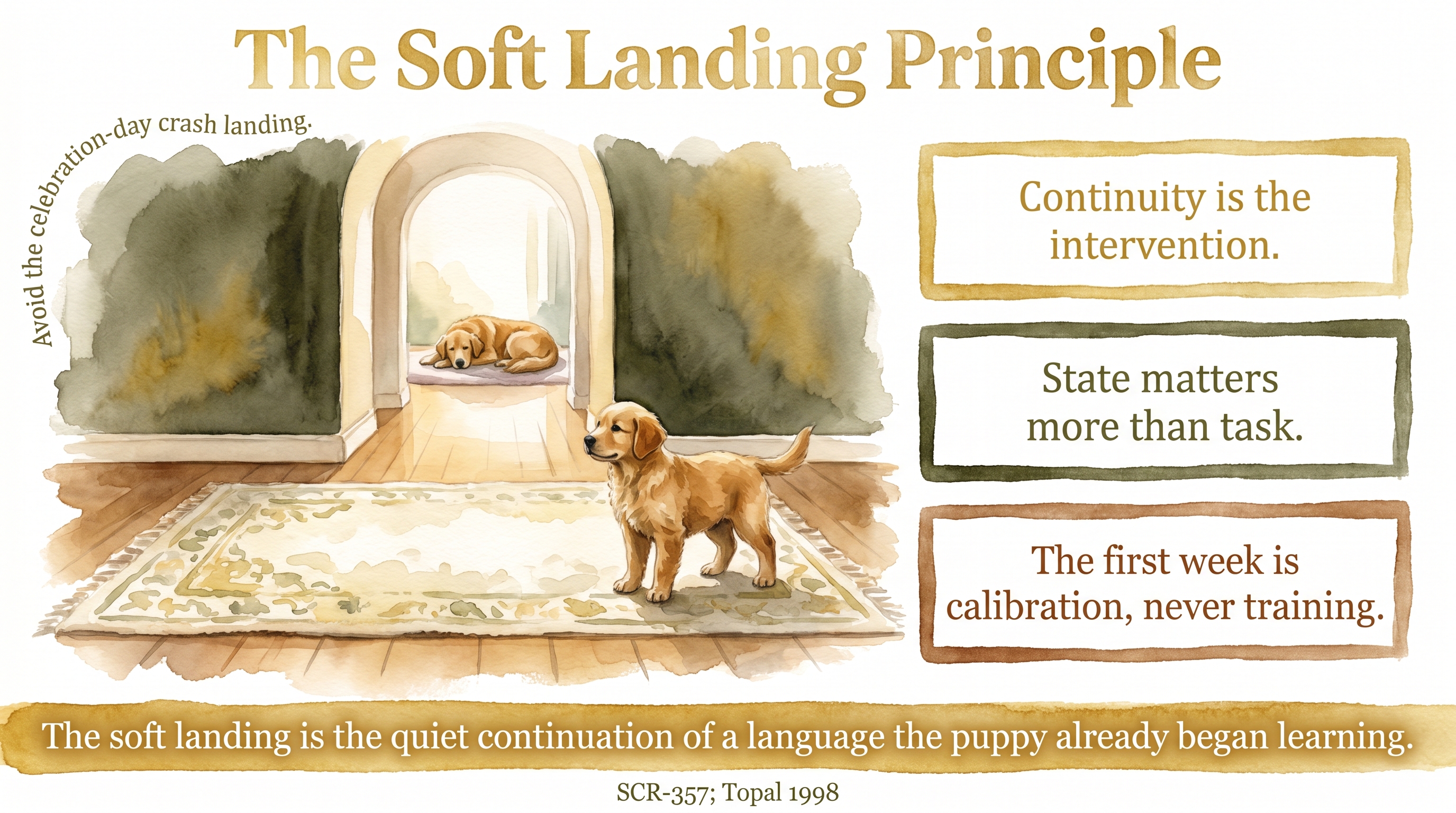
The soft landing is the quiet continuation of a language the puppy already began learning.
Key Takeaways
- The Soft Landing Principle means giving the puppy continuity of calm, structure, and adult leadership rather than turning arrival into an event.
- The first week home is primarily a calibration window, not a performance or training window.
- A crash landing usually comes from loving families following the culture's excitement script, not from bad intent, but it still teaches the wrong baseline.
- The soft landing itself is a JB heuristic, while the attachment and caregiving science underneath it is much stronger than a casual welcome-home script suggests.
The Evidence
- Bowlby (1969/1982); Ainsworth et al. (1978); Hennessy et al. (2009); Hostinar et al. (2013)humans and social mammals
Young organisms regulate more effectively when caregivers function as predictable secure bases and safe havens rather than as unstable or emotionally noisy figures. - Bowlby (1969/1982); Ainsworth et al. (1978); Hennessy et al. (2009); Hostinar et al. (2013)multiple mammals
Postnatal caregiving quality, proximity, and social buffering affect stress regulation and exploratory confidence during development.
- Topal et al. (1998); Horn et al. (2013); Dale et al. (2024); Thielke & Udell (2019)domestic dogs
Dogs show attachment-relevant behavior and secure-base effects with familiar humans, supporting the claim that caregiver quality matters behaviorally rather than only sentimentally. - Mariti et al. (2020); Fallani et al. (2006); Topal et al. (2005); Cannas et al. (2010)domestic dogs
Rehoming and abrupt caregiver transition are real stressors, while continuity and stable caregiving environments are associated with better adjustment.
- JB synthesisGolden Retriever puppies and family homes
The claim that breeder-to-family transition should preserve the same calm social grammar through the first week is an interpretive bridge from attachment, caregiving, and transition-stress science rather than a directly trialed puppy intervention. - JB synthesisfamily-dog transition practice
The first week is best understood as a calibration window in which the puppy is reading household state more than formal training tasks.
No published study directly tests the specific Just Behaving guidance on soft landing principle within a breeder-to-family transition, so this entry relies on broader canine evidence, breeder observation, and practical synthesis rather than a direct trial of the full protocol.
SCR References
Sources
- Bowlby, J. (1969/1982). Attachment and Loss: Vol. 1. Attachment (2nd ed.). Basic Books.
- Ainsworth, M. D. S., Blehar, M. C., Waters, E., and Wall, S. (1978). Patterns of Attachment: A Psychological Study of the Strange Situation. Erlbaum.
- Hennessy, M. B., Kaiser, S., and Sachser, N. (2009). Social buffering of the stress response: Diversity, mechanisms, and functions. Frontiers in Neuroendocrinology, 30(4), 470-482. https://doi.org/10.1016/j.yfrne.2009.06.001
- Hostinar, C. E., Sullivan, R. M., & Gunnar, M. R. (2013). Psychobiological mechanisms underlying the social buffering of the hypothalamic-pituitary-adrenocortical axis: A review of animal models and human studies across development. Psychological Bulletin, 140(1), 256-282. https://doi.org/10.1037/a0032671
- Topal, J., Miklosi, A., Csanyi, V., and Doka, A. (1998). Attachment behavior in dogs: A new application of Ainsworth's Strange Situation Test. Journal of Comparative Psychology, 112(3), 219-229. https://doi.org/10.1037/0735-7036.112.3.219
- Horn, L., Huber, L., and Range, F. (2013). The importance of the secure base effect for domestic dogs. PLoS ONE, 8(1), e65296. https://doi.org/10.1371/journal.pone.0065296
- Dale, F. C., Burn, C. C., Murray, J., & Casey, R. (2024). Canine separation-related behaviour at six months of age: Dog, owner and early-life risk factors identified using the 'Generation Pup' longitudinal study. Animal Welfare, 33, e60, 1-16. https://doi.org/10.1017/awf.2024.56
- Thielke, L. E., & Udell, M. A. R. (2019). Evaluating cognitive and behavioral outcomes in conjunction with the secure base effect for dogs in shelter and foster environments. Animals, 9(11), 932. https://doi.org/10.3390/ani9110932
- Mariti, C., Lenzini, L., Carlone, B., Zilocchi, M., Ogi, A., & Gazzano, A. (2020). Does attachment to man already exist in 2 months old normally raised dog puppies? A pilot study. Dog Behavior, 6(1), 1-11. https://doi.org/10.4454/db.v6i1.96
- Fallani, G., Previde, E. P., & Valsecchi, P. (2006). Do disrupted early attachments affect the relationship between guide dogs and blind owners? Applied Animal Behaviour Science, 100(3-4), 241-257. https://doi.org/10.1016/j.applanim.2005.12.005
- Topal, J., Gacsi, M., Miklosi, A., Viranyi, Z., Kubinyi, E., & Csanyi, V. (2005). Attachment to humans: A comparative study on hand-reared wolves and differently socialized dog puppies. Animal Behaviour, 70, 1367-1375. https://doi.org/10.1016/j.anbehav.2005.03.025
- Cannas, S., Frank, D., Minero, M., Godbout, M., & Palestrini, C. (2010). Puppy behavior when left home alone: Changes during the first few months after adoption. Journal of Veterinary Behavior, 5(2), 94-100. https://doi.org/10.1016/j.jveb.2009.08.009