The 3-3-3 Rule: A Careful Audit
The 3-3-3 rule is one of the most popular pieces of transition advice in the broader dog world. Families hear some version of it constantly: a short early period of decompression, a later period of settling, and a longer period before the dog feels fully at home. The rule is popular because it captures something emotionally useful. It gives people a narrative arc. JB's job is not to sneer at that usefulness. It is to audit it honestly. The mnemonic points toward a real adjustment rhythm, but it is not a measured clinical protocol and the specific calendar checkpoints are not validated canine milestones. Heuristic
What It Means
The rule survives because it speaks to something families recognize.
Dogs do not arrive home fully settled.
Many transitions do unfold in layers: an early acute phase, a later routine-forming phase, and a still later deeper sense of belonging.
That broad observation is real enough to be useful.
What is not established is that the boundaries between those phases fall neatly on the same day counts for every dog. Heuristic
What the Mnemonic Gets Right
The mnemonic gets three things roughly right.
First, adjustment has stages.
Second, the first days and weeks often feel different from each other.
Third, families benefit from being reminded that settling takes time.
That is the charitable and sensible reading.
What It Does Not Prove
The mnemonic is not a clinical protocol.
There is no canine behavioral study showing that: this exact number of days marks decompression, this exact number of weeks marks routine consolidation, and this exact number of months marks feeling at home. Evidence Gap
That matters because families often move from a helpful story to an unhelpful demand: why is my puppy not at the right stage yet and why is day twenty-one not looking the way the chart promised. Observed-JB
Once the rule becomes a stopwatch, it stops helping.
The JB Alternative
JB prefers describing states rather than dates.
That is why Dispatch 4 used: honeymoon period, second-week regression, and settled baseline.
Those labels are more honest because they describe what the family is actually observing instead of pretending the calendar alone can tell the story.
Hold It Loosely or Not at All
This is the whole practical position in one line.
If the mnemonic reassures a family that transitions take time, it can be held loosely.
If it starts making the family anxious about whether the puppy is "on schedule," it should be dropped entirely. Heuristic
The puppy does not owe the internet a deadline.
Why It Matters for Your Dog
This page matters because badly used transition advice can create pressure where patience is needed. Families start reading the dog against a chart instead of reading the dog itself.
That is especially dangerous in the first month, when individual variation is large and the household is still building its own baseline.
The more useful question is not: what day are we on.
It is: what state is the puppy showing today.
That question leads to better care.
It also keeps the adults calmer, which feeds directly back into the transition.
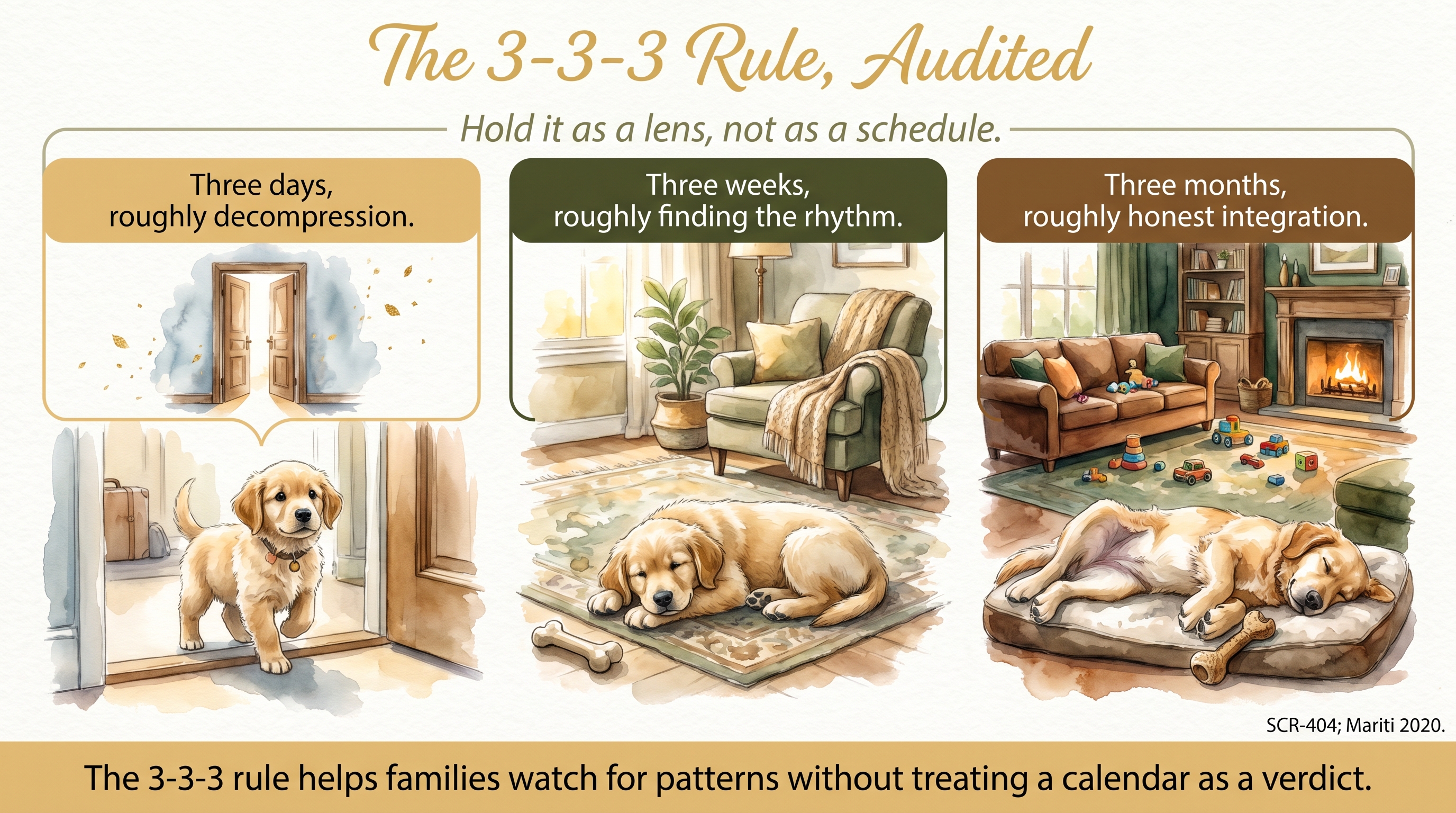
The 3-3-3 rule helps families watch for patterns without treating a calendar as a verdict.
Key Takeaways
- The mnemonic is useful only insofar as it reminds families that transitions happen in stages rather than all at once.
- There is no canine behavioral study validating the exact calendar checkpoints as universal milestones.
- JB prefers state-based descriptions such as honeymoon, regression, and settled baseline because they fit what families actually observe.
- If the mnemonic reduces pressure it can be held loosely, but if it creates pressure it should be dropped.
The Evidence
- Breeder, shelter, and family observation traditionstransitioned dogs broadly
Dogs often pass through recognizable early, middle, and later settling phases after major transitions, even though the phases vary meaningfully by individual and context.
- Mariti et al. (2020); Fallani et al. (2006); Topal et al. (2005); Cannas et al. (2010)domestic dogs
Adjustment, attachment, and routine consolidation unfold over time and show meaningful individual variability rather than rigid universal deadlines.
- JB audit positionpopular transition guidance
The specific day-and-month framing is best treated as a useful folk mnemonic rather than as a validated clinical schedule.
No published study directly tests the specific Just Behaving guidance on the 3 3 3 rule audit. This entry relies on broader canine evidence, breeder observation, and practical synthesis.
SCR References
Sources
- Mariti, C., Lenzini, L., Carlone, B., Zilocchi, M., Ogi, A., & Gazzano, A. (2020). Does attachment to man already exist in 2 months old normally raised dog puppies? A pilot study. Dog Behavior, 6(1), 1-11. https://doi.org/10.4454/db.v6i1.96
- Fallani, G., Previde, E. P., & Valsecchi, P. (2006). Do disrupted early attachments affect the relationship between guide dogs and blind owners? Applied Animal Behaviour Science, 100(3-4), 241-257. https://doi.org/10.1016/j.applanim.2005.12.005
- Topal, J., Gacsi, M., Miklosi, A., Viranyi, Z., Kubinyi, E., & Csanyi, V. (2005). Attachment to humans: A comparative study on hand-reared wolves and differently socialized dog puppies. Animal Behaviour, 70, 1367-1375. https://doi.org/10.1016/j.anbehav.2005.03.025
- Cannas, S., Frank, D., Minero, M., Godbout, M., & Palestrini, C. (2010). Puppy behavior when left home alone: Changes during the first few months after adoption. Journal of Veterinary Behavior, 5(2), 94-100. https://doi.org/10.1016/j.jveb.2009.08.009