The Decompression Period
Families often hear the word decompression in rescue-dog conversations, and the word can be useful here too if it is handled carefully. A puppy leaving a good breeder is not the same as an adult dog leaving a shelter, and JB should not flatten those situations together. But the larger idea still helps: after a meaningful transition, the nervous system does not become fully settled the moment the body arrives in a new place. It settles in layers. That broader application to the breeder-to-family handoff is best treated as a heuristic, not as a directly measured month-one canine protocol. Heuristic
What It Means
Decompression is the period in which the puppy is still coming down into the new home.
That does not mean the puppy is miserable.
It means the puppy is still adjusting across several systems at once: sleep quality, appetite rhythm, startle threshold, social confidence, and recovery after stimulation.
Humans often expect those systems to normalize together and on a tidy schedule. Observed-JB
They rarely do.
Settling Is Broader Than Stress Hormones
This page needs one scientific caution stated plainly. It is tempting to explain the whole month with a single hormone story. JB should resist that simplification. Acute cortisol shifts in dogs happen on the scale of minutes to hours. Documented The broader settling families observe across days and weeks is more reasonably described as whole-system adaptation involving sleep, familiarity, predictability, attachment, and reduced uncertainty. Heuristic
So when JB talks about decompression, it is not describing one fixed elevated-cortisol state that persists for a set number of days. It is using a broader settling framework for layered adjustment. Heuristic
It is describing the visible settling process the family can actually observe.
What Ongoing Decompression Can Look Like
A puppy can be eating, playing, and sleeping reasonably well and still be decompressing.
The signs are often subtle: sleep that is a little lighter than expected, startles that linger briefly, appetite that varies by meal, odd flat moments after stimulation, and sensitivity to too many visitors or errands in a row.
These do not automatically indicate a problem.
They often indicate that the puppy is still integrating the new reality of the household.
Why Families Misread It
Families usually make one of two errors.
The first is thinking the puppy should be fully settled by now because it looks comfortable in the house.
The second is thinking every small wobble means something has gone wrong.
JB takes a calmer middle path.
The puppy may be comfortable enough to show more of itself and still not be fully decompressed. Heuristic
Both can be true at once.
Boredom Is Often the Real Threat
The quiet weeks create their own pressure. Adults begin to feel that the puppy needs more. More outings. More visitors. More errands. More "fun." Often that impulse comes exactly when the puppy is still in the last stretch of settling.
That is why decompression is important as a concept.
It reminds the family that quiet is not empty.
Quiet is work the nervous system is still doing.
Why It Matters for Your Dog
The decompression idea matters because it prevents families from pushing too hard too early. When people understand that settling is a process, they become less likely to flood the calendar, over-interpret small regressions, or assume the puppy must be entertained back into confidence.
Instead, they protect what actually helps: regular sleep, predictable meals, steady voices, sparse novelty, and unhurried time in the house.
That gives the puppy room to become real without having to become overextended.
This page also helps with emotional expectations. Families often wonder why the puppy seemed easy, then harder, then easier again. Decompression offers a more humane way to see that arc. The puppy is not being inconsistent. It is arriving in stages.
That is normal.
And the family does not have to force those stages to move faster.
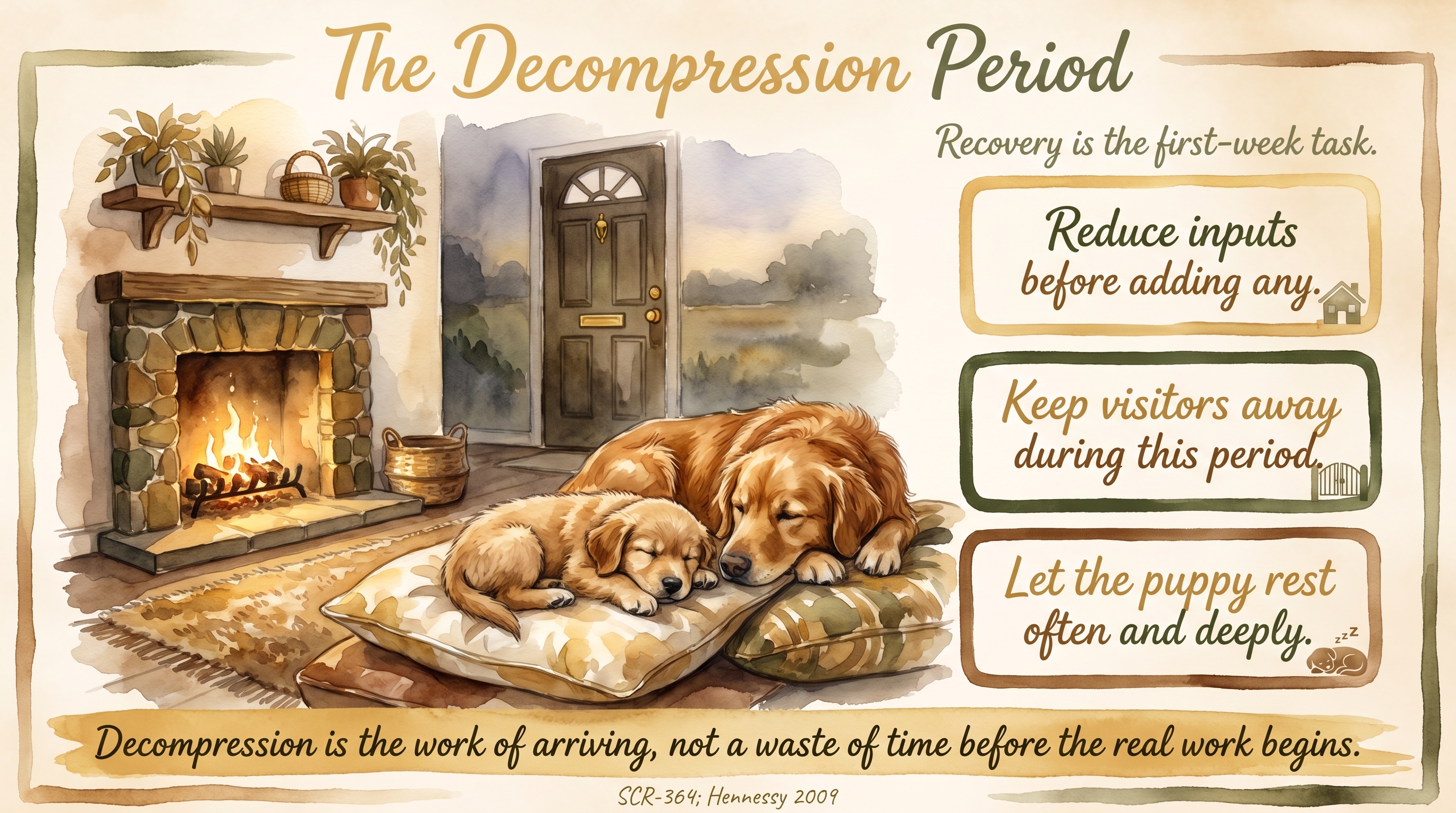
Decompression is the work of arriving, not a waste of time before the real work begins.
Key Takeaways
- Decompression is a useful way to describe the layered settling process of the first month, but it should be treated as an interpretive framework rather than a directly measured breeder-home protocol.
- Month-one settling is broader than any single hormone story and is better understood as whole-system adaptation.
- Subtle variation in sleep, appetite, startle, and social confidence can still be part of normal settling rather than proof that something is wrong.
- Families help most by protecting quiet, predictable routines instead of adding stimulation just because the household feels bored.
The Evidence
- Sundman et al. (2019); Hoglin et al. (2021); Beerda et al. (1999); Hennessy et al. (2009)domestic dogs
Stress recovery and arousal regulation are dynamic processes shaped by context, predictability, sleep, and repeated experience rather than by a single one-dimensional marker. - Mariti et al. (2020); Fallani et al. (2006); Topal et al. (2005); Cannas et al. (2010)domestic dogs
Transitions in caregiver and environment are meaningful events for dogs, and quality of support during those transitions influences how the animal settles.
- JB transition observationfamily-raised puppies
New puppies often continue showing subtle signs of settling across the first month even after they seem outwardly comfortable, especially when novelty and household pace stay well managed.
- JB synthesisbreeder-to-family transition practice
Applying the shelter-style language of decompression to breeder-raised puppies is a useful explanatory bridge, but the exact breeder-home process has not been measured as a distinct decompression protocol in the literature.
No published study directly tests the specific Just Behaving guidance on decompression period within a breeder-to-family transition, so this entry relies on broader canine evidence, breeder observation, and practical synthesis rather than a direct trial of the full protocol.
SCR References
Sources
- Sundman, A.-S., Van Poucke, E., Svensson Holm, A.-C., Faresjo, A., Theodorsson, E., Jensen, P., & Roth, L. S. V. (2019). Long-term stress levels are synchronized in dogs and their owners. Scientific Reports, 9, 7391. https://doi.org/10.1038/s41598-019-43851-x
- Hoglin, A., Van Poucke, E., Katajamaa, R., Jensen, P., Theodorsson, E., & Roth, L. S. V. (2021). Long-term stress in dogs is related to the human-dog relationship and personality traits. Scientific Reports, 11, 8612. https://doi.org/10.1038/s41598-021-88201-y
- Beerda, B., Schilder, M. B. H., van Hooff, J. A. R. A. M., de Vries, H. W., & Mol, J. A. (1999). Chronic stress in dogs subjected to social and spatial restriction. I. Behavioral responses. Physiology & Behavior, 66(2), 233-242. https://doi.org/10.1016/S0031-9384(98)00289-3
- Hennessy, M. B., Voith, V. L., Mazzei, S. J., Buttram, J., Miller, D. D., & Linden, F. (2009). Behavior and cortisol levels of dogs in a public animal shelter, and an exploration of the ability of these measures to predict problem behavior after adoption. Applied Animal Behaviour Science, 113(4), 798-810. https://doi.org/10.1016/j.applanim.2008.06.004
- Mariti, C., Lenzini, L., Carlone, B., Zilocchi, M., Ogi, A., & Gazzano, A. (2020). Does attachment to man already exist in 2 months old normally raised dog puppies? A pilot study. Dog Behavior, 6(1), 1-11. https://doi.org/10.4454/db.v6i1.96
- Fallani, G., Previde, E. P., & Valsecchi, P. (2006). Do disrupted early attachments affect the relationship between guide dogs and blind owners? Applied Animal Behaviour Science, 100(3-4), 241-257. https://doi.org/10.1016/j.applanim.2005.12.005
- Topal, J., Gacsi, M., Miklosi, A., Viranyi, Z., Kubinyi, E., & Csanyi, V. (2005). Attachment to humans: A comparative study on hand-reared wolves and differently socialized dog puppies. Animal Behaviour, 70, 1367-1375. https://doi.org/10.1016/j.anbehav.2005.03.025
- Cannas, S., Frank, D., Minero, M., Godbout, M., & Palestrini, C. (2010). Puppy behavior when left home alone: Changes during the first few months after adoption. Journal of Veterinary Behavior, 5(2), 94-100. https://doi.org/10.1016/j.jveb.2009.08.009