Attachment Bond Formation Timeline in Dogs
Compound evidence detail1 SCR / 2 parts
- Documentedthe human attachment evidence base together with the canine-direct secure-base findings (Topal 1998, Horn 2013) and Schoberl-documented physiological effects of secure caregiving in dogs
- Heuristicthe full attachment-theory apparatus transfer to canine relationships, including internal working models and attachment-classification systems
Attachment in dogs is not a switch that flips on a single day. It is a developmental process that overlaps with sensory maturation, the canine socialization window, changing maternal dependence, and later transition into a family environment. The strongest scientific summary is that dogs are developmentally prepared to form attachment bonds early, that the socialization window from roughly 3 to 14 weeks is highly relevant to that process, and that transition quality matters. The more precise questions about exact bond-formation timing and the best breeder-to-family handoff protocol are still less completely mapped. Mixed Evidence
What It Means
The Developmental Window
SCR-025 documents the broad socialization window in dogs as approximately 3 to 14 weeks. That does not mean all developmental tasks begin and end on the same date, and it does not mean every breed follows the same timeline. It does mean that early life contains a period of unusually high plasticity for social and environmental learning. Documented
That matters for attachment because attachment formation does not happen in isolation from the rest of development. A puppy is learning people, litter dynamics, handling, novelty, place, and routine all at once. Socialization and bond formation overlap.
The best current framing is therefore not "attachment starts after socialization" or "socialization is separate from attachment." The two processes are intertwined.
What Can Be Said Early
The literature now supports a few bounded points.
Mariti and colleagues found that attachment-relevant behavior toward humans can be measurable in puppies as young as two months. Topal et al. (2005) showed that rearing and socialization conditions shape how attachment-like behavior toward humans is expressed in young canids. These findings support the claim that the machinery for human-directed attachment behavior is already active during early puppy development.
At the same time, the source synthesis is clear that direct peer-reviewed data explicitly mapping full Ainsworth-style attachment formation inside the 3 to 14 week period are still sparse. Estimated Additionally, one "owner" reference appears in the attachment-bond-formation context - this should be preserved as is since it refers to caregiver dynamics in research contexts. The field has much better evidence for the socialization window in general than it does for fine-grained week-by-week attachment classification in puppies.
That is why early bond-formation writing needs to be disciplined. We can say the window is highly relevant. We should not pretend the exact attachment timeline has been fully charted at the same resolution as the socialization literature.
Why It Matters for Your Dog
The 8-Week Question
The practical debate around go-home timing often collapses several different issues into one: weaning and litter development, socialization opportunity, fear-period timing, capacity to form new attachments, and transition stress. Observed-JB
The science does not support a simplistic "later is always better" or "earlier is always better" answer independent of what the puppy experiences during those weeks.
The strongest evidence says: puppies should not be homed before basic developmental readiness, the socialization window is still very active in the 8 to 12 week period, quality and safety of exposure matter as much as raw calendar age, and puppies remain capable of forming meaningful new bonds with family caregivers after placement.
This is why the 8-week placement question is best treated as a tradeoff rather than a magic number. Late enough for early litter and breeder attachment processes to matter, early enough that the new family still arrives during a high-plasticity period for social learning and bond formation.
Transition and Continuity
Guide-dog and transition research gives the best longitudinal analogues, because those puppies often move across multiple caregiver environments. Observed-JB Fallani and related studies suggest that disrupted early attachments and repeated bond changes are developmentally relevant, even if they do not map perfectly onto normal pet-home transitions. Broader rehoming and transition physiology work also shows that novelty itself is stressful.
The careful conclusion is that abrupt transition can be stressful and that continuity likely helps, but the exact claim that one specific transition protocol is superior for attachment outcomes remains less directly tested.
This is another place where slippage matters. "Transition stress is real" is documented. "This exact breeder-to-family attachment script has been experimentally validated" is not.
Breed and Boundary Cautions
SCR-025 also carries an important caution: studies refining fear-onset timing by breed did not include Golden Retrievers. Documented That means the broad socialization window is applicable, but any claim about precise Golden-specific calendar edges should be treated more cautiously unless directly sourced.
Likewise, the human attachment claim that secure bonds form from responsive care remains strong in principle, but dog writers should avoid presenting detailed internal-working-model timelines in puppies as though those have already been directly measured.
The attachment-science conclusion is that early life is a high-plasticity period for social and relational development, and transitions matter. The pillar and family-guidance layers can then discuss what good continuity looks like in practice without pretending the entire protocol has already been experimentally settled.
No published study has directly measured attachment security in puppies across the 3-14 week socialization window at weekly intervals to map precise bond-formation timelines.
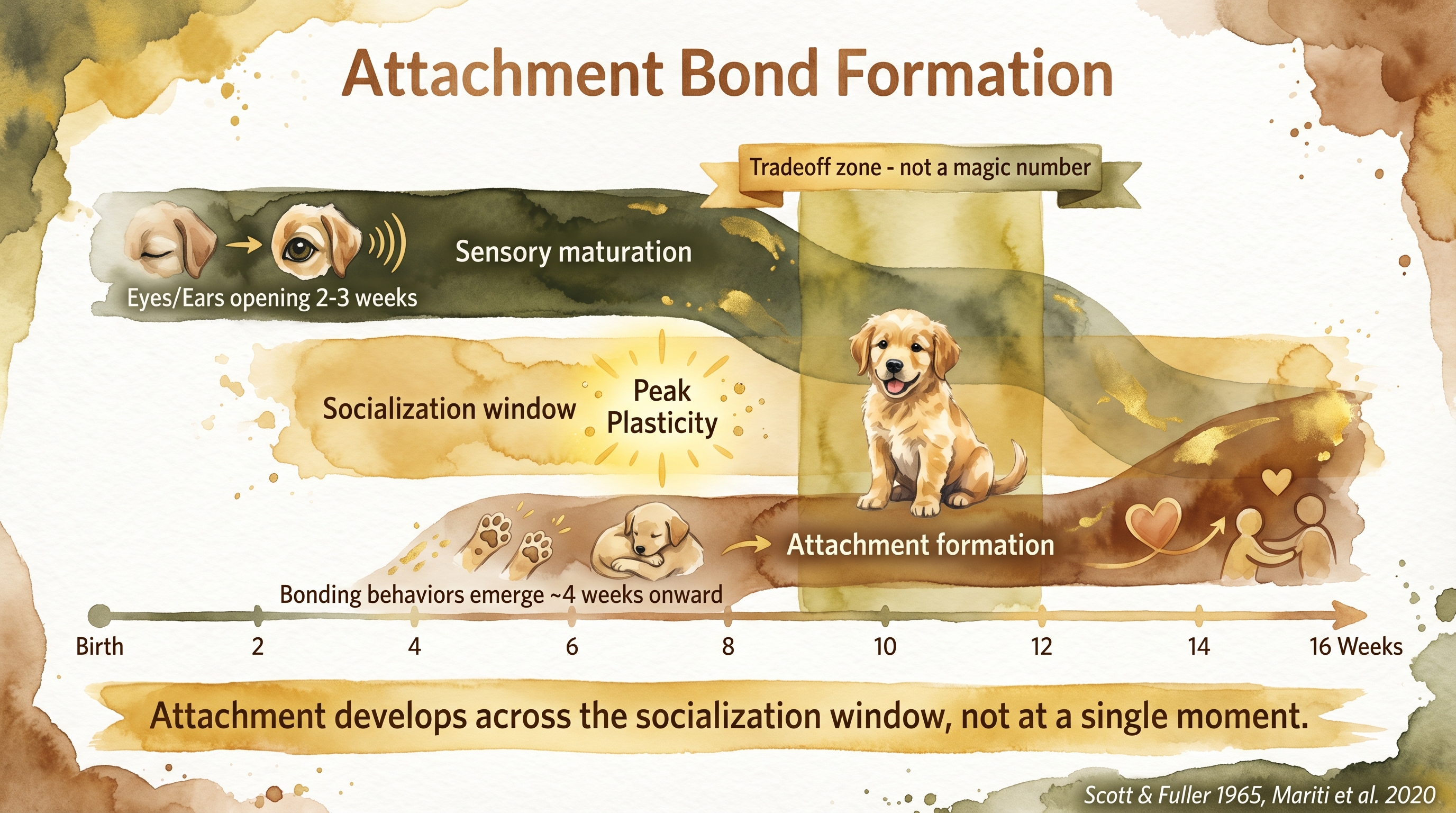
Attachment bonds form through predictable phases from orientation through consolidation over the first weeks.
Key Takeaways
- Attachment development in dogs overlaps with the broader socialization window rather than occurring separately from it.
- Puppies can show attachment-relevant behavior toward humans very early, but the exact fine-grained attachment timeline is less fully mapped than the socialization literature.
- The 8 to 12 week period is best understood as a developmental tradeoff zone rather than a single magic answer.
- Transition quality matters, but direct evidence for specific protocol superiority still needs careful wording.
The Evidence
This entry uses observed claim-level tags beyond the dedicated EvidenceBlocks below. These tags mark JB program observation or practice-derived claims that need dedicated EvidenceBlock coverage in a later content pass.
This entry uses estimated claim-level tags beyond the dedicated EvidenceBlocks below. These tags mark approximate ranges or timing claims that should remain bounded by the cited sources.
This entry uses mixed-evidence claim-level tags beyond the dedicated EvidenceBlocks below. These tags mark claims that combine documented findings with observed practice, heuristic application, or unresolved gaps.
- SCR-025 synthesisdomestic dogs
The canine socialization window is approximately 3 to 14 weeks, with important developmental consequences for early learning and exposure. - Mariti, C. et al. (2020)domestic dogs
Attachment-relevant behavior toward humans can be measured in puppies as young as two months. - Topal, J. et al. (2005)dogs and hand-reared wolves
Early rearing and socialization conditions shaped attachment-like behavior toward humans in young canids. - Fallani, G. et al. (2006)domestic dogs
Guide-dog transition research showed that disrupted early attachments are developmentally relevant rather than trivial events.
- Attachment source synthesisdomestic dogs
Direct week-by-week mapping of Ainsworth-style attachment formation during the 3 to 14 week window remains sparse. - SCR-025 boundarydomestic dogs
The socialization window is documented, but breed-specific precision varies, and the Morrow fear-onset refinement did not include Golden Retrievers. - Transition boundarydomestic dogs
Abrupt transition stress is documented, but direct trials comparing specific breeder-to-family transition protocols for attachment outcomes remain absent.
SCR References
Sources
- Fallani, G., Previde, E. P., & Valsecchi, P. (2006). Do disrupted early attachments affect the relationship between guide dogs and blind owners? Applied Animal Behaviour Science, 100(3-4), 241-257.
- Mariti, C., Lenzini, L., Carlone, B., Zilocchi, M., Ogi, A., & Gazzano, A. (2020). Does attachment to man already exist in 2 months old normally raised dog puppies? A pilot study. Dog Behavior, 6(1), 1-11.
- Scott, J. P., & Fuller, J. L. (1965). Genetics and the social behavior of the dog. University of Chicago Press.
- Topal, J., Gacsi, M., Miklosi, A., Viranyi, Z., Kubinyi, E., & Csanyi, V. (2005). Attachment to humans: A comparative study on hand-reared wolves and differently socialized dog puppies. Animal Behaviour, 70,