House Training in the First Week
House training in the first week is not mainly a lesson the puppy gives to itself. It is a logistics task the family either organizes well or organizes poorly. JB frames the whole issue through Prevention: the puppy's job is to succeed, and the adults' job is to arrange the day so success is much easier than failure. That means the family does not wait for mistakes and then correct them. It learns the puppy's rhythm and gets there first. Observed-JB
What It Means
Most families approach house training with a training mindset: watch for an accident, interrupt it, move the puppy, praise outside, and hope the message lands. Observed-JB
There is nothing irrational in that sequence. It is simply later and rougher than it needs to be.
JB starts earlier.
The adults ask: When is this puppy most likely to need to eliminate? How small is the gap between urge and accident? What environmental cues can we use to stay ahead of that gap?
That is a very different posture. It is not correction-centered. It is arrangement-centered.
The Puppy Is Not Choosing Between Principles
A first-week puppy is not making a moral choice about indoor versus outdoor elimination.
The puppy is operating inside: a tiny bladder, a changing feeding schedule, transition stress, sleep fragmentation, and a brand-new floor map.
That is why the family should not overread accidents as defiance or poor learning. In the first week, accidents usually mean one of a few ordinary things: the puppy woke and needed to go immediately, the wake window lasted too long, the family missed the post-meal timing, the puppy drank and was not taken out quickly enough, and the room map was too large. Observed-JB
The interpretation matters because it determines the response. If the family interprets accidents as puppy failure, it reaches for correction. If it interprets accidents as adult arrangement failure, it reaches for better rhythm.
JB wants the second response.
The Reliable Windows
Most first-week house training becomes much easier once the adults respect the obvious bathroom windows: immediately after waking, shortly after meals, shortly after drinking, after play or excitement, and before bedtime.
These are not subtle. They are the biological backbone of the first-week rhythm.
The family's job is not to discover the puppy's need after the puppy has already started circling in the kitchen. The family's job is to move the puppy to the right place before that stage.
This is why carrying is often useful in the first week. A puppy who wakes and has to walk through the whole house may not reach the door in time. Observed-JB A puppy carried directly to the potty area gets a much fairer chance to succeed.
Why Correction So Often Misses the Point
The standard mistake in first-week house training is to wait.
The family hopes the puppy will signal.
Then the puppy does what its body needed to do.
Then the humans become very involved.
This usually teaches less than the family thinks. At best, the puppy learns that the adults react strongly around elimination. At worst, the puppy learns that eliminating in front of humans is risky, which can create later confusion around toileting in sight of the caregiver. Observed-JB
JB avoids that whole mess by treating first-week house training as anticipatory management.
The puppy should mostly learn: this is where I go, my humans get me there in time, and the rhythm is predictable.
Not: I have to avoid being caught.
What a Crash Landing Looks Like Here
The crash-landing version of house training is extremely common.
The family lets the puppy roam too much, misses the wake-up outing, delays after meals, gets distracted by visitors or children, then discovers a puddle or pile and becomes animated.
The result is that the puppy's first week teaches several bad lessons at once: the house is large and hard to navigate, bathroom timing is inconsistent, elimination produces human intensity, and accidents are part of ordinary household life.
Then the family starts saying: she just doesn't get it yet, he knows better but still goes, and she will not tell us.
Usually the puppy is not failing the plan. The plan is failing the puppy.
Smaller Space, Better Odds
One of the most underappreciated house-training tools in the first week is simply a smaller world.
A puppy with access to: one or two rooms, close supervision, and a quick route to the door.
has much better odds than a puppy with access to: the entire first floor, multiple carpets, and several people assuming someone else is watching.
This is why the transition category keeps returning to bounded space. Smaller first-week territory does not only help calmness. It helps bathroom success too.
The Practical Checklist
The first-week bathroom checklist is beautifully boring: wake-up outing, post-breakfast outing, post-nap outing, post-play outing, regular outings every thirty-ish minutes during active windows as needed, and final outing before bed.
The exact minutes will vary by age, intake, and individual puppy. The principle stays the same. Stay ahead of the body.
Why It Matters for Your Dog
House training matters for obvious reasons, but JB cares about it for a deeper one too. It is one of the clearest places where adults learn whether they are actually living Prevention or merely admiring it.
The family should not wait for a mistake and then feel proud for correcting it. In the first week, success means arranging the day so the mistake rarely gets the chance to happen.
This approach changes the emotional tone of house training. The puppy is not a problem to catch. The puppy is a young body to understand.
That changes: the family's patience, the amount of frustration in the room, the likelihood that the puppy will fear eliminating near people, and the speed at which the routine becomes ordinary.
It also makes the whole first week calmer. Families underestimate how much household tension rises when accidents keep surprising people. Once the rhythm is in place, the house relaxes because the adults stop waiting for failure.
The first-week goal is not perfect continence. The first-week goal is a pattern of success strong enough that the puppy starts to experience outdoor elimination as the default outcome of ordinary daily rhythms.
That is enough. More than enough, in fact, for a very young dog who has been in your house only a few days.
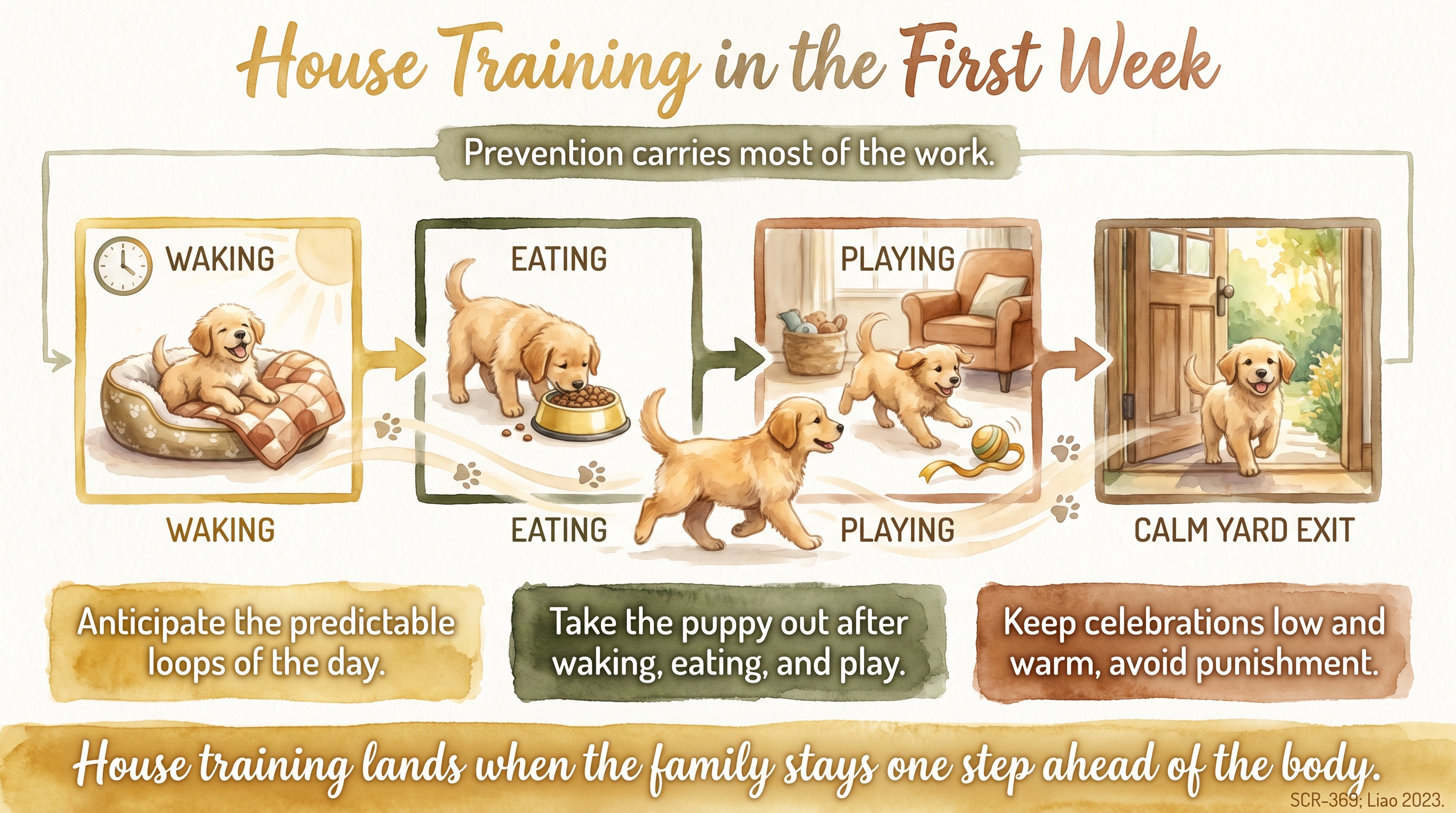
House training lands when the family stays one step ahead of the body.
Key Takeaways
- First-week house training is best treated as prevention and logistics, not as a correction-centered obedience problem.
- The most important bathroom windows are after waking, after meals, after play, and before bed.
- A crash landing happens when adults wait for accidents, then bring emotion and correction after the fact instead of arranging better timing.
- Smaller space, closer supervision, and faster movement to the potty area give the puppy a much fairer path to success.
The Evidence
- Vaterlaws-Whiteside & Hartmann (2017); Stolzlechner et al. (2022); Mariti et al. (2020); Freedman et al. (1961)domestic dogs
Young puppies operate inside narrow physiological windows around waking, feeding, and arousal, making caregiver timing and environmental management central to early success.
- JB first-week practicefamily-raised puppies
House training works best in the first week when adults learn the post-wake, post-meal, and post-play rhythm and move the puppy proactively rather than waiting for an accident to create the lesson.
No published study directly tests the specific Just Behaving guidance on house training in the first week. This entry relies on broader canine evidence, breeder observation, and practical synthesis.
SCR References
Sources
- Vaterlaws-Whiteside, H., & Hartmann, A. (2017). Improving puppy behavior using a new standardized socialization program. Applied Animal Behaviour Science, 197, 55-61.
- Stolzlechner, L., Bonorand, A., & Riemer, S. (2022). Optimising Puppy Socialisation-Short- and Long-Term Effects of a Training Programme during the Early Socialisation Period. Animals, 12(22), 3067. https://doi.org/10.3390/ani12223067
- Mariti, C., Lenzini, L., Carlone, B., Zilocchi, M., Ogi, A., & Gazzano, A. (2020). Does attachment to man already exist in 2 months old normally raised dog puppies? A pilot study. Dog Behavior, 6(1), 1-11. https://doi.org/10.4454/db.v6i1.96
- Freedman, D. G., King, J. A., & Elliot, O. (1961). Critical period in the social development of dogs. Science, 133(3457), 1016-1017.