Urinary Tract Infections in Dogs
Compound evidence detail2 SCRs / 4 parts
- Documentedthe ISCAID 2019 consensus position that asymptomatic bacteriuria should not receive antimicrobial therapy in most dogs and cats, with named exceptions for severe immunosuppression and invasive urological surgery
- Estimatedthe approximately 12% prevalence of bacterial growth in urine from clinically healthy dogs, drawn from peer-reviewed healthy-cohort studies whose individual sample sizes vary
- Documentedthe current ISCAID guideline favoring 3-5 days of targeted therapy for sporadic uncomplicated bacterial cystitis, with amoxicillin or trimethoprim-sulfamethoxazole as first-line agents
- Documentedthe multicenter prescribing-evaluation finding that real-world durations commonly cluster around 10-14 days, representing a documented gap between guideline recommendation and field practice
Urinary tract infections are common in dogs, but they are also commonly oversimplified. Many families hear "UTI" and imagine a straightforward bladder infection that needs an antibiotic. Sometimes that is exactly what is happening. Other times the dog has urinary inflammation without infection, a contaminated sample, subclinical bacteriuria that does not need treatment, or a structural problem such as ectopic ureters that keeps setting the stage for recurrence. Good urinary medicine starts by sorting those possibilities apart instead of treating all of them as the same story. Documented
What It Means
What a UTI Actually Is
In most dogs, a true lower urinary tract infection means bacterial cystitis: bacteria have colonized the bladder and triggered inflammation. Documented The most common organism is Escherichia coli, though other bacteria also appear.
Typical signs include frequent small urinations, straining, blood in the urine, urgency, accidents in a previously continent dog, and licking at the genital area. Documented
These signs suggest lower urinary tract irritation. They do not, by themselves, prove bacterial infection.
Why Symptoms Alone Are Not Enough
This is one of the most important evidence points in the whole page.
Clinical signs that look like UTI can also occur with bladder stones; sterile cystitis; vaginitis; urinary tract tumors; structural abnormalities; and behavioral changes that alter voiding pattern. Documented
That is why culture matters. Treating a "UTI" based only on symptoms increases the odds of overtreatment and misses the cases where the actual problem is something else. Documented
Why Sample Collection Matters
The SCR strongly supports that cystocentesis is far superior to free-catch urine collection when culture accuracy matters. That is not a fussy technical point. It changes the quality of the diagnosis.
Free-catch samples are easily contaminated by bacteria from the lower tract and surrounding skin. Cystocentesis, where urine is drawn directly from the bladder with a sterile needle, gives a much cleaner culture sample. Families do not need to memorize the procedure details. They do benefit from knowing that "we cultured the urine" and "we cultured a free-catch sample" are not equally strong statements.
The Stewardship Shift in Treatment Duration
The old routine of long uncomplicated UTI courses is changing. The SCR supports that treatment for uncomplicated bacterial cystitis is commonly in the three-to-five-day range under current guidance, not the old default of ten to fourteen days.
That does not mean every urinary case gets a short course. Complicated infections, pyelonephritis, resistant organisms, and underlying structural disease are different stories. It does mean families should know that longer is not automatically better.
Why It Matters for Your Dog
The Subclinical Bacteriuria Question
Another important update in modern urinary stewardship is that bacteria in urine without clinical signs often should not be treated. This is subclinical bacteriuria.
The intuitive human response is "if bacteria are there, kill them." The evidence-based veterinary response is more selective. If the dog feels well and the bacteria are not causing active disease, unnecessary antibiotics may do more harm than good by selecting for resistance and disturbing normal biology.
This is especially important in dogs who are repeatedly cultured for other reasons.
When a UTI Is Really a Clue
Some dogs get one straightforward infection and never see another. Others recur. Recurrent or refractory infections should prompt questions about underlying cause, including ectopic ureters; recessed vulva or perivulvar conformation problems; urinary stones; endocrine disease; incontinence; and incomplete bladder emptying.
This matters in Goldens because some structural urinary issues are genuinely part of the breed landscape. Documented A dog with repeated infections may not just be unlucky.
What Families Should Do
The practical family job is not to diagnose. It is to recognize the pattern and seek the right workup.
Good questions to ask a veterinarian include was a culture performed, how was the sample collected, is this uncomplicated or complicated, do you suspect an underlying structural or endocrine reason, and does this dog need a further urinary workup if the problem keeps coming back.
These are not confrontational questions. They are evidence-aligned questions.
Why This Fits JB Philosophy
UTIs are one more place where prevention and precision matter more than reflex.
The same general logic shows up here as elsewhere in the project do not create new problems while solving old ones; avoid pressure where the issue may be structural; and match the response to the actual mechanism.
If a puppy or adult dog is suddenly urinating in the house, the calm next question is not "how do we correct this?" It is "what changed, and does this dog need medical evaluation?"
When to See a Veterinarian
Veterinary evaluation is warranted for straining to urinate, bloody urine, repeated urgent attempts to urinate, urinary accidents in a previously continent dog, foul-smelling urine plus discomfort, and recurrent licking plus urinary changes.
Same-day evaluation is especially important if the dog seems painful, feverish, profoundly lethargic, or unable to pass urine normally.
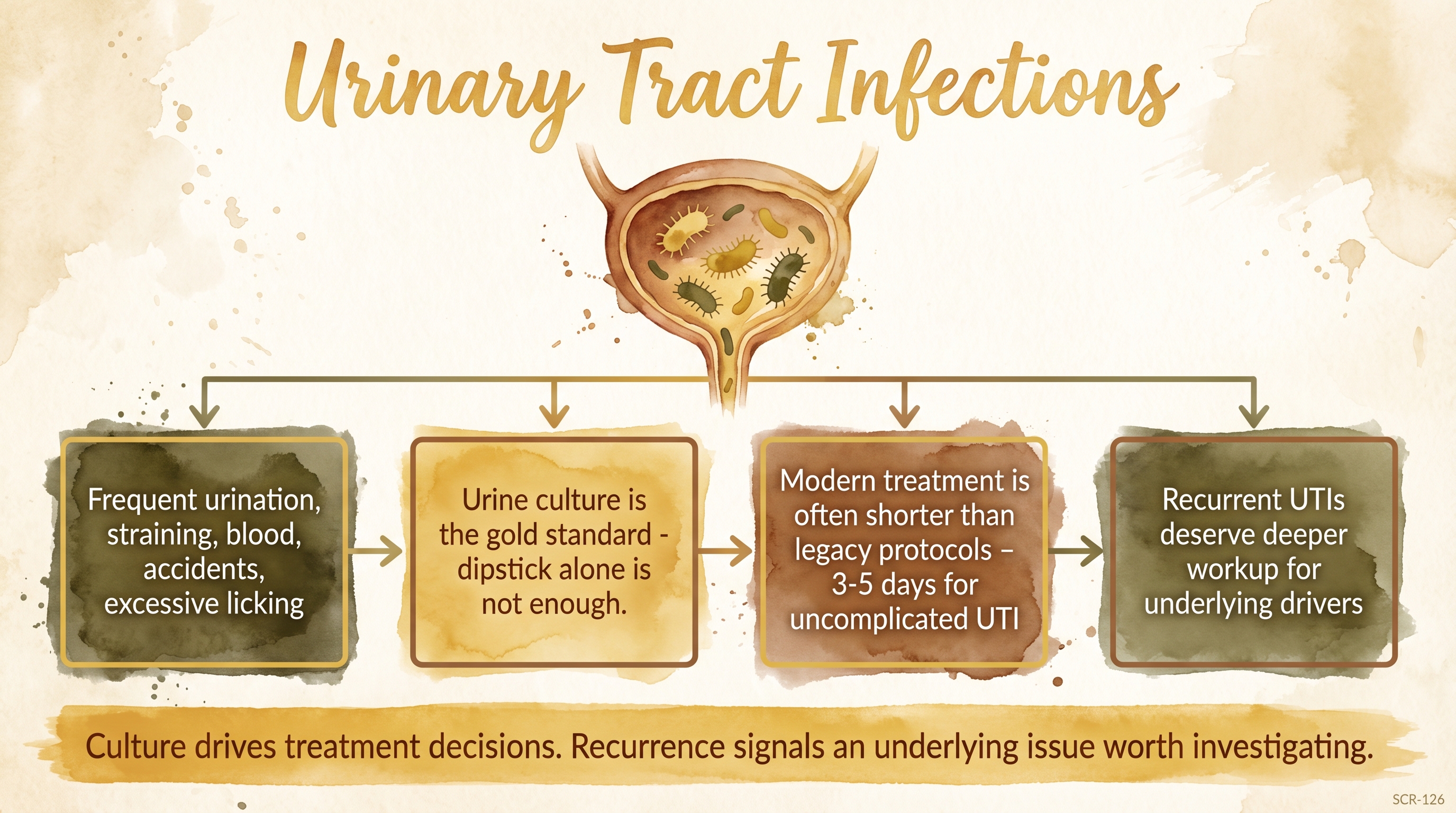
Culture drives treatment decisions - recurrence signals an underlying issue worth investigating.
Key Takeaways
- Not every dog with urinary signs has a true bacterial UTI, which is why culture and sample quality matter.
- Cystocentesis is the preferred collection method for meaningful culture results.
- Uncomplicated UTIs are now commonly treated with shorter courses than the old ten-to-fourteen-day default.
- Recurrent infections are often a clue to a deeper structural or medical problem, not just a reason for repeated empiric antibiotics.
The Evidence
- SCR-087 supportdogs
Cystocentesis greatly outperforms free-catch collection for diagnostically reliable urine culture. - SCR-088 supportdogs
Subclinical bacteriuria generally should not be treated routinely in otherwise stable dogs. - SCR-089 supportdogs
Current treatment for uncomplicated bacterial cystitis is typically three to five days rather than the older ten-to-fourteen-day default.
- ISCAID guidancedogs
Urine culture, interpretation of complicating factors, and follow-up strategy should be tailored to the actual clinical category rather than handled as one-size-fits-all infection care. - Veterinary urology literaturedogs
Recurrent infection should trigger a search for structural, endocrine, or continence-related contributors.
- domestic dogs
No published study directly compares the most effective long-term management paths for urinary tract infections in dogs in dogs across breeds and ordinary home settings.
SCR References
Sources
- Weese, J. S., Blondeau, J., Boothe, D., Breitschwerdt, E. B., Guardabassi, L., Hillier, A., Lloyd, D. H., Papich, M. G., Rankin, S. C., Turnidge, J. D., & Sykes, J. E. (2019). International Society for Companion Animal Infectious Diseases guidelines for the diagnosis and management of bacterial urinary tract infections in dogs and cats. Veterinary Journal, 247, 8-25. https://doi.org/10.1016/j.tvjl.2019.02.008
- Weese, J. S., Blondeau, J. M., Boothe, D., Guardabassi, L. G., Gumley, N., Papich, M., Jessen, L. R., Lappin, M., Rankin, S., Westropp, J. L., & Sykes, J. E. (2019). International Society for Companion Animal Infectious Diseases guidelines for the diagnosis and management of bacterial urinary tract infections in dogs and cats. The Veterinary Journal, 247, 8-25. https://doi.org/10.1016/j.tvjl.2019.02.008