Context-Dependent Learning
Compound evidence detail1 SCR / 2 parts
- Documentedthe cross-species context-dependent learning principle (Bouton 2002, 2004) demonstrating that learned responses do not transfer freely across contexts in rat models and broader learning science
- Documentedthe canine-direct demonstrations of context-specific behavioral transfer (Bray, MacLean and Hare 2014; Brucks 2017; Silver 2025; Range and Viranyi 2015; Gergely 2014)
Context-dependent learning means that what an animal learns is tied not only to the behavior and consequence, but also to the conditions surrounding the learning. Place, handler, time of day, arousal state, and environmental cues all become part of what is learned. That is why a behavior that looks solid in one setting can weaken or even reverse in another. Documented
What It Means
Mark Bouton's work is the modern foundation here. Across decades of extinction and relapse research, he showed that new learning is often context-governed rather than globally replacing old learning. Documented
This matters in two directions.
First, acquisition itself is context-dependent. A dog that learns to sit, stay, search, or orient toward a handler does not automatically build a context-free skill. Documented The room, handler, sensory background, and emotional state become part of the learning package.
Second, extinction is context-dependent. When a response stops paying off, the animal does not simply delete the old learning. Instead, new inhibitory learning is layered on top, and that inhibitory learning is especially tied to where and how it was acquired.
That is why the classic recovery effects matter. ABA renewal occurs when conditioning in context A, extinction in context B, and relapse follows when returned to A. ABC renewal occurs when conditioning in A, extinction in B, and relapse in a new context C. AAB renewal occurs when conditioning and extinction in A, and relapse in a new context B. Reinstatement occurs after re-exposure to the original reinforcer, and spontaneous recovery occurs after time passes. These are not obscure laboratory quirks. They are powerful reminders that the animal has not learned one simple sentence like "this behavior no longer matters everywhere." Documented Instead, the animal has learned something closer to "in this context, under these conditions, this response is no longer useful."
The canine literature supports that broader picture. Gazit and colleagues showed context-related renewal in trained detection dogs. SCR-169 further summarizes canine training-transfer failures across handler, location, and distraction contexts. Documented
The implication is bigger than extinction. All learning sits in context. That is why generalization is labor-intensive and why simple training demonstrations can overstate real-world reliability.
Why It Matters for Your Dog
This page explains a very common family experience: the dog does the behavior beautifully in one place and poorly somewhere else.
That does not necessarily mean the dog is being defiant. It may mean the human has mistaken local success for broad learning.
Context-dependent learning is one reason prevention has such strategic value. A behavior never built does not later have to be suppressed across a hundred different contexts, handlers, and emotional states.
It also explains why relapse after "successful correction" is so common. If the dog stopped the behavior in the kitchen with one adult at 7 p.m., that says much less about the park, the front door, the visiting relative, or the overstimulated holiday house than people often assume. Observed-JB
The training solution is usually more context work. The JB solution, when possible, is upstream: do not spend months building and then suppressing a behavior that never needed to become established in the first place.
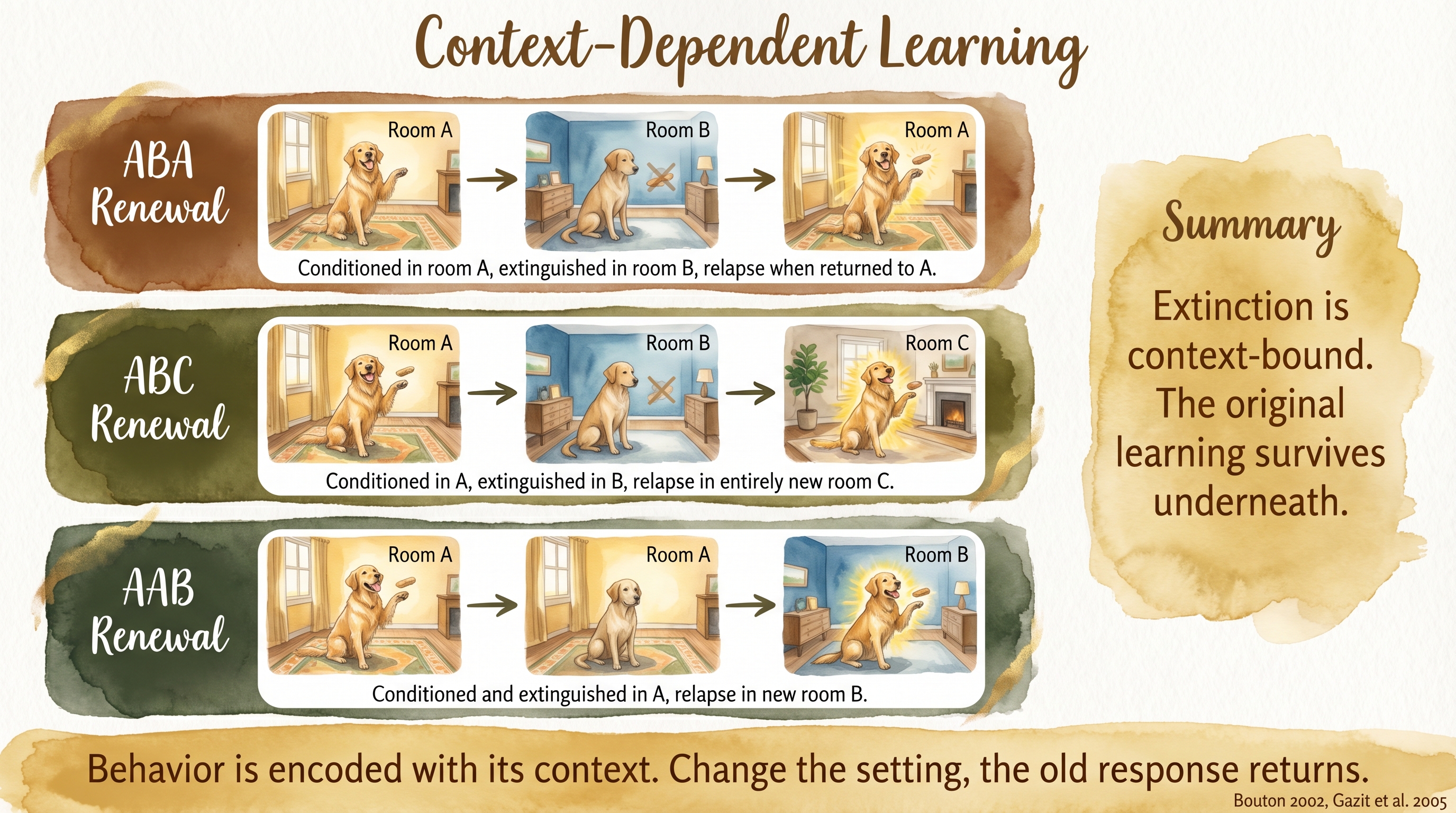
Learning is encoded with its context - behavior reliable in one setting may not transfer without deliberate generalization.
Key Takeaways
- Learning is tied to context, not just to the behavior and consequence in isolation.
- Extinction creates new context-bound learning rather than deleting the old response.
- Renewal, reinstatement, and spontaneous recovery are expected features of memory, not strange exceptions.
- Context dependence is one reason trained behavior often looks less reliable in daily life than it did in the original lesson setting.
The Evidence
This entry uses observed claim-level tags beyond the dedicated EvidenceBlocks below. These tags mark JB program observation or practice-derived claims that need dedicated EvidenceBlock coverage in a later content pass.
- Bouton, M. E. (2002, 2004)rats and multiple species
Established the contemporary framework that extinction creates competing context-bound learning rather than erasing original learning. - Rescorla, R. A. (2004)multiple species
Clarified spontaneous recovery as a lawful relapse phenomenon rather than a rare failure condition.
- Gazit, I., Goldblatt, A., & Terkel, J. (2005)domestic dogs
Detection-dog performance renewed when the training context changed, directly supporting canine context dependence and renewal. - Hall, N. J., & Wynne, C. D. L. (2016)domestic dogs
Reviewed persistence and resistance to extinction in dogs, including practical implications for applied training and working contexts. - SCR-169 synthesisdomestic dogs
Canine training-transfer failures across location, handler, and distraction level are directly relevant examples of context-governed learning.
No published study has directly compared dogs raised in environment-wide, context-varied settings against dogs trained in discrete, single-context sessions with systematic long-term behavioral follow-up to test the JB hypothesis that broader learning generalizes more readily.
SCR References
Sources
- Bouton, M. E. (2002). Context, ambiguity, and unlearning: Sources of relapse after behavioral extinction. Biological Psychiatry, 52(10), 976-986.
- Bouton, M. E. (2004). Context and behavioral processes in extinction. Learning & Behavior, 32(4), 485-494.
- Gazit, I., Goldblatt, A., & Terkel, J. (2005). The role of context in extinction of searching behavior in dogs. Animal Cognition, 8(2), 91-99.
- Hall, N. J., & Wynne, C. D. L. (2016). Persistence and resistance to extinction in the domestic dog: Basic research and applications to canine training. Behavioural Processes, 129, 67-72.
- Rescorla, R. A. (2004). Spontaneous recovery. Learning & Memory, 11(