Building the Calm Floor at Home in the First Month
The calm floor is not an abstract idea the family is supposed to admire from a distance. In the first month, it becomes visible in the sound, pace, and emotional texture of the house itself. The puppy is not only learning where the bed is or when breakfast happens. It is learning what kind of nervous system lives in this home. JB treats that household baseline as one of the most powerful inputs in the entire transition. Observed-JB
What It Means
Many families imagine Calmness as a personality trait.
JB treats it more like household architecture.
The calm floor is built out of ordinary things: how quickly people move through rooms, how loud voices get when something unexpected happens, whether the television is background noise or constant intensity, how children approach the puppy after school, what happens when the doorbell rings, and whether dinner time feels structured or frantic.
The puppy is exposed to all of that long before formal habits are discussed.
Puppies Learn the House as a State
This is one of the most important month-one truths. The puppy does not separate the family's life into neat topics the way adults do. Observed-JB
It does not think: now I am learning sleep, now I am learning greetings, and now I am learning children. Observed-JB
It learns the house as one flowing state.
If the house is often loud, sudden, and reactive, the puppy lives in that state. If the house is mostly measured, legible, and low-drama, the puppy lives in that state instead.
That is why the calm floor matters so much in the first month. The puppy's calibration to the family's everyday tempo is happening all day, not only during special interactions.
Household Audits Help More Than Families Expect
JB does not ask families to become silent monks.
It asks them to notice where unnecessary arousal is being generated.
That usually means small operational changes: turning the television down, slowing the kitchen rush a little, greeting deliveries without a household surge, teaching children to approach quietly after naps, and not narrating every puppy movement.
These changes do not remove joy from the home.
They remove noise from the signal.
Calmness Is Contagious in Both Directions
The exact physiology of co-regulation in dogs should be spoken about carefully, but the basic picture is serious. Dogs and humans do influence each other's state, and long-term stress synchronization is documented in dog-human pairs. Documented
JB then makes the practical move from that science to the family home: if the puppy is going to borrow heavily from the household's emotional tone, then the household should become more worth borrowing from. Heuristic
That is why calmness is load-bearing rather than decorative.
The Calm Floor Is Not the Same as Boredom
Some adults worry that a calmer house means a dull puppyhood.
It does not.
A calm floor does not eliminate: curiosity, affection, play, and exploration.
It simply means those things happen from a more regulated starting point.
The puppy can still be lively. The house just does not teach the puppy that liveliness must always rise into chaos before anything meaningful happens.
The First Month Is When the Household Itself Gets Trained
This page is really about the humans.
Month one often reveals: which adult tends to answer arousal with more arousal, which child forgets the nap rhythm, and which routines become sloppy under stress. Observed-JB
That is useful information. The puppy is not only adjusting to the family. The family is adjusting to the responsibility of being a developmental environment.
Once adults see that clearly, they usually become more intentional very quickly.
Why It Matters for Your Dog
The calm floor matters because many of the behaviors families later call "training problems" are really state problems that were allowed to become ordinary.
The calm floor is built by the way the household sounds, moves, and reacts all day long. In the first month, the puppy is not just learning rules. It is learning what state belongs in this house.
When the calm floor holds, the puppy often becomes: easier to settle, easier to handle, less intense at doors and greetings, and less likely to spill from normal energy into evening chaos.
There is also a quiet side benefit families often discover for themselves. Many homes feel better when they are run with a little more intention. Adults speak more evenly. Children become more aware of timing. The whole house can feel less scattered.
That is why this page should not be heard as a list of sacrifices for the dog.
It is a description of how to make the household's baseline more usable for everyone living in it.
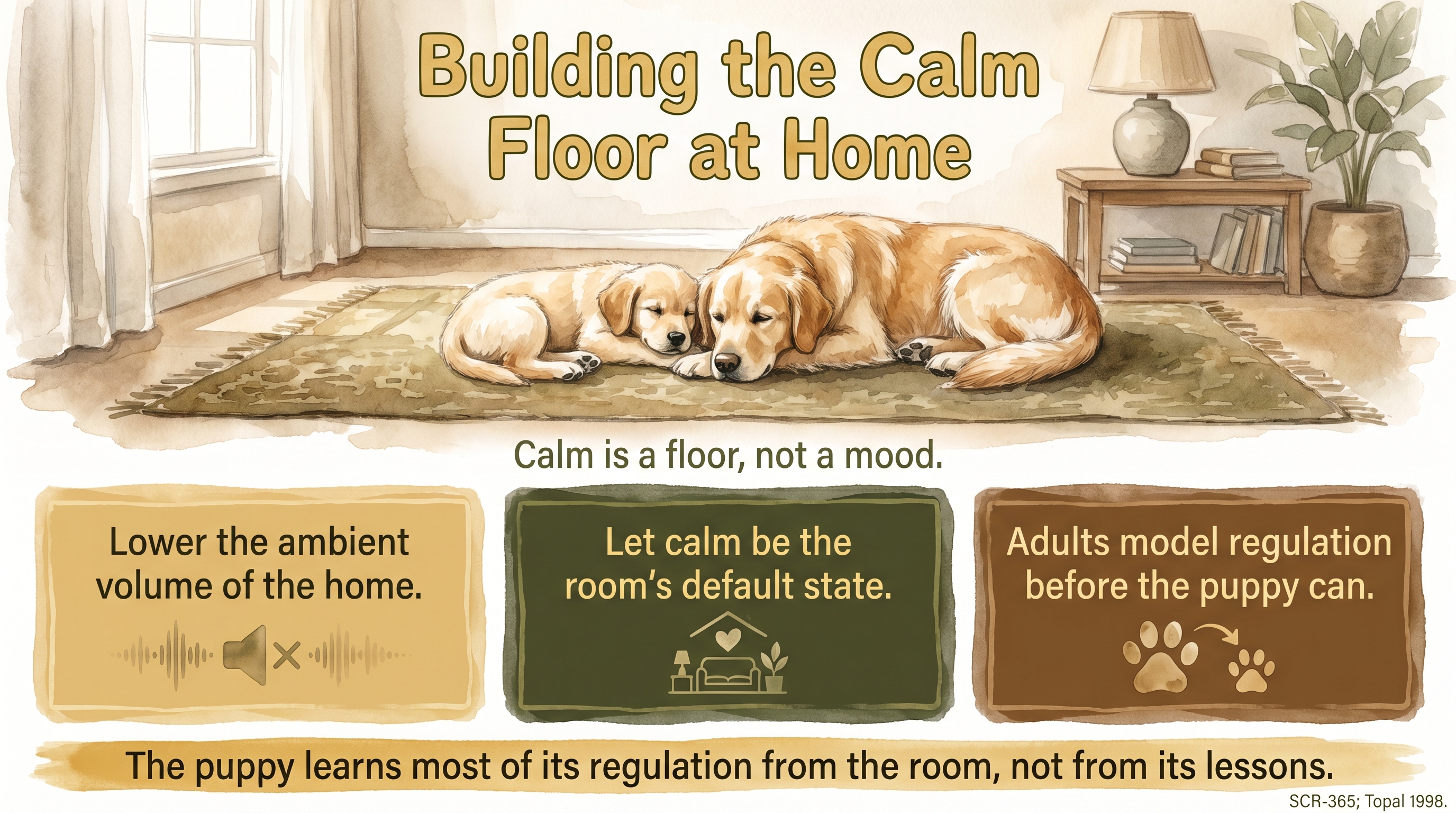
The puppy learns most of its regulation from the room, not from its lessons.
Key Takeaways
- The calm floor is the household's operating state, made visible in noise level, movement tempo, greeting style, and how adults react to daily events.
- Puppies learn the home as a whole nervous-system environment long before they sort life into separate topics like sleep, walks, or visitors.
- Small adjustments in household pace and sound often do more in month one than bigger training-style interventions.
- Building the calm floor helps the puppy settle more easily and often improves the felt quality of the household for the humans too.
The Evidence
- Sundman et al. (2019); Hoglin et al. (2021); Beerda et al. (1999); Hennessy et al. (2009)domestic dogs and humans
Dog-human pairs show measurable physiological co-modulation, and long-term stress markers in dogs are related in part to the quality and emotional character of the human relationship. - Bray et al. (2015); Affenzeller et al. (2017, 2020); Kis et al. (2017)domestic dogs
Calm social conditions and regulated caregiver behavior are consistent with better stress buffering than chronically loud, reactive, or highly activating environments.
- JB family-coaching observationfamily-raised Golden Retriever puppies
Small operational adjustments to noise, movement, greetings, and rest protection in the first month reliably make the household easier for puppies to read and settle into.
- JB synthesisfamily home environments
The claim that the puppy runs on the state the family most often shares with it is biologically plausible and strongly aligned with the literature, even where exact mechanism language requires caution.
No published study directly tests the specific Just Behaving guidance on building the calm floor at home in the first month within a breeder-to-family transition, so this entry relies on broader canine evidence, breeder observation, and practical synthesis rather than a direct trial of the full protocol.
SCR References
Sources
- Sundman, A.-S., Van Poucke, E., Svensson Holm, A.-C., Faresjo, A., Theodorsson, E., Jensen, P., & Roth, L. S. V. (2019). Long-term stress levels are synchronized in dogs and their owners. Scientific Reports, 9, 7391. https://doi.org/10.1038/s41598-019-43851-x
- Hoglin, A., Van Poucke, E., Katajamaa, R., Jensen, P., Theodorsson, E., & Roth, L. S. V. (2021). Long-term stress in dogs is related to the human-dog relationship and personality traits. Scientific Reports, 11, 8612. https://doi.org/10.1038/s41598-021-88201-y
- Beerda, B., Schilder, M. B. H., van Hooff, J. A. R. A. M., de Vries, H. W., & Mol, J. A. (1999). Chronic stress in dogs subjected to social and spatial restriction. I. Behavioral responses. Physiology & Behavior, 66(2), 233-242. https://doi.org/10.1016/S0031-9384(98)00289-3
- Hennessy, M. B., Voith, V. L., Mazzei, S. J., Buttram, J., Miller, D. D., & Linden, F. (2009). Behavior and cortisol levels of dogs in a public animal shelter, and an exploration of the ability of these measures to predict problem behavior after adoption. Applied Animal Behaviour Science, 113(4), 798-810. https://doi.org/10.1016/j.applanim.2008.06.004
- Bray, E. E., MacLean, E. L., & Hare, B. A. (2015). Increasing arousal enhances inhibitory control in calm but not excitable dogs. Animal Cognition, 18(6), 1317-1329.
- Affenzeller, N., Palme, R., & Zulch, H. (2017). Playful activity post-learning improves training performance in Labrador Retriever dogs (Canis lupus familiaris). Physiology & Behavior, 168, 62-73. https://doi.org/10.1016/j.physbeh.2016.10.014
- Affenzeller, N. (2020). Dog-Human Play, but Not Resting Post-Learning Improve Re-Training Performance up to One Year after Initial Task Acquisition in Labrador Retriever Dogs: A Follow-On Study. Animals, 10(7), 1235. https://doi.org/10.3390/ani10071235
- Kis, A., Szakadat, S., Gacsi, M., Kovacs, E., Simor, P., Torok, C., Gombos, F., Bodizs, R., & Topal, J. (2017). The interrelated effect of sleep and learning in dogs (Canis familiaris); an EEG and behavioural study. Scientific Reports, 7, 41873.