The Quiet Bedroom Principle
The Quiet Bedroom Principle takes the logic of the first night and extends it into the first weeks. In JB, the caregiver's bedroom is not just where the puppy sleeps after dark. It becomes the puppy's primary rest anchor during the transition period: the place for night sleep, the place for many of the protected nap windows, and the place where the household's calmest rhythm is easiest to feel. This is not presented as a universal forever-rule. It is a transition tool. The claim that bedroom proximity during the first weeks improves canine transition outcomes has not been directly tested as a standalone intervention, which is why the principle stays heuristic. But its logic is strong: proximity supports regulation, protected rest supports recovery, and the calmest room in the house is often the best room in which to preserve both. Heuristic
What It Means
Families often think about the bedroom as a human-preference question: Do we want the dog in here? What about hair? What about future boundaries?
Those are real household questions, but they are not the transition question.
The transition question is different: Where can the puppy rest with the least social and sensory disruption while still remaining near the caregiver?
For many homes, the answer is the bedroom.
Not because bedrooms are magically soothing, but because they usually contain four things puppies need in the first weeks: lower traffic, darker light patterns, quieter sound patterns, and proximity to the primary human nervous system.
That combination matters more than people realize.
Why the Bedroom Is Often the Calmest Room
Most living rooms are built for wakefulness.
They hold: television, conversation, visitors, children passing through, household movement, meal spillover, and ambient noise.
For an adult dog with established rhythms, that may be manageable. For a newly arrived puppy whose sleep and regulation are still fragile, it is often too much. Observed-JB
Bedrooms, by contrast, usually carry a different social meaning: fewer entrances and exits, less stimulation, longer uninterrupted quiet, and lower expectation of social performance.
That makes the room useful even during daytime naps. The puppy does not need to remain in the emotional weather of the whole house during every recovery window. In fact, one of the deepest transition mistakes families make is believing proximity to family life must always happen in the busiest room of the home.
The quiet bedroom keeps the puppy near the family while protecting the puppy from the busiest expression of family life.
Passive Monitoring Matters
Another overlooked advantage of the bedroom is passive monitoring.
The caregiver does not have to stare at the puppy constantly in order to supervise it there. In a bedroom setup, the adult can: fold laundry, read, work quietly, rest, and prepare for sleep.
All while the puppy remains nearby inside a lower-stimulation environment.
That matters because one of the easiest ways to wreck rest is active supervision. Families hover, talk, check, touch, and narrate. The puppy never quite falls into deep sleep because the adults never stop "including" it.
Passive monitoring is better. The puppy can feel presence without being made responsible for a relationship every minute.
The Bedroom as an Emotional Filter
The quiet bedroom also serves as an emotional filter.
A new puppy does not need access to every fluctuation of the household: children getting ready for school, visitors coming through, evening conversation getting louder, the television rising in volume, pots clanging in the kitchen, and the resident dog's excitement at the door.
If every household state change lands directly on the puppy, then the puppy's nervous system never gets a protected baseline from which to recover. Heuristic
This is one of the main JB claims in transition: the calm floor has to be protected spatially as well as emotionally. Heuristic
The bedroom often becomes the best spatial container for that protection.
Why This Is Not a Forever Argument
The most common objection to the principle is future-oriented: we do not want the dog sleeping in the bedroom forever, we want independence, and we want the dog in another room eventually.
JB agrees that eventual arrangements are legitimate household decisions.
The quiet bedroom principle does not deny that. It simply refuses to treat the first weeks as though they must prove the forever arrangement immediately.
Transition tools do not need to be lifetime rules in order to be wise.
A family may eventually move the dog: to a hallway crate, to a mudroom sleep area, to a family-room pen, and to another designated bedroom.
That can happen gradually after the puppy has first learned: where safety lives, what nighttime sounds mean, how the house rests, and how to settle in proximity to the caregiver.
The order matters. Security first, distance later. Not distance first in the hope that security will somehow assemble itself.
What a Crash Landing Looks Like Here
The crash-landing alternative is not only "crate downstairs."
It can also be: puppy naps in the center of the living room while everyone keeps waking it, puppy falls asleep in traffic areas and is repeatedly disturbed, every rest window becomes another interaction opportunity, and the puppy never experiences a truly quiet room near the caregiver.
In that version of the first weeks, the puppy is technically near the family but rarely protected by them.
That distinction matters. Constant exposure is not the same thing as secure inclusion.
The quiet bedroom principle says the family should create a protected zone where the puppy can absorb the family's calm without having to metabolize the family's full daily noise.
The Bedroom and the Calm Floor
The phrase calm floor is especially important here.
The puppy does not build regulation from isolated training moments. The puppy builds regulation from repeated exposure to a baseline state: resting human, quiet breathing, low light, predictable bedtime, calm waking, and no social performance required.
The bedroom is one of the most efficient places in the house to repeat that baseline.
It is also one of the places where the dog-human relationship stops looking like entertainment and starts looking like companionship. The puppy does not need to be made excited in order to feel bonded. In fact, the opposite is closer to the truth. Quiet coexistence is often one of the fastest ways for a puppy to feel that a human is safe.
Why It Matters for Your Dog
The quiet bedroom principle matters because rest is fragile in the first weeks.
Puppies are sleeping a great deal, but they are not always sleeping well. New sounds, new smells, digestive changes, potty timing, and social uncertainty all threaten rest. A bedroom setup reduces the number of variables hitting the puppy at once.
The bedroom is not important because it is sentimental. It is important because it is often the quietest place in the house where proximity and low stimulation can coexist.
It also matters because it protects the humans from their own good intentions. Families often keep the puppy in the busiest room because they want it close. Then they accidentally create: overtired evenings, fragmented naps, more mouthing, more crying, and more difficulty settling at night.
The quiet bedroom is a form of mercy in both directions. It lets the family stay close without constantly making the puppy engage.
The principle also reinforces one of JB's deepest relational claims: belonging does not mean total access to household energy. Heuristic Belonging means being held inside a structure that is actually good for you.
That is what the bedroom is doing in the first weeks. It is not hiding the puppy away. It is anchoring the puppy to the calmest version of the household's life.
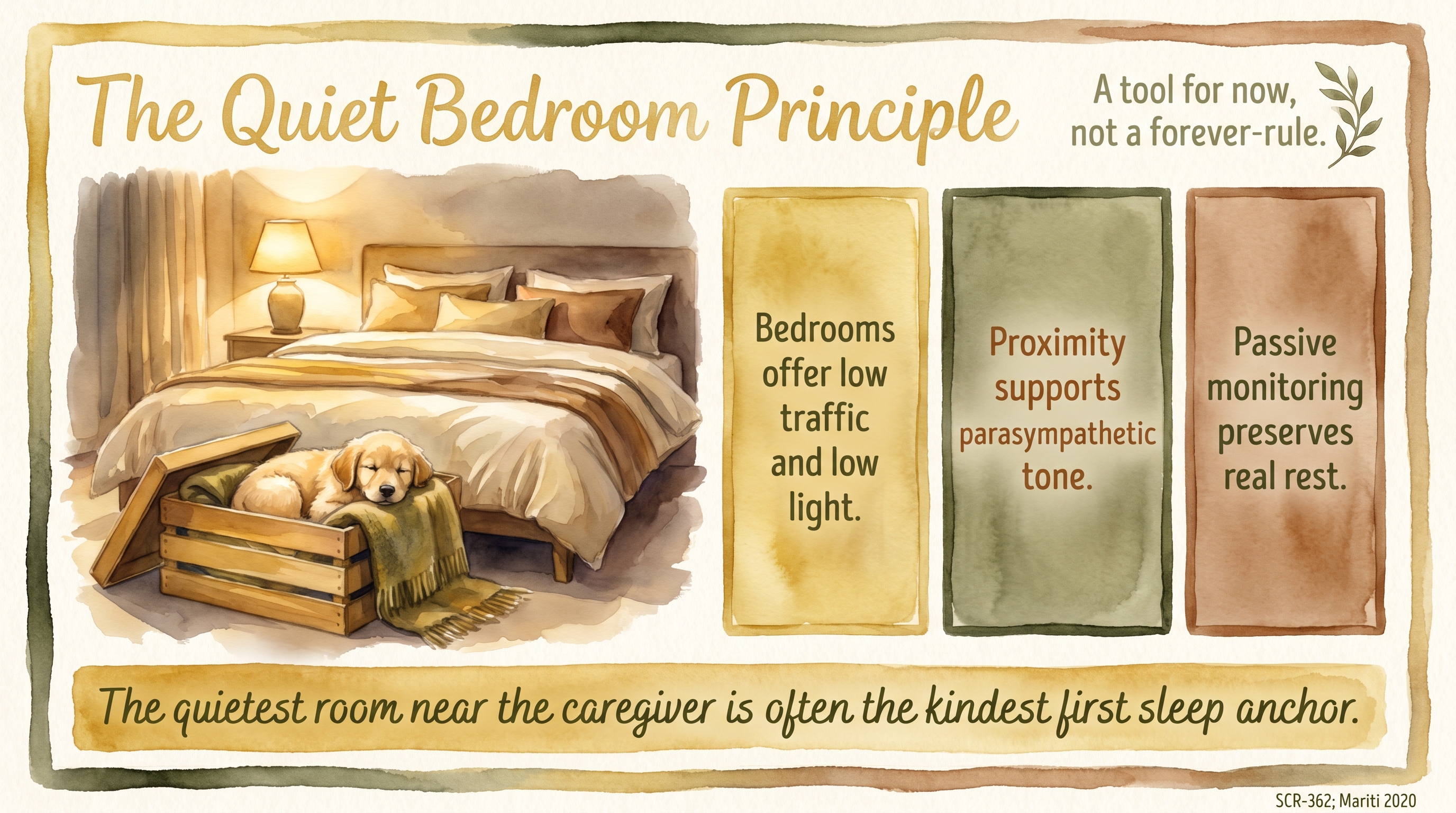
The quietest room near the caregiver is often the kindest first sleep anchor.
Key Takeaways
- The quiet bedroom principle uses the caregiver's bedroom as the puppy's main rest anchor during the first weeks, not necessarily forever.
- Bedrooms often provide the best combination of proximity, lower stimulation, and passive monitoring in a new puppy home.
- A crash landing at rest time happens when the puppy is kept near the family but never protected from the family's busiest emotional weather.
- The principle is heuristic, but its logic is strong: proximity plus protected rest gives the puppy a clearer calm floor to return to.
The Evidence
This entry uses observed claim-level tags beyond the dedicated EvidenceBlocks below. These tags mark JB program observation or practice-derived claims that need dedicated EvidenceBlock coverage in a later content pass.
- Mariti et al. (2020); Fallani et al. (2006); Topal et al. (2005); Cannas et al. (2010)domestic dogs
Proximity to a predictable caregiver and stable rest contexts are relevant to early adjustment during social and environmental transition. - Adams & Johnson (1993); Kis et al. (2014, 2017); Reicher et al. (2021)domestic dogs
Protected, uninterrupted sleep is a major regulatory need in young dogs, and fragmentation raises the likelihood of overtired behavior.
- JB synthesisfamily homes with new puppies
Using the caregiver's bedroom as the puppy's main rest anchor in the first weeks is a transition strategy built from attachment continuity, low-stimulation architecture, and calm-floor preservation rather than from a direct comparative trial.
No published study directly tests the specific Just Behaving guidance on the quiet bedroom principle. This entry relies on broader canine evidence, breeder observation, and practical synthesis.
SCR References
Sources
- Mariti, C., Lenzini, L., Carlone, B., Zilocchi, M., Ogi, A., & Gazzano, A. (2020). Does attachment to man already exist in 2 months old normally raised dog puppies? A pilot study. Dog Behavior, 6(1), 1-11. https://doi.org/10.4454/db.v6i1.96
- Fallani, G., Previde, E. P., & Valsecchi, P. (2006). Do disrupted early attachments affect the relationship between guide dogs and blind owners? Applied Animal Behaviour Science, 100(3-4), 241-257. https://doi.org/10.1016/j.applanim.2005.12.005
- Topal, J., Gacsi, M., Miklosi, A., Viranyi, Z., Kubinyi, E., & Csanyi, V. (2005). Attachment to humans: A comparative study on hand-reared wolves and differently socialized dog puppies. Animal Behaviour, 70, 1367-1375. https://doi.org/10.1016/j.anbehav.2005.03.025
- Cannas, S., Frank, D., Minero, M., Godbout, M., & Palestrini, C. (2010). Puppy behavior when left home alone: Changes during the first few months after adoption. Journal of Veterinary Behavior, 5(2), 94-100. https://doi.org/10.1016/j.jveb.2009.08.009
- Adams, G. J., & Johnson, K. G. (1993). Sleep-wake cycles and other night-time behaviours of the domestic dog (Canis familiaris). Applied Animal Behaviour Science, 36(2-3), 233-248.
- Kis, A., Szakadat, S., Kovacs, E., Gacsi, M., Simor, P., Gombos, F., Topal, J., Miklosi, A., & Bodizs, R. (2014). Development of a non-invasive polysomnography technique for dogs (Canis familiaris). Physiology & Behavior, 130, 149-156.
- Kis, A., Szakadat, S., Gacsi, M., Kovacs, E., Simor, P., Torok, C., Gombos, F., Bodizs, R., & Topal, J. (2017). The interrelated effect of sleep and learning in dogs (Canis familiaris); an EEG and behavioural study. Scientific Reports, 7, 41873.
- Reicher, V., Bunford, N., Kis, A., Carreiro, C., Csibra, B., Kratz, L., et al. (2021). Developmental features of sleep electrophysiology in family dogs. Scientific Reports, 11, 22760. https://doi.org/10.1038/s41598-021-02117-1