Dyadic Physiological Coupling in Dog-Human Pairs
Physiological coupling means that the dog's body and the human's body do not always regulate independently. Across endocrine and autonomic measures, dog-human pairs can show coordinated patterns that reflect relationship history, shared environment, and direct co-modulation. The strongest canine evidence comes from hair cortisol, heart rate variability, and caregiver-profile effects on canine stress flexibility. Documented
What It Means
Coupling Is Not the Same as Contagion
This distinction matters.
Contagion focuses on transfer: one individual's state affects the other. Coupling is the broader pattern in which two systems move together over time. A dog can be physiologically coupled with a person without every moment being a simple one-way transmission event.
That is why this page sits next to, but separate from, stress contagion. Coupling includes shared long-term endocrine patterning, short-timescale autonomic co-modulation, and relationship-linked effects of caregiver personality on canine stress flexibility. Documented
Some of these may include contagion. Not all of them reduce cleanly to it.
Long-Term Cortisol Synchrony
SCR-105 captures the strongest long-timescale coupling result. Sundman and colleagues measured hair cortisol concentrations in 58 dog-caregiver pairs across two seasons and found that caregiver hair cortisol significantly predicted dog hair cortisol. Reported training frequency and measured activity did not explain the effect by themselves.
The directionality finding is especially important. Dog personality did not significantly predict caregiver cortisol, while caregiver personality did predict dog cortisol. Documented That makes the synchrony result more than a generic "same household, same stressors" observation. It suggests that the human side of the dyad is a major regulatory variable for the dog.
At the same time, hair cortisol has built-in limits. It is a retrospective measure of longer-term systemic exposure, not a timestamped readout of one acute interaction. Coupling in hair cortisol tells us about patterning over weeks to months, not about what happened in the last ten minutes.
The Effect Is Real but Not Universal
The source layer adds a useful boundary here. Hoglin and colleagues did not find the same long-term synchronization pattern across all breed groups, especially not in some more independent or ancient breeds. Other household studies also reported weaker or null overall caregiver-dog hair-cortisol correlations. Documented
That does not erase the Sundman result. It sharpens it. Long-term cortisol coupling appears to be real in some dog-human populations, moderated by breed-selection history, influenced by relationship features and caregiver traits, and not a universal constant across every dog and every household.
For cooperative breeds, this bounded claim is especially relevant.
Why It Matters for Your Dog
Short-Term HRV Coupling
SCR-106 gives the autonomic version of the same story. Koskela and colleagues measured heart rate variability and activity in dog-caregiver pairs and found HRV coupling during baseline periods in real dyads. When the same dogs were paired with unfamiliar humans, the HRV correlation disappeared.
That is a strong result because it reduces one easy alternative explanation. If the dog were simply matching any nearby human or any shared task structure, the effect should have remained with strangers. It did not. The coupling was relationship-dependent.
HRV is especially useful because it changes quickly. Hair cortisol tells us about longer-term synchrony. HRV shows that coupling can also appear on the scale of moment-to-moment autonomic regulation.
Caregiver Profile and Canine Stress Flexibility
SCR-059 adds another layer that makes coupling more than simple co-exposure. Schoberl and colleagues showed that caregiver psychological profile, especially Neuroticism and insecure attachment variables, predicted lower cortisol variability and flexibility in dogs. Documented
That matters because the relevant outcome was not just "higher cortisol." It was reduced flexibility. In other words, the dog's stress system looked less adaptive and less able to shift cleanly across contexts when paired with certain caregiver-side traits.
This is one of the reasons dyadic physiology should not be reduced to a single biomarker story. The relationship can shape how flexibly the dog regulates, not only how high one hormone happens to be.
What Coupling Does and Does Not Prove
The science supports a strong mechanistic claim: dog and caregiver physiology can become linked in measurable ways. Documented
The science does not support a simplistic moralistic version such as every anxious moment instantly harming the dog, the caregiver always being the sole driver, or coupling magnitude being identical across all dyads.
Shared routines, breed history, interaction style, relationship duration, and the dog's own biology all matter. Coupling is best understood as a relationship-level physiological phenomenon, not as a single linear dose-response rule.
The social-buffering pillar interprets this literature as evidence that a regulated caregiver can function as part of the dog's regulatory infrastructure. This page supports the narrower scientific claim: dog-human dyads can show measurable endocrine and autonomic coupling, with relationship and caregiver-profile effects that make the caregiver biologically relevant to the dog's stress system.
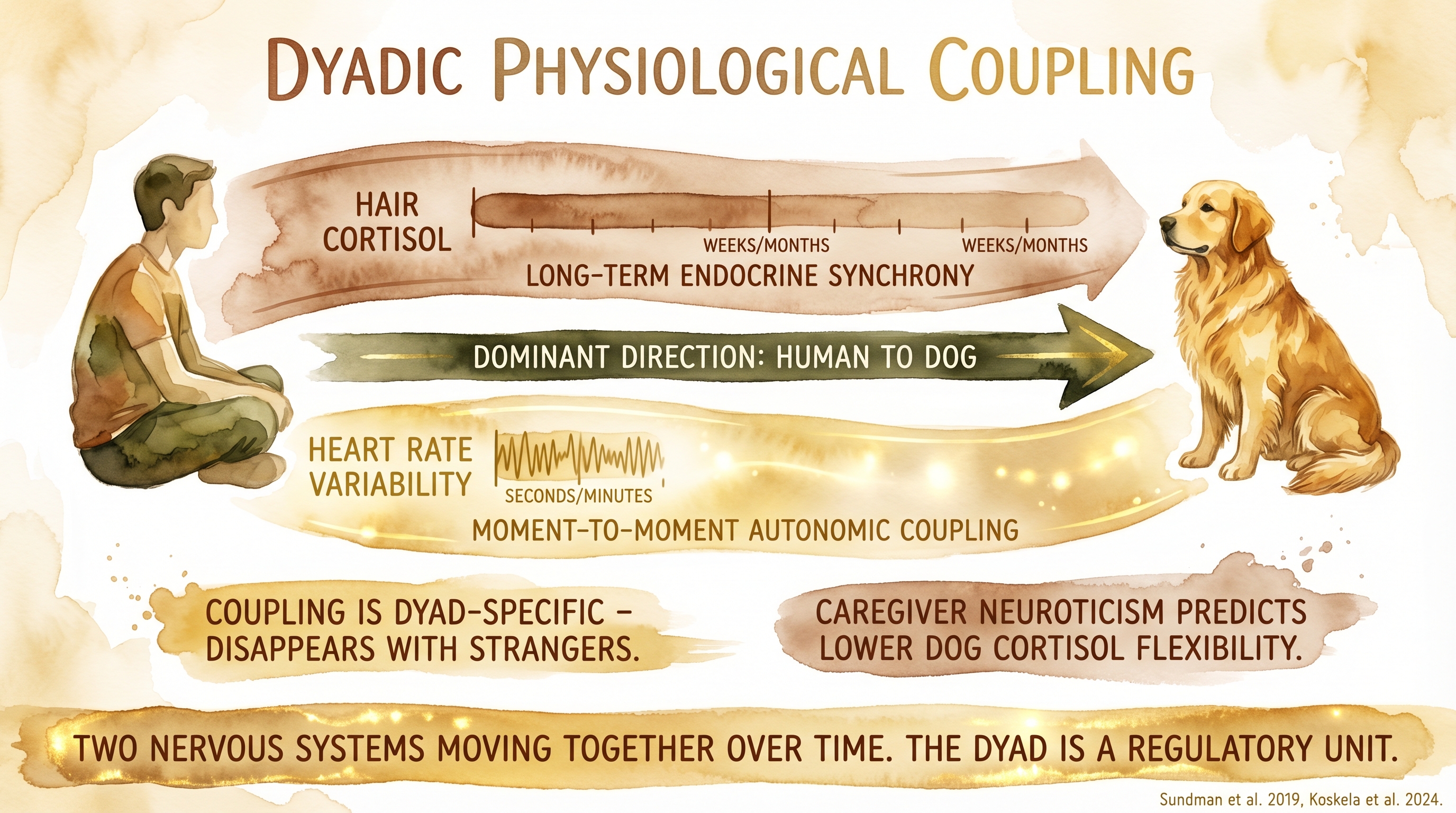
Dogs and caregivers synchronize physiologically - cortisol, heart rate, and behavioral states co-regulate across the pair.
Key Takeaways
- Dog-human physiology can couple across both long-term endocrine measures and short-timescale autonomic measures.
- Hair cortisol synchrony and HRV coupling show that the effect is measurable, not just anecdotal.
- Caregiver psychological profile predicts how flexible the dog's stress system remains, not only how high one biomarker rises.
- Coupling is real but bounded by breed, relationship, context, and measurement method rather than operating as a universal constant.
The Evidence
- Sundman, A. S. et al. (2019)domestic dogs and humans
Hair cortisol concentrations were synchronized across dog-caregiver dyads, with caregiver variables predicting dog values more than the reverse. - Hoglin, A. et al. (2021)domestic dogs and humans
Found breed-group boundaries and showed that long-term cortisol coupling is not equally expressed across all dogs. - Koskela, A. et al. (2024)domestic dogs and humans
Demonstrated HRV coupling in true dog-caregiver dyads that disappeared when dogs were paired with unfamiliar humans. - Schoberl, I. et al. (2017)domestic dogs and humans
Caregiver Neuroticism and insecure relational variables predicted lower cortisol flexibility in dogs.
- Wojtas, J. et al. (2022)humans, dogs, and cats
Found no significant overall owner-dog hair cortisol correlation in a mixed household sample, underscoring that long-term coupling is not uniform across all contexts. - Synchrony source synthesisdomestic dogs
Coupling is strongest as a bounded claim about certain dyads and contexts, not as a universal rule that applies equally across all breeds and households.
No direct canine research located for this specific topic. Current understanding relies on related research, clinical observation, and cross-species inference.
SCR References
Sources
- Hoglin, A., et al. (2021). Long-term stress in dogs is related to the human-dog relationship and personality traits. Scientific Reports, 11, 10940.
- Koskela, A., et al. (2024). Behavioral and emotional co-modulation during dog-owner interaction measured by heart rate variability and activity. Scientific Reports.
- Schoberl, I., et al. (2017). Psychobiological factors affecting cortisol variability in human-dog dyads. PLOS ONE, 12(2), e0170707.
- Sundman, A. S., et al. (2019). Long-term stress levels are synchronized in dogs and their owners. Scientific Reports, 9, 7391.
- Wojtas, J., et al. (2022). Are hair cortisol levels of humans, cats, and dogs from the same household correlated? Animals, 12(11), 1472.